
WAIC 2026 explainer
BrainCo brain-controlled robot explained in 3 steps
The useful story is not telepathy. It is a three-part control chain: measure a signal, classify a limited intent, then let the robot plan the movement.
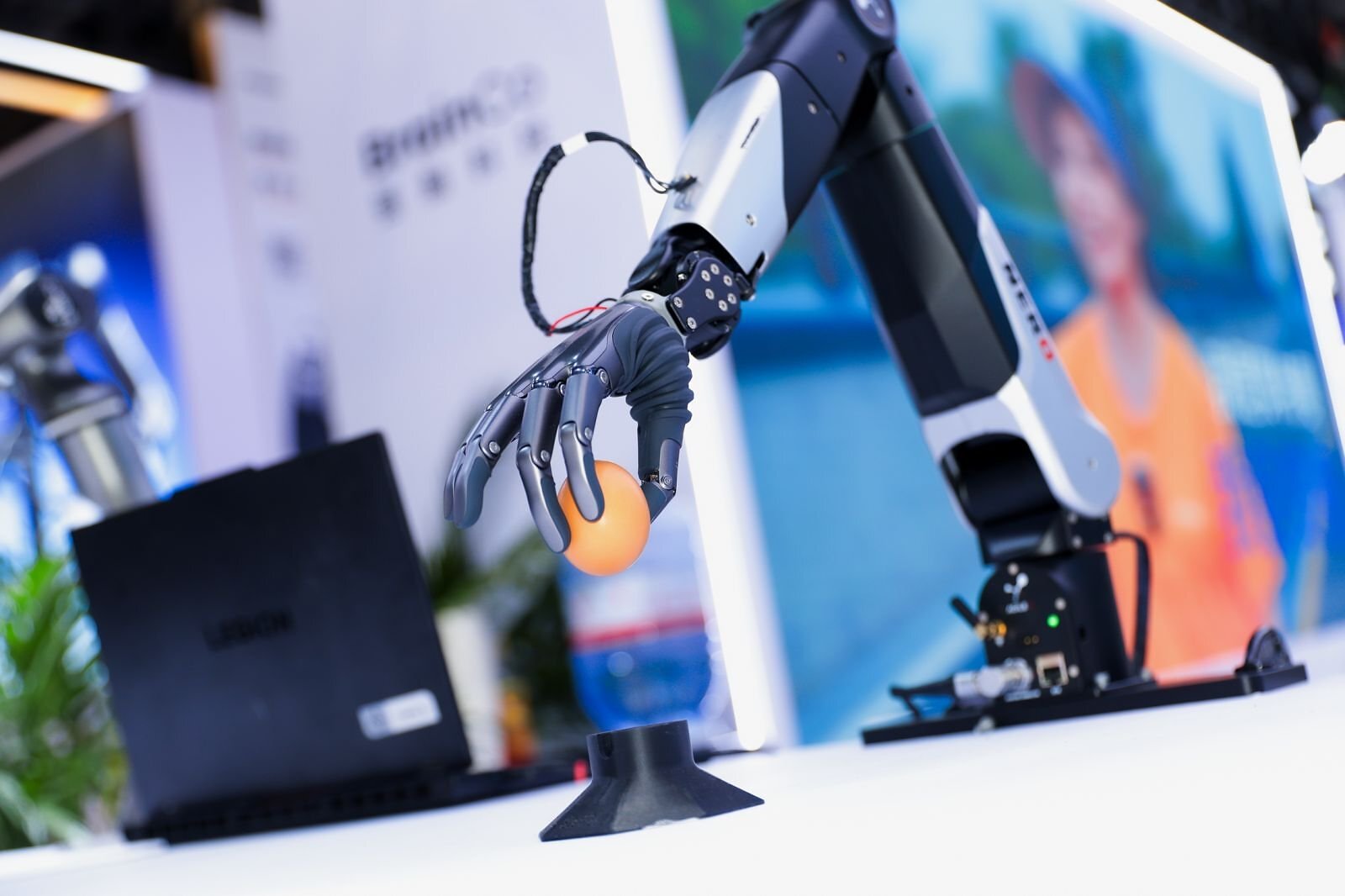
The BrainCo brain-controlled robot demonstration opened at the World Artificial Intelligence Conference in Shanghai on July 17, 2026. BrainCo showed a person wearing a lightweight EEG headset while a robot arm grasped a cup and picked up an apple. The visual is startling. The mechanism is more understandable than the phrase “mind-controlled robot” makes it sound.
The plain-English version is EEG pattern to intent label to robot action. Electrodes measure changing electrical activity at the scalp. Software maps a trained pattern to a limited command. The robot’s own controller decides how to execute that command with motors and joints.
This article explains the public company demonstration and the surrounding WAIC announcement. BTI did not attend the event, operate the headset, inspect the software, test the robot, review private data, or verify BrainCo’s latency, accuracy, compatibility, safety, clinical, or training-data claims. South China Morning Post independently reported the announcement, but the detailed performance figures still come from BrainCo.
- EEG records electrical patterns through scalp electrodes; it does not receive a person’s thoughts as sentences.
- The AI layer classifies a constrained, learned intent instead of understanding every possible intention.
- The robot controller still performs the difficult physical work of planning and moving.
- The next meaningful evidence is reliability across people, settings, tasks, and independent tests.
Want the quick version next time?
Follow @besttechinsight for fast, source-backed explanations of new products, chips, AI, robots, EVs, and science. The detailed guide stays here on BTI.
BrainCo brain-controlled robot: the quick answer
BrainCo’s public description has three steps. First, an EEG headset picks up electrical patterns at the scalp. Second, an AI system classifies those patterns as a limited motor or control intent. Third, that intent becomes a command for a robot whose own control software handles the physical movement.
That distinction matters. The headset is not sending a detailed route for every finger and joint. It is closer to choosing a high-level action from a trained menu. The robot still needs sensors, motion planning, collision checks, grip control, and feedback to complete the task.
| Layer | Its job | Plain meaning | It does not mean |
|---|---|---|---|
| 1. EEG headset | Measure changing electrical patterns at the scalp | Electrodes record a noisy signal that can change when a person prepares or imagines a trained action. | The headset receives a sentence, memory, or unrestricted private thought. |
| 2. AI intent classifier | Map a learned signal pattern to a limited intent label | Software looks for a pattern associated with an option such as reach, grasp, or release. | The software automatically understands every possible intention from every new user. |
| 3. Robot controller | Turn the intent label into safe motor commands | The robot’s own planning and control stack decides how joints should move around the real object. | A person’s brain signal directly steers every motor or joint. |
Step 1: the EEG headset measures a pattern
Electroencephalography, or EEG, uses electrodes on the scalp to monitor electrical activity through the skull. The U.S. National Institute of Neurological Disorders and Stroke describes EEG as a way to record the brain’s electrical activity with scalp electrodes. An NCBI scientific overview adds an important detail: each scalp recording combines activity from groups of cortical neurons.
That is why “the headset read a thought” is too broad. The signal is not a clean sentence waiting to be decoded. It is a changing electrical pattern mixed with noise, movement artifacts, muscle activity, and differences between people. A useful brain-computer interface needs a carefully defined task, signal processing, calibration, and a model that can distinguish the target pattern from everything else.
For this demonstration, the useful beginner mental model is a switchboard, not a transcript. The system looks for a pattern associated with an intended control option. It does not reveal what else a person is thinking, and the public sources do not establish unrestricted thought decoding.
Step 2: AI maps the pattern to a limited intent
BrainCo says its algorithms identify a motor or control intent from the EEG signal. In practice, this middle layer is the translator. It has to take a noisy measurement and choose an action label the rest of the system understands.
The word “intent” can sound unlimited, but a classifier normally works inside the categories and training setup it was given. A system trained to separate reach, grasp, release, and rest is solving a narrower problem than understanding an unprompted idea. That narrower problem can still be technically valuable because it creates a hands-free control channel.
The public announcement does not provide the test protocol, participant count, calibration time, confusion matrix, false-command rate, or performance across untrained users. Those are not reasons to dismiss the demonstration. They are the next measurements needed to understand how far the result travels beyond one controlled setup.
Step 3: the robot turns the command into movement
After the classifier produces an intent label, the robot still has to act in the physical world. A grasp requires the robot to locate the object, choose an approach, move without collision, close its hand with suitable force, and react if the object shifts.
This is why the robot is not a puppet with every joint directly controlled by brain signals. The high-level intent can begin the action, while the robot’s own software handles the many lower-level decisions. Separating those jobs also explains BrainCo’s compatibility claim: the same intent-decoding layer could, in principle, send commands to different robot platforms if each platform has a compatible interface and control stack.
BrainCo says the process from signal decoding to a robot command takes under 200 milliseconds. That is a company-reported figure, not an independent BTI benchmark. It also should not be confused with the time needed for the robot to finish reaching and grasping an object. The next useful report would separate signal acquisition, classification, command delivery, physical response, and total task time.
What the WAIC demo shows, and what to measure next
A strong technology explanation keeps the demonstration and the conclusion at the same size. The WAIC scene gives the public a concrete example of an EEG-to-robot pipeline. It does not yet answer every reliability, safety, accessibility, or generalization question.
| Public claim or demonstration | Supported takeaway | What to measure next |
|---|---|---|
| A robot arm grasped a cup and picked up an apple at WAIC 2026 | BrainCo showed a concrete company demonstration of its EEG-to-intent-to-robot pipeline. | How reliably does it work across new people, objects, rooms, and repeated trials? |
| Signal-to-command processing took under 200 milliseconds | BrainCo reports a low-latency command path, which matters for responsive control. | What test setup, sample size, error rate, and end-to-end movement latency produced that figure? |
| The platform can connect to several kinds of commercial robots | The proposed architecture separates intent decoding from the robot hardware. | Which specific robots, interfaces, safety systems, and tasks have been validated? |
| EEG can join robot, human-demonstration, and simulation data | Intent labels could add context to a robot-training dataset, not just hand trajectories. | Does the added EEG signal improve model quality, transfer, or safety in independent comparisons? |
Why BrainCo also talked about robot training data
The second half of BrainCo’s announcement is less cinematic but potentially important. Robot developers need examples of people performing tasks so models can learn what useful movement looks like. Traditional demonstration data can capture hand paths, camera views, force, and robot state. BrainCo proposes adding EEG as another signal about what the person intended while demonstrating the task.
That could help separate a purposeful action from a correction, hesitation, or accidental movement. It could also give a training system a high-level label while the hands provide the detailed trajectory. The company says its collection setup combines robot execution, human demonstration, simulation, glove data, and EEG.
The open question is whether the additional signal measurably improves a robot model. More data channels do not automatically mean better data. Researchers would need to compare models trained with and without the EEG layer, document participant and task diversity, measure errors, and show whether any gain transfers to new environments.
Why this matters without calling it mind reading
A reliable hands-free command channel could matter for human-machine interaction, robotics research, and future accessibility tools. It could let a person choose an action when speech, touch, or ordinary movement is unavailable or inconvenient. Those are research directions, not a claim that this conference setup is a medical device or a proven treatment.
The clearer description also protects the real engineering achievement. “Mind reading” makes the system sound magical, then invites disappointment when the limits appear. “A trained EEG pattern selects an intent, and the robot plans the action” is less sensational, but it tells readers what was actually built and what teams need to improve next.
For buyers, there is no retail recommendation here. The public sources do not establish a consumer price, release date, supported robot list, warranty, clinical approval, safety certification, independent accuracy result, or general availability for the integrated platform.
A five-question checklist for the next brain-to-robot demo
- What exact intents can the system classify? A short, defined command set is different from unrestricted control.
- How much calibration does each person need? Fast setup and reliable transfer matter outside a staged demonstration.
- What is the error rate? A missed command and an unintended command create different risks.
- Which work happens in the BCI and which happens in the robot? This reveals what the neural signal actually controls.
- Who measured the result? Company figures are useful starting evidence; independent protocols make comparisons possible.
Sources and reporting boundary
This guide uses BrainCo’s company announcement, independent reporting on that announcement, official WAIC event context, and U.S. government and NCBI EEG explainers. BTI treats the cup, apple, latency, compatibility, and training-data details as company-reported demonstration claims unless a source explicitly establishes otherwise.
- BrainCo’s WAIC 2026 announcement distributed by PR Newswire: Primary company source for the three-stage architecture, the cup and apple demonstration, the reported under-200-millisecond path, hardware compatibility, and training-data claims.
- South China Morning Post report on the WAIC announcement: Independent reporting that confirms the announcement and explains the EEG, intent-decoding, and robot-action sequence while attributing performance claims to BrainCo.
- Shanghai government WAIC 2026 exhibit overview: Official event context confirming the July 17 opening, more than 1,100 companies, more than 3,000 exhibits, and a major embodied-AI and robotics presence.
- NINDS neurological diagnostic tests explainer: Explains that scalp electrodes monitor the brain’s electrical activity through the skull.
- NCBI scientific basis of EEG: Provides the technical basis for the caution that scalp EEG combines electrical activity from groups of cortical neurons rather than receiving complete thoughts as text.
- BrainCo official site: Company background and product context. BTI does not treat company marketing as independent testing.
BrainCo brain-controlled robot FAQ
Did the BrainCo headset read a person’s thoughts?
No public source establishes unrestricted thought reading. The company describes an EEG headset measuring brain signals while software identifies a trained motor or control intent. That limited classification is different from receiving sentences, memories, or every idea in a person’s mind.
What did the robot do at WAIC 2026?
BrainCo says a robotic arm grasped a cup and picked up an apple using commands produced from its EEG-to-intent pipeline. BTI did not operate the system or independently verify its accuracy, latency, or repeatability.
What does the reported under-200-millisecond number mean?
BrainCo describes it as the time for its signal-to-command process. The public announcement does not provide enough methodology to treat it as an independent benchmark, and it is not the same as the robot’s full physical task time.
Can consumers buy the full brain-to-robot platform?
The checked sources do not establish a consumer price, release date, complete compatibility list, or general retail availability. This is a technology explainer, not a product review or buying recommendation.
Why might EEG help train robots?
EEG could add a high-level signal about a demonstrator’s intended action while cameras, gloves, and robot sensors capture the physical movement. Whether that extra signal improves robot performance still needs comparative evidence.
BTI final take
The memorable WAIC image is a robot hand closing around an apple. The durable idea is the control chain behind it: EEG measures a pattern, AI chooses a limited intent, and the robot handles the motion.
That three-step map makes the demonstration interesting without turning it into science fiction. It also gives readers a useful test for future claims: ask what the headset measured, what choices the classifier knew, what the robot did on its own, and who verified the result.