
Advancing AI 2026 explainer
AMD Helios rack explained: how 72 AI GPUs act like one
Putting 72 GPUs in one rack is only the visible part. The difficult job is moving model data, coordinating work, delivering power, and removing heat fast enough that the rack behaves like one useful computer.
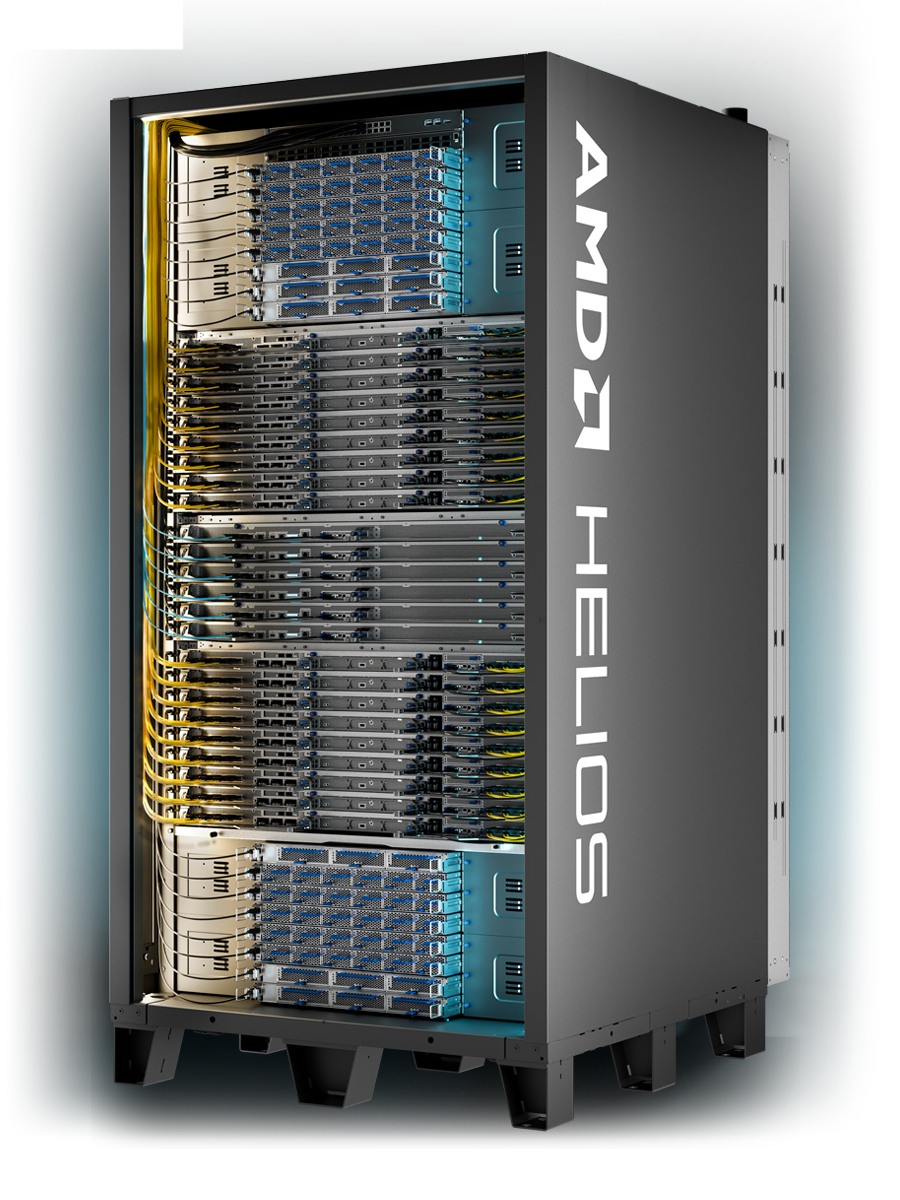
AMD used its Advancing AI 2026 conference to put Helios at the center of its data-center plan. The AMD Helios rack combines 72 Instinct MI455X GPUs, EPYC “Venice” CPUs, Pensando networking, 31 TB of HBM4, rack-level power delivery, and liquid cooling.
The headline number is easy to remember. The architecture is the more useful story. A rack full of processors does not automatically become one fast AI system. Every GPU needs model data at the right time. The GPUs need high-bandwidth paths to exchange partial results. Host processors and data-processing units need to handle coordination and infrastructure work. Power and cooling have to support the entire machine.
Helios is a reference design, not a retail product for sale. AMD says it is a blueprint that system partners can use to build branded systems based on the Open Rack Wide standard. AMD expects volume deployments in the second half of 2026. BTI has not operated Helios or independently verified AMD’s performance, memory, bandwidth, efficiency, deployment, or availability statements.
Want the quick version next time?
Follow @besttechinsight for fast, source-backed explanations of new products, chips, AI, robots, EVs, and science. The detailed guide stays here on BTI.
The fast answer
Think of Helios as a very large team. The 72 GPUs are the workers. HBM4 is the shared workbench. The scale-up network is the set of hallways between workers. EPYC CPUs and Pensando DPUs coordinate and offload supporting tasks. The power shelf and cooling manifold keep the building running.
If any one layer cannot keep up, adding more GPU math does not solve the bottleneck. That is why modern AI infrastructure is increasingly designed as a complete rack rather than as a collection of interchangeable accelerator cards.
AMD Helios rack system map
| System layer | AMD component | Plain English | AMD-published detail | Evidence boundary |
|---|---|---|---|---|
| Compute | 72 AMD Instinct MI455X GPUs | The workers that perform the repeated math behind AI training and inference. | AMD lists 72 GPUs in one Helios rack-scale reference design. | The count is an AMD design specification, not an independent BTI performance result. |
| Working memory | 31 TB of HBM4 | The fast workbench that keeps active model data close to the GPUs. | AMD lists 31 TB of aggregate HBM4 memory capacity. | Capacity alone does not establish application speed, utilization, or cost. |
| Conversation | UALoE scale-up fabric | The hallways that let the 72 GPUs exchange data instead of waiting in isolation. | AMD lists up to 260 TB/s of aggregate scale-up bandwidth. | The figure is an AMD internal design specification and actual results can vary. |
| Coordination | EPYC Venice CPUs and Pensando Salina DPUs | The coordinators that host the system and offload networking, storage, and security work. | AMD describes EPYC host processors plus DPUs for front-end infrastructure tasks. | The checked sources do not establish a universal workload advantage. |
| Infrastructure | Power shelf and liquid-cooling manifold | The electrical and thermal support that keeps a dense rack operating. | AMD describes a vertical power busbar and quick-disconnect liquid-cooling connections. | AMD does not publish a complete deployment-level energy or operating-cost result on this page. |
1. The 72 GPUs are the workers
GPUs are good at repeating many mathematical operations in parallel. AI training uses that ability to adjust a model across large amounts of data. AI inference uses it to turn an existing model into outputs such as text, images, code, predictions, or classifications.
Helios uses 72 AMD Instinct MI455X GPUs in one rack-scale design. AMD publishes peak FP4 and FP8 compute figures for the full design, but those are theoretical, company-calculated specifications. Real application performance depends on the model, numerical format, software, communication pattern, batch size, memory use, and how fully the hardware stays occupied.
The beginner-friendly rule is simple: more workers can finish more work only when the job can be divided and every worker receives the needed material without long waits.
2. HBM4 is the working memory beside the GPUs
High Bandwidth Memory, or HBM, is stacked close to an accelerator so data can move between memory and compute much faster than it could through ordinary system memory. Helios combines 31 TB of HBM4 across the rack according to AMD.
That capacity matters because large AI models contain many parameters and create additional temporary data while they run. A larger, faster working area can hold more of that active state close to the processors. It can also support larger model partitions and longer context windows, depending on the workload and software.
Memory capacity is not the same as speed. A system can have a large workbench and still lose time if workers cannot find, exchange, or reuse the right material efficiently. Capacity, bandwidth, software scheduling, and network behavior all matter together.
3. The scale-up network makes 72 GPUs cooperate
When one AI job spans many GPUs, each processor frequently needs data produced by others. The scale-up network carries that communication inside the rack. AMD says Helios uses UALink over Ethernet, called UALoE, to provide all-to-all GPU connectivity and up to 260 TB/s of aggregate scale-up bandwidth.
Picture 72 specialists working on different sections of the same enormous calculation. If their hallways are narrow, people spend time waiting to exchange pages. A wider, well-managed communication layer reduces that wait. It does not make communication free, and the published bandwidth number does not guarantee identical results for every model.
Helios also needs scale-out networking to connect the rack to other racks, plus front-end networking for storage, security, management, and client traffic. These are different traffic problems. Treating all networking as one generic cable hides why a rack-scale system requires several coordinated layers.
4. CPUs and DPUs coordinate the supporting work
The GPU does not replace every processor in the system. AMD EPYC “Venice” CPUs act as host processors. They run operating-system and application-control work, prepare jobs, and coordinate resources around the accelerators.
Pensando Salina DPUs offload front-end networking, storage, and security services. A DPU is a specialized infrastructure processor. Moving those tasks away from the main host can free CPU resources and isolate infrastructure functions, though the practical benefit depends on the deployment and software.
AMD also lists Vulcano AI network interface cards for high-speed scale-out traffic. The names are less important than the division of labor: GPUs perform the dense AI math, CPUs host and coordinate, DPUs handle infrastructure services, and network interfaces move traffic between systems.
5. Power and cooling are part of the computer
A dense AI rack needs more than wall outlets and room fans. AMD describes a centralized power shelf that distributes electricity through a vertical busbar. A busbar is a rigid conductor that carries large amounts of electrical current through the rack.
AMD also shows a cooling manifold that sends liquid coolant to compute and switch trays through quick-disconnect connections. Liquid can carry heat away from dense components more effectively than air alone in many data-center designs. The manifold also has to support maintenance without turning every service event into a plumbing rebuild.
This is why the rack itself becomes a design unit. Compute trays, network switches, cables, power conversion, coolant, service access, and software have to fit one physical and operational plan. A GPU specification tells only part of the story.
What Helios does not prove yet
AMD calls Helios its most powerful rack-scale AI infrastructure and publishes peak compute and bandwidth comparisons. Those are AMD claims supported by company calculations and internal analysis. They are not independent BTI benchmarks, and system manufacturers may vary their configurations.
The reference design also does not establish the purchase price, deployment cost, electricity use, cooling-plant requirements, application reliability, software migration effort, or performance for every AI model. Microsoft has announced a planned Azure deployment, which is meaningful adoption evidence, but production operation will provide stronger evidence than a launch specification.
Helios is not a consumer PC, gaming rig, or a product that an individual buyer can order from AMD. Its relevance to normal users is indirect: systems like this help determine the cost, speed, availability, and competitive landscape of the cloud AI services people eventually use.
How BTI checked the AMD Helios rack
BTI started with AMD’s Advancing AI 2026 event page, then checked the current Helios architecture page, the official rack-scale networking explanation, the conference architecture session, and AMD’s Microsoft deployment announcement. Component counts, memory, bandwidth, power, cooling, and deployment timing remain attributed to AMD.
BTI translated the architecture into workers, a workbench, hallways, coordinators, and infrastructure. Those are teaching analogies, not AMD product names or measured results. BTI did not operate the rack, reproduce AMD’s calculations, inspect a partner system, or infer a universal performance ranking from the published specifications.
Why this matters beyond the data center
The AI industry often talks as if the newest chip alone decides progress. Helios shows the broader reality. Modern AI systems are limited by data movement, memory, networking, power, cooling, software, and serviceability as much as by raw arithmetic.
That same lesson appears at smaller scales. A laptop NPU can be fast but constrained by memory and power. A phone processor can add an AI engine but still depend on software and thermal limits. A home server can have several GPUs but lose efficiency if its interconnect and cooling cannot keep pace.
The useful question is not only “How many chips?” Ask: How much working memory is available? How do the chips communicate? What coordinates the system? What powers and cools it? Which figures are measured results, and which are design specifications?
AMD Helios FAQ
What is AMD Helios?
AMD Helios is an open rack-scale AI reference design that combines Instinct GPUs, EPYC CPUs, Pensando networking, HBM4 memory, power distribution, liquid cooling, and ROCm software.
How many GPUs are in one Helios rack?
AMD’s published design combines 72 Instinct MI455X GPUs in one double-wide Open Rack Wide system.
What does 31 TB of HBM4 mean?
It is the aggregate high-bandwidth working memory listed for the rack. HBM4 keeps active model data close to the GPUs, but capacity alone does not establish application performance.
Why does Helios need a scale-up network?
One AI job can span many GPUs. The scale-up network carries the intermediate data those GPUs exchange so they can cooperate on the same workload.
Can consumers buy AMD Helios?
No. AMD describes Helios as a reference design, not a product for sale. OEM and ODM partners can build systems from the blueprint.
When will Helios systems deploy?
AMD says the reference design is being shared with partners and expects volume deployments in the second half of 2026. AMD also says Microsoft plans to deploy Helios on Azure.
Did BTI test Helios?
No. This guide explains AMD’s published architecture and clearly separates company specifications from independent evidence.
Sources and evidence boundaries
- AMD Advancing AI 2026 event page: Primary event source for the July 22-23 conference and the Helios announcement context.
- AMD Helios rack-scale solution page: Primary source for the 72-GPU architecture, memory, networking, power, cooling, and reference-design boundaries.
- AMD AI networking built for scale: Primary AMD explanation of the scale-up, scale-out, and front-end networking layers.
- Inside AMD Helios session: Official conference session for the rack-scale architecture and system-design context.
- AMD and Microsoft Helios deployment announcement: Primary source for Microsoft’s planned Azure deployment and AMD’s second-half 2026 shipment statement.
BTI final take
The most interesting Helios number is 72, but the most important idea is coordination. AI infrastructure improves when compute, memory, networking, software, power, cooling, and maintenance are designed together.
Remember the map: workers, workbench, hallways, coordinators, infrastructure. That translation makes a rack-scale announcement easier to understand and much harder to oversell.