
Google AI model update
Gemini 3.6 Flash vs 3.5 Flash-Lite: What Is Flash Cyber?
Google announced three names. Only two are general-use model choices.
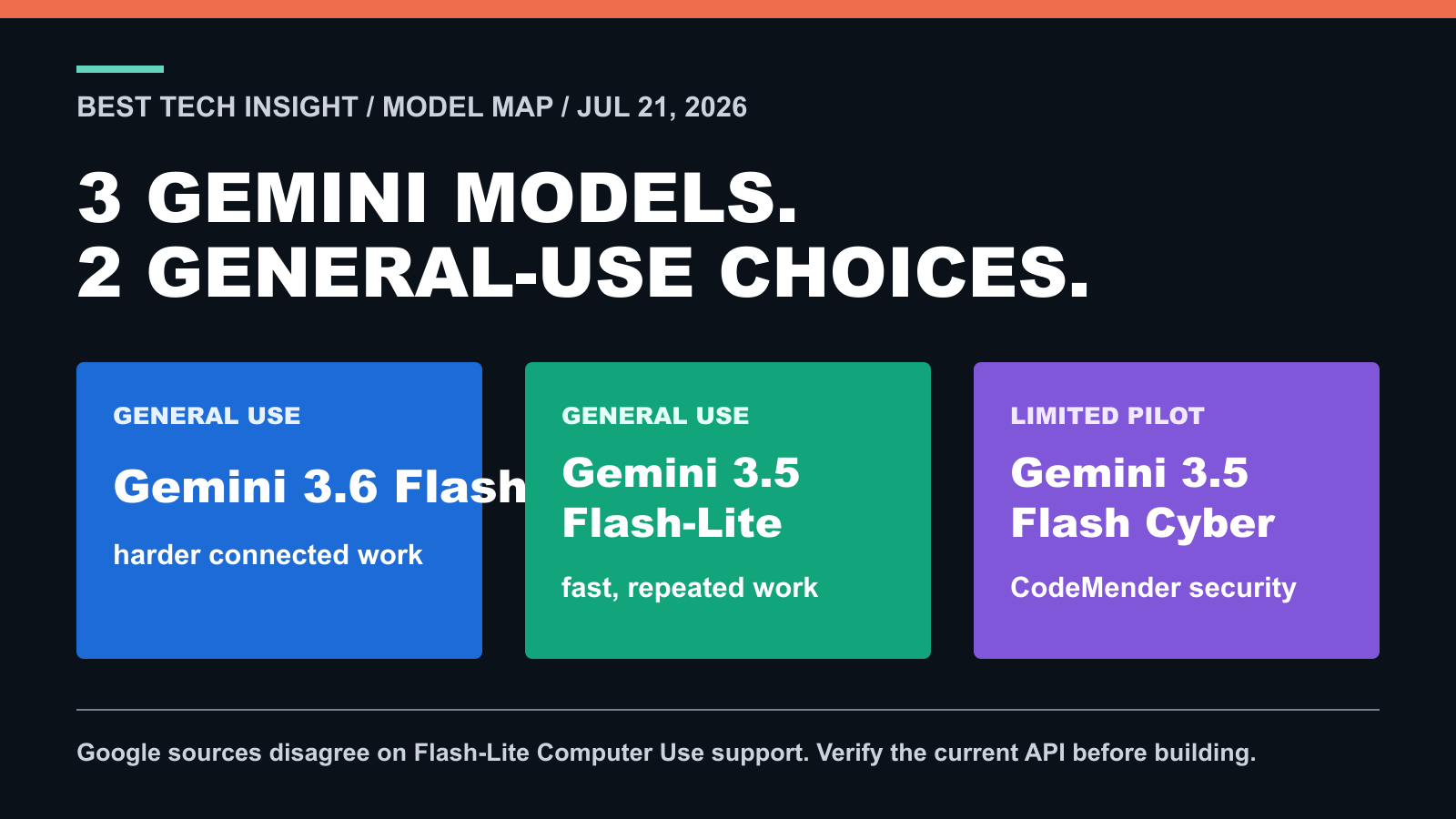
Google announced three Gemini Flash models on July 21, 2026: Gemini 3.6 Flash, Gemini 3.5 Flash-Lite, and Gemini 3.5 Flash Cyber. The first two became generally available. Flash Cyber is a specialized security model that Google says will be offered through CodeMender to governments and trusted partners in a limited-access pilot.
Gemini 3.6 Flash is the better fit when one model must plan, code, use tools, and revise a connected task. Gemini 3.5 Flash-Lite is the better fit for fast, repeated work with a clear check. Flash Cyber is not a third everyday model to pick from the Gemini API list.
Do not pick only by the model number. First ask who owns the plan. The main worker must keep choices, tools, and edits connected. A helper should get one small job with an answer that software can check.
This guide translates Google’s public docs. BTI did not run an independent model benchmark, test Flash Cyber access, or verify Google’s speed, token, price, or production claims. Limits, controls, access, and pricing can change.
Want the quick version next time?
Follow @besttechinsight for fast, source-backed explanations of new products, chips, AI, robots, EVs, and science. The detailed guide stays here on BTI.
Which model can you actually choose?
Choose the 3.6 model when one worker must keep several choices linked. It can plan a code change, choose tools, review files, turn a goal into steps, and revise after a failed check.
Choose Gemini 3.5 Flash-Lite when the job reads like a small function. Classify this note. Extract these fields. Route this request. Check this answer against one rule. Do not give the lighter model an open-ended plan just because it is fast.
What about Gemini 3.5 Flash Cyber?
Flash Cyber is a specialized security model built on Gemini 3.5 Flash. Google DeepMind says it is tuned to find, validate, and patch software vulnerabilities inside the CodeMender security system.
It is not presented as a normal general-purpose model for everyday prompts or a generally available Gemini API choice. Google says access will be exclusive to governments and trusted partners through a limited pilot. “Soon” is not a public release date, and BTI did not test access.
The practical answer is simple: most people choosing between the new models are choosing between 3.6 Flash and 3.5 Flash-Lite. Flash Cyber matters because it shows where specialized defensive AI is going, not because it belongs in a normal model picker today.
Gemini 3.6 Flash vs 3.5 Flash-Lite
| Model | Google’s description | Practical fit | Checks before switching |
|---|---|---|---|
| Gemini 3.6 Flash (model ID: gemini-3.6-flash) | A generally available model Google calls its workhorse for coding, knowledge work, multimodal tasks, and connected agent workflows. | Use it as the main worker for several steps, code changes, tool choices, or one connected plan. | Run the same real tasks on both models. Compare correct results, speed, failures, and total token use. |
| Gemini 3.5 Flash-Lite (gemini-3.5-flash-lite) | A generally available, low-latency model Google designed for high-throughput work, document processing, and repeated subagent tasks. | Use it to classify, extract, route, reshape, or check data when the job has a clear pass rule. | Test edge cases. Keep the job small enough for another system to check the answer. |
What the two models share
Both model pages list text, image, video, audio, and PDF input. Both return text. Both list a 1,048,576-token input limit and a 65,536-token output limit.
They also share function calls, set output formats, code tools, caching, File Search, web grounding, URL context, and thinking. A long context limit only says how much can fit in a request. It does not say both models will plan equally well.
The job is still the key. Use the 3.6 model for hard work that must stay connected. Use Flash-Lite for a small helper call that repeats.
Google’s Computer Use pages do not agree
Google’s July 21 launch post says Gemini 3.5 Flash-Lite now has Computer Use as a built-in tool. The Gemini 3.5 Flash-Lite model page, also updated July 21, lists Computer Use as not supported. Google’s Gemini 3.6 Flash model page lists Computer Use as supported in preview.
BTI cannot tell from those public pages whether the Flash-Lite mismatch reflects a staged rollout, a surface-specific limitation, or documentation lag. Treat its Computer Use status as unresolved until the model page, your account, and a small API test agree. Do not build a production workflow around the launch sentence alone.
Any computer-control tool needs strict boundaries. Limit what the model can open, ask before high-impact actions, use a safe test space, keep logs, and preserve a human recovery path.
What generally available means here
Google labels both models generally available, or GA. Google also calls them stable and ready for production use. This means they are not just preview IDs. It does not mean zero errors or a risk-free switch.
Your team still needs a test. Record the exact model ID, prompt, tools, output format, safety rules, and expected result. Test bad output and retries, not only easy cases. Keep a rollback path while you try a small share of real traffic.
Google names the stable IDs gemini-3.6-flash and gemini-3.5-flash-lite. Use those exact IDs in a test. Do not assume a moving latest name points to the version you meant to use.
Why token efficiency matters more than shorter answers
Google says the 3.6 model uses fewer output tokens than 3.5 Flash on its cited evaluations and is less wordy. Those are Google-attributed benchmark claims, not BTI measurements, and they do not provide a savings number for your workload.
Do not count words alone. A short answer that misses a field may cause a retry. A longer answer may prevent a bad tool call. Track all input and output tokens, total time, retries, tool calls, bad formats, and tasks that pass without repair.
For code work, check the result too. Did the model touch only the right files? Did it keep old behavior and run the right tests? Did it stop when proof or access was missing? Fewer tokens help only when the work stays correct.
Where Flash-Lite fits in an agent system
A subagent is a helper with a clear limit. The main worker gives it one repeated step. The helper returns a set format. The main worker then decides what comes next. Google puts Flash-Lite in this fast, high-volume role.
Good jobs have a clear input, a short output, and a cheap check. Pull an order number into set fields. Put a support note in an approved group. Turn one file into fixed fields. Check whether a page has a required notice.
Vague jobs are a poor fit. “Handle this customer” and “fix the repo” have no clear edge. Add approval and audit rules if any model can spend money, contact a person, publish, delete data, or change access.
The July 21 parameter change to check
Google’s July 21 note says temperature, top_p, and top_k are deprecated. Search your code for those names before you switch. Then read Google’s current model guide.
Do not use a low temperature as a promise of the same answer each time. Test your output format and checks on their own. Google can change a default even when your code stays the same.
Deprecated does not mean shut down today. It means a current assumption may break later. Link the current Google doc in the change ticket and record the date you checked it.
A five-step model migration check
- Split the work: identify which tasks need a primary planner and which can become narrow helper calls.
- Freeze a test set: keep representative normal cases, edge cases, known failures, and safety-sensitive examples.
- Use explicit IDs: compare the current model with
gemini-3.6-flashorgemini-3.5-flash-litedirectly. - Measure completed work: record correctness, latency, total tokens, retries, tool failures, and human repair time.
- Roll out gradually: keep logs, a rollback path, and a small traffic percentage until the evidence is stable.
Gemini Flash FAQ
Is the 3.6 model generally available?
Yes. Google’s July 21, 2026 Gemini API release notes list gemini-3.6-flash as a generally available, stable model.
What is Gemini 3.5 Flash-Lite for?
Google positions gemini-3.5-flash-lite as a low-latency, cost-effective subagent for high-volume automation. A practical fit is a narrow repeated task with a clear validator.
What is Gemini 3.5 Flash Cyber?
Google DeepMind describes Flash Cyber as a specialized model for finding, validating, and patching software vulnerabilities inside CodeMender. Google says it will be limited to governments and trusted partners in a pilot, not generally available as an everyday model choice.
Which model should handle coding and agent plans?
Google specifically highlights code and agentic planning improvements for the 3.6 model. Test it on your own repositories and tool workflows before moving production traffic.
Do the models accept the same kinds of input?
Google’s current model pages list text, image, video, audio, and PDF input for both, with text output. They also list the same 1,048,576-token input limit and 65,536-token output limit.
Which one supports Computer Use?
Google’s current public pages conflict. The launch post says Flash-Lite now has Computer Use built in, while its model page lists the capability as unsupported. The 3.6 model page lists Computer Use in preview. Verify the current model page and your own account before relying on it.
Does Flash-Lite always cost less?
Google describes Flash-Lite as cost-effective, but provider pricing and total workflow cost can change. Check the current official pricing and model pages, then include retries and repair work in the comparison.
Are temperature, top_p, and top_k still supported?
Google’s July 21 release note says those sampling parameters are deprecated. Review the current latest-model guide and test the replacement behavior before changing a production integration.
Official Gemini sources
- Google Gemini API release notes: The July 21, 2026 entry confirms both generally available model IDs, Google’s intended roles, and the sampling-parameter deprecation notice.
- Google’s three-model launch announcement: The launch post introduces 3.6 Flash, 3.5 Flash-Lite, and 3.5 Flash Cyber, describes their roles, and says Flash-Lite now has Computer Use built in.
- Google latest Gemini model guide: The current implementation guide is the place to check model behavior, supported controls, limits, and migration details before deployment.
- Google Gemini 3.6 Flash model page: The model page documents supported inputs, context and output limits, tools, and the Computer Use preview.
- Google Gemini 3.5 Flash-Lite model page: The model page documents supported inputs, context and output limits, and the high-volume subagent focus. It currently lists Computer Use as not supported.
- Google DeepMind Gemini 3.5 Flash Cyber announcement: The DeepMind post describes a specialized security model for finding, validating, and patching vulnerabilities in a limited CodeMender pilot.
BTI final take
For general work, let 3.6 Flash own the harder connected task and let Flash-Lite handle fast repeated work that can be checked. Treat Flash Cyber as a separate, limited security program rather than a third everyday option.
Google’s own Computer Use pages currently disagree about Flash-Lite. That is exactly the kind of launch-day detail worth checking before a model name becomes architecture.
Then test finished work, not launch copy. GA status helps. Your own tasks, access rules, error checks, logs, and rollback path still decide if a model is ready for your system.