
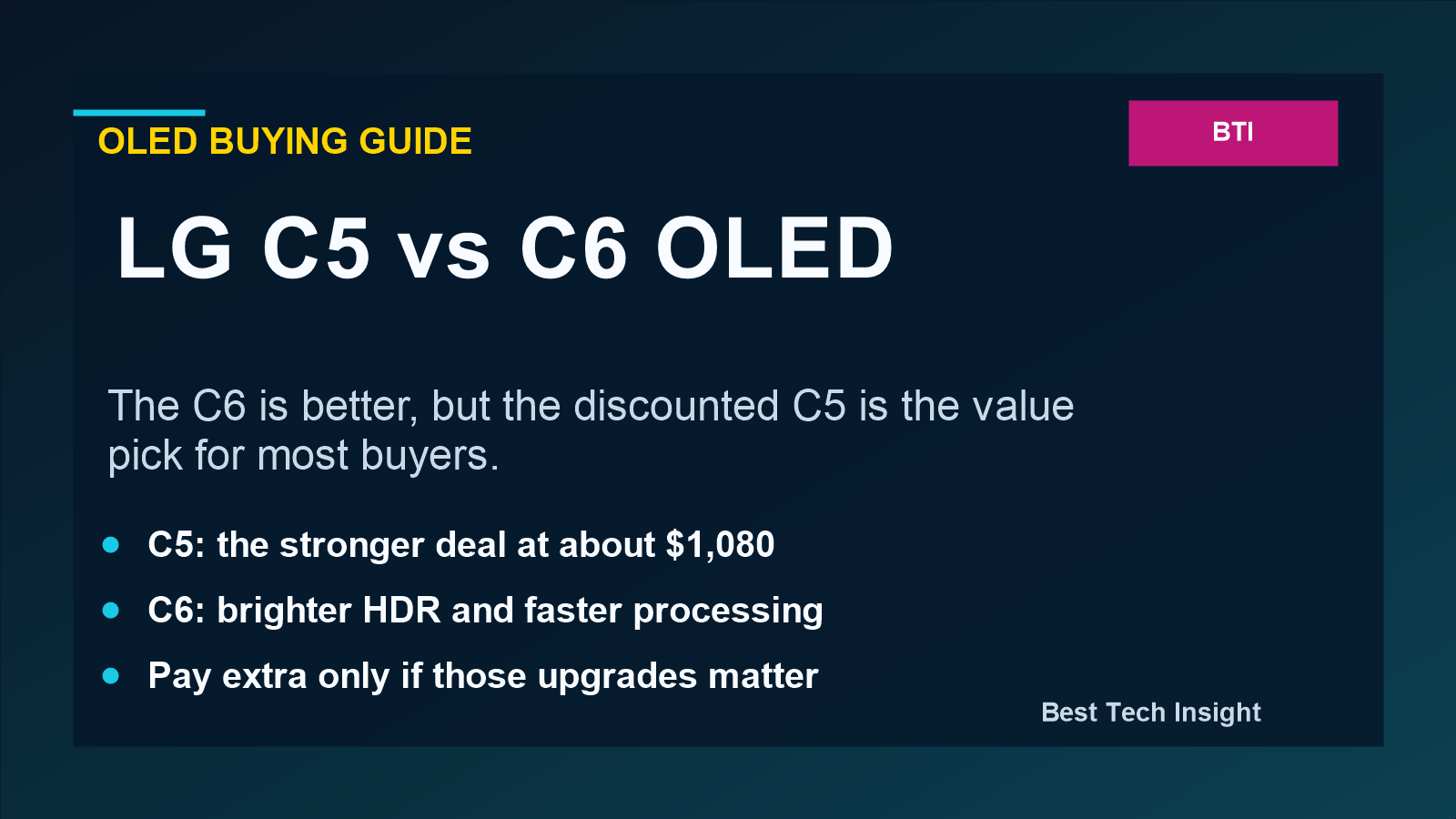
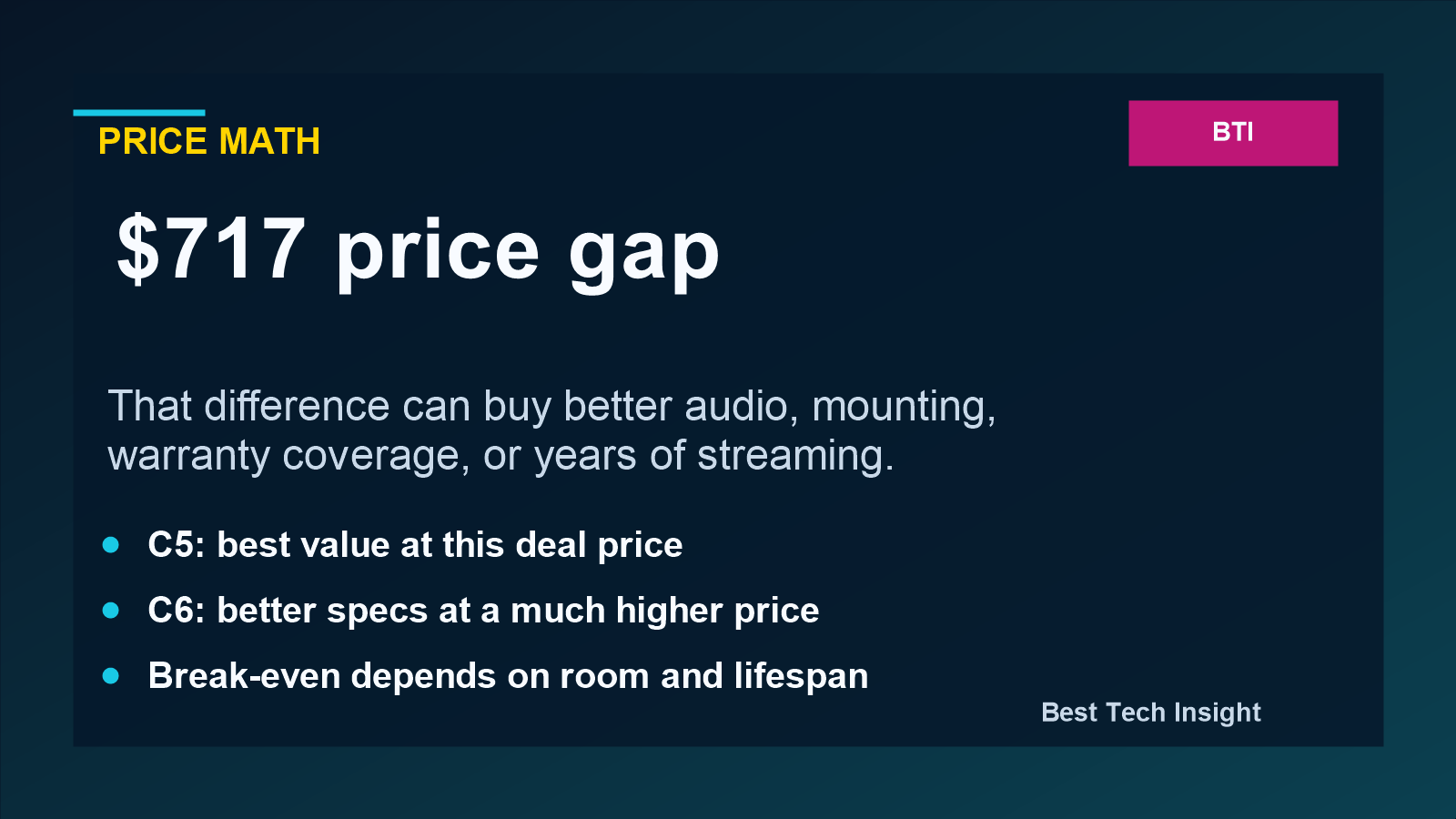
This LG C5 vs C6 OLED TV decision comes down to one number: about $717. The 65-inch LG C5 deal that triggered this comparison was listed at $1,079.99 before tax with free installation, a bracket, and a $70 Sling TV credit on Slickdeals. The equivalent 65-inch LG C6 deal was listed at $1,796.99 with free shipping through another Slickdeals thread.
That makes the C6 roughly 66 percent more expensive before tax. It is not a tiny upgrade fee. It is enough money to buy a strong soundbar, a streaming box, a game console accessory bundle, a wall mount setup, or several years of streaming services. So the real question is not whether the C6 is technically better. It is whether the better brightness, newer processor, and 165Hz gaming support are worth giving up the C5’s unusually strong value.
My short answer: at these prices, I would buy the 65-inch LG C5 unless the room is bright, HDR impact matters a lot, or the TV will double as a high-refresh PC gaming display. The LG C5 vs C6 OLED TV choice gets closer if the C6 drops near $1,500, but at a $700-plus gap the C5 is the more rational buy for most movie, streaming, console gaming, and sports use.
Those Amazon buttons are useful for checking live availability, but they should not override the deal math by themselves. If the C5 partner-store price is available to you and Amazon is much higher, the C5 deal can still be the better purchase even if the Amazon listing is easier to access.
BTI on InstagramNew tech, decoded in plain EnglishFollow @besttechinsight for quick breakdowns of products, chips, robots, EVs, and science. Full reviews and guides stay here on BTI.
LG C5 vs C6 OLED TV: the short answer
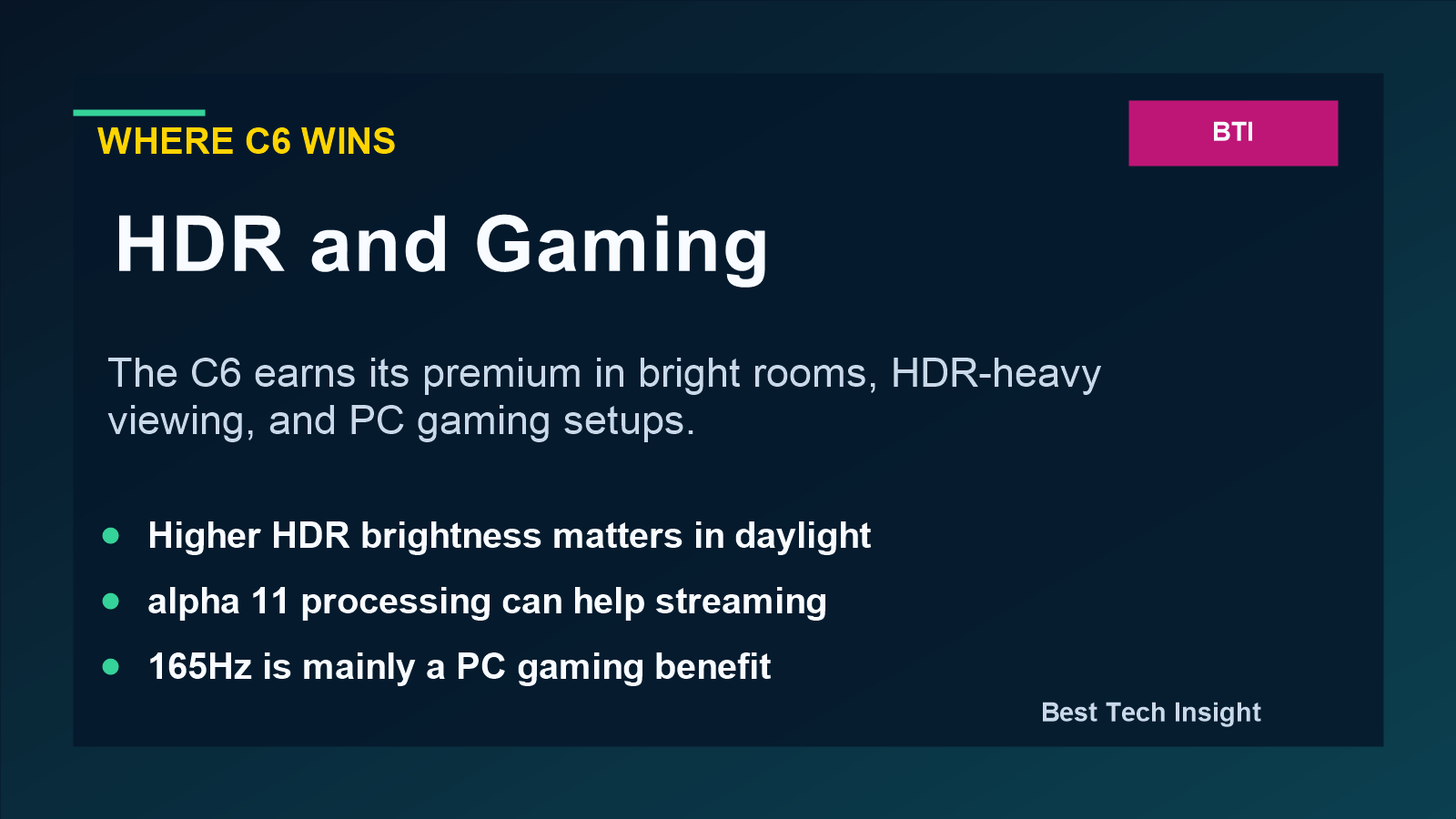
The C6 wins the spec sheet. LG lists the 65-inch C6 with its alpha 11 AI Processor 4K Gen3, Brightness Booster, Dolby Vision, Dolby Atmos, webOS 26, and VRR up to 165Hz on the official LG C6 product page. The C5 is one generation older and uses LG’s alpha 9 AI Processor 4K Gen8, webOS 25, and VRR up to 144Hz according to the official LG C5 product page.
That sounds like an obvious C6 win until the price enters the room. The 65-inch C5 is not an old budget TV with obvious compromises. It is still a premium OLED with perfect black, Dolby Vision, four HDMI inputs with gaming features, 144Hz VRR for PC use, and the same basic C-series strengths that made LG OLEDs such a common recommendation. For most living rooms, it already clears the bar.
The C6 matters most if you are chasing the best C-series image LG offers in 2026. Independent testing from TechRadar’s C6 review found a meaningful HDR brightness lift over the C5, with the 65-inch C6 hitting higher peak and full-screen HDR brightness in its measurements. That is the upgrade you are really paying for, along with the faster processor and higher PC refresh ceiling.
The problem is value. A better TV is not automatically the better purchase. If you are choosing between a discounted C5 and a newer C6, the C6 has to create enough visible, daily benefit to justify a second purchase decision on top of the TV itself. At this exact spread, the answer leans C5.
What actually changes between the LG C5 and C6 OLED TV
| Category | LG C5 65-inch | LG C6 65-inch | How much it should matter |
|---|---|---|---|
| Deal price in this decision | About $1,079.99 before tax | About $1,796.99 before tax | Huge. This is the whole decision. |
| Processor | alpha 9 AI Processor 4K Gen8 | alpha 11 AI Processor 4K Gen3 | Moderate to high if you watch lower-quality streams. |
| HDR brightness | Excellent OLED, but dimmer than C6 | Brighter highlights and higher full-screen HDR in testing | High in bright rooms or with HDR movies. |
| Gaming refresh | 120Hz native, VRR up to 144Hz | 120Hz native, VRR up to 165Hz | High for PC gamers, low for most console buyers. |
| Smart platform | webOS 25 | webOS 26 | Nice, but not worth $700 by itself. |
The most important C6 upgrade is brightness. OLED already wins on black levels and contrast, but brightness is where premium OLEDs have been improving fastest. If you watch HDR movies, prestige streaming shows, or games with bright highlights, the C6’s extra headroom should look punchier. It should also help in a room where daylight or lamps make OLED brightness limitations easier to notice.
The second meaningful upgrade is processing. The C6’s alpha 11 processor is not just a marketing label. Better processing can help with upscaling, gradation, tone mapping, and the way lower-quality streaming sources hold together. That matters because a lot of real TV watching is not pristine 4K Blu-ray. It is compressed streaming, sports, YouTube, older shows, and apps that vary in quality.
The gaming upgrade is more specific. The C5 already handles what most console buyers need. PlayStation 5 and Xbox Series X gaming are usually about 4K 120Hz, VRR, low latency, and HDMI 2.1 support. The C6’s 165Hz ceiling is much more relevant if a gaming PC will be connected and you can actually push high frame rates at 4K. If this is mainly a PS5, Xbox, movies, and streaming TV, 165Hz should not drive the purchase.
There is also a naming wrinkle. The 65-inch C6 is not the same as the larger C6H models. Reviews and spec talk around the 77-inch and 83-inch C6H can mention more advanced panel technology, but that does not automatically apply to the 65-inch C6PUA in this decision. For this article, the relevant comparison is the standard 65-inch C5 versus the standard 65-inch C6.
Why paying more for the LG C6 can still make sense
The strongest argument for the C6 is that TVs are long-term purchases. If you keep a TV for seven years, the $717 difference becomes roughly $102 per year before tax. If you keep it for five years, it becomes about $143 per year. That framing makes the C6 easier to justify if you care deeply about picture quality and know you will notice the upgrade every night.
The C6 also makes more sense in a brighter room. OLED is amazing in dark and controlled rooms because black levels stay perfect and contrast looks clean. In a sunny living room, brightness and reflection handling become more important. The C5 is still bright enough for many rooms, but the C6 gives you more HDR punch and more room to fight ambient light.
PC gamers have a better reason than most people to consider the C6. The jump from 144Hz to 165Hz is not dramatic for everyone, but it is meaningful if the TV will sit near a gaming PC and you want the highest C-series refresh support. The C6 also keeps the rest of the gaming checklist strong: VRR, G-Sync compatibility, AMD FreeSync Premium, Game Optimizer, and very fast OLED response time.
There is also a resale and ownership argument. A newer model with a stronger processor may feel current for longer. If you are the type of buyer who keeps TVs until they feel slow, dim, or outdated, paying extra up front can be easier to defend. The C6 gives you more headroom for future HDR content, more processing power, and LG’s newest webOS generation.
Finally, some buyers simply do not want the “last year’s model” feeling. That is emotional, but it is real. If the C6 will make you happier every time you look at the setup, and the extra money will not crowd out a soundbar, warranty, furniture, or another priority, then the premium may be personally worth it even when the value math favors the C5.
The value math favors the C5 at these prices
The C5 deal is unusually aggressive. LG’s own page showed a 65-inch C5 sale price of $1,399.99 when checked for this draft, while the Slickdeals partner-store thread showed $1,079.99 with a promo code and extras. The C6’s official 65-inch price is $2,699.99, while the Amazon deal in the Slickdeals thread was listed at $1,796.99. Both are discounts, but the C5 is the deeper discount relative to its original pricing.
That matters because the C5 is not cheap because it is bad. It is cheap because the new generation is here and retailers are clearing or promoting the 2025 set. That is often the best time to buy a mature OLED. You are getting most of the performance people actually notice, after early-model pricing has already fallen.
The C6’s upgrades are real. TechRadar measured stronger HDR brightness and called out a more refined picture. LG’s official specs confirm the newer processor and 165Hz VRR ceiling. Those are not imaginary benefits. The question is whether those benefits beat the opportunity cost of the extra money.
For a normal living-room buyer, the opportunity cost is obvious. Put $717 toward audio and the whole setup may improve more than the TV-only C6 upgrade. A good soundbar can make movies, sports, and games feel more cinematic every day. Even simple installation savings matter if the C5 deal includes free mounting or a bracket and the C6 purchase does not.
There is also the upgrade-from-what factor. If you are replacing an older LED TV, an older non-evo OLED, or a budget 4K set, the C5 will already feel like a massive jump. Perfect black, instant pixel response, Dolby Vision, strong gaming support, and modern smart TV features will be the headline improvement. In that situation, the C6’s extra refinement may be harder to appreciate than the price difference.
If you are replacing a recent LG C3, C4, Sony OLED, or Samsung OLED, the calculus changes. A C5 may not feel as dramatic, and a C6’s brightness and processing improvements may matter more. But if the decision is simply “which 65-inch OLED should I buy right now at these prices?”, the discounted C5 is the cleaner answer.
For more context on older OLED ownership, see our LG C3 OLED TV review. For broader buying help, the Best Tech Insight reviews hub is the better place to compare related TV and home theater coverage.
Final verdict: buy the C5 unless you know exactly why you need the C6
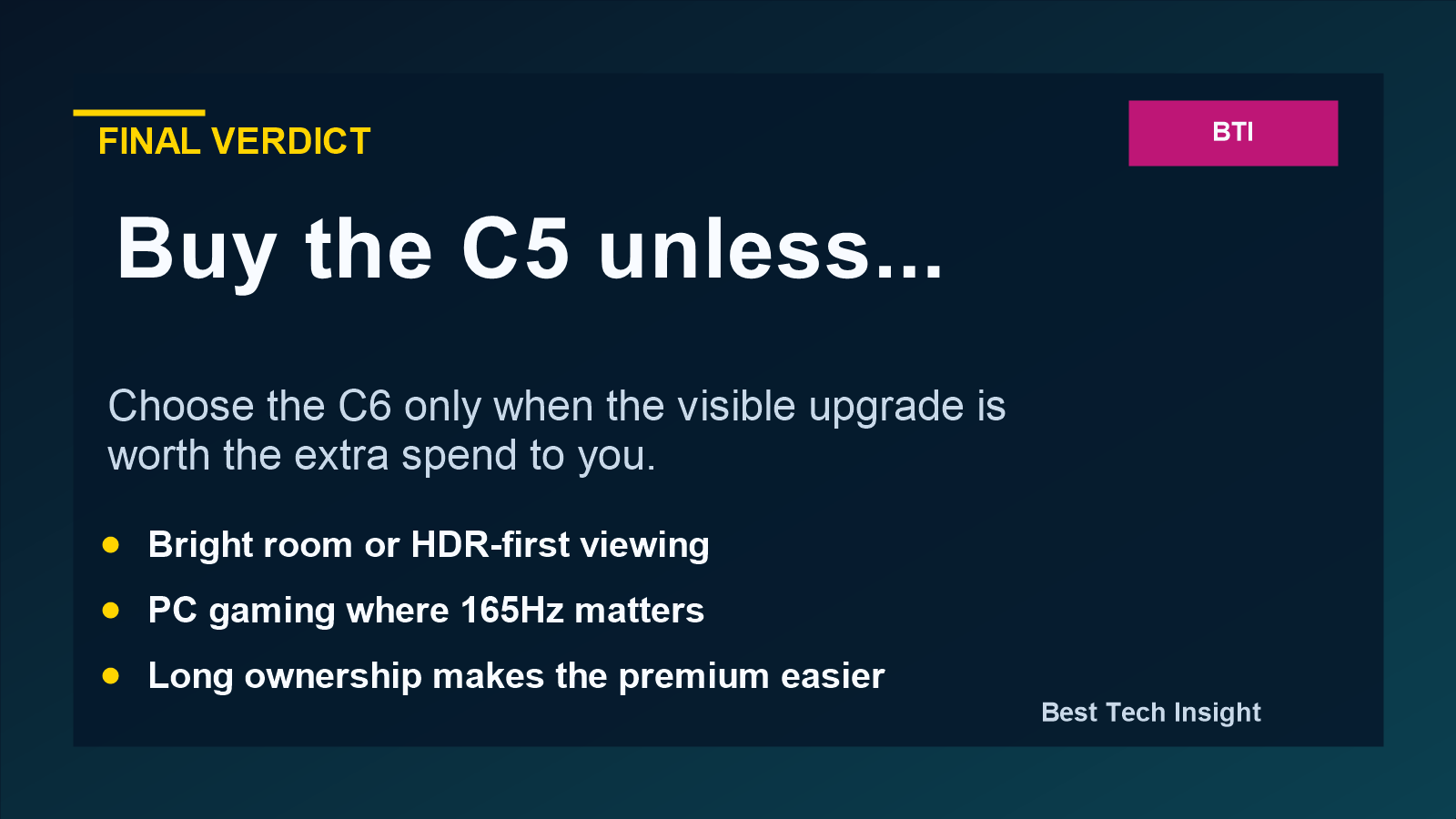
My LG C5 vs C6 OLED TV verdict is simple: at $1,079.99 versus $1,796.99, I would buy the C5. The C6 is better, but the C5 is the better deal. The C5 already gives you the main OLED reasons to upgrade: perfect blacks, excellent contrast, Dolby Vision, strong gaming features, and a premium C-series experience at a price that looks more like a midrange TV.
I would pay for the C6 only in three situations. First, the TV is going into a bright room and HDR brightness is a top priority. Second, a gaming PC will use the display and 165Hz matters. Third, you keep TVs for a long time and want the newest processor and image processing headroom because the annualized cost difference feels acceptable.
If none of those are true, the extra $700 is hard to defend. The C6’s improvements are visible and meaningful, but they are not the kind of upgrade that changes the category for every buyer. The C5 is already a serious OLED, and this deal makes it feel like the sweet spot.
The cleanest buying rule is this: if the C6 falls within about $300 to $400 of the C5, consider stretching for it. If the gap is $700 or more, take the C5 and use the savings on audio, mounting, warranty coverage, or just keeping money in your pocket. At the current spread, this decision is less about chasing the newest model and more about recognizing when last year’s excellent TV becomes the smarter buy.
Leave a Reply