
Battery explainer
Dodge Charger Solid-State Battery Explained: What the Road Test Means
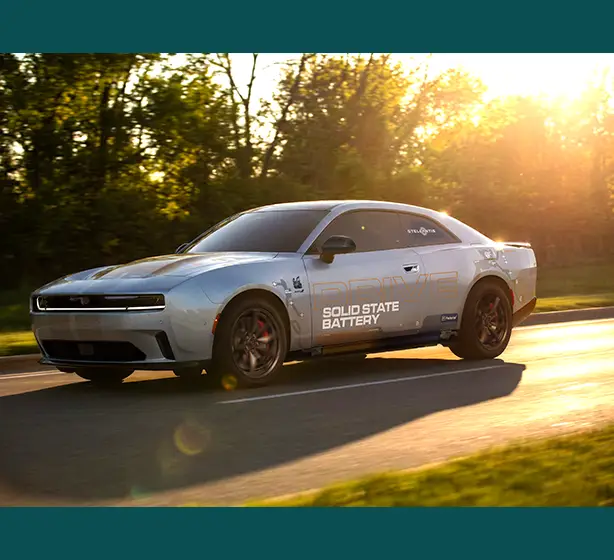
Stellantis and Factorial say solid-state cells are now inside a Dodge Charger Daytona development vehicle for road testing. The exciting part is the vehicle step. The honest caveat is that a road test is not the same as a production promise.
Dodge Charger solid-state battery sounds like a future-car headline, but the useful version is simpler. Stellantis and Factorial say Factorial’s solid-state battery cells have been integrated into a Dodge Charger Daytona development vehicle, and road testing has begun. That matters because the story moved from cell claims toward vehicle-level testing.
BTI is treating this as a plain-English technology explainer, not a car review, buying recommendation, price check, range claim, charging promise, or investment note. We did not test the vehicle, measure the pack, confirm a customer launch, verify production timing, or compare it against every EV battery. The useful job here is to explain what the road-test step actually means.
The headline number travels fast: Factorial says validated FEST cells have shown 15% to 90% charging in 18 minutes. That is interesting, but it is a cell-level claim in source material. The road-test milestone asks a different question: can the technology survive the real vehicle environment with heat, vibration, power delivery, safety systems, and long-term durability?
- The development vehicle is a Dodge Charger Daytona, not a production guarantee.
- Solid-state batteries use a different electrolyte approach from many current lithium-ion packs.
- The 18-minute number should be treated as Factorial’s cell claim, not a BTI test or confirmed production-car result.
- The next proof steps are vehicle validation, manufacturing scale, cost, safety, and real charging behavior.
BTI on InstagramNew tech, decoded in plain EnglishFollow @besttechinsight for quick breakdowns of products, chips, robots, EVs, and science. Full reviews and guides stay here on BTI.
Dodge Charger solid-state battery quick answer
The quick answer: Stellantis and Factorial have put solid-state battery cells into a Dodge Charger Daytona development vehicle and started road testing. That is a more concrete step than a lab-only announcement because the battery has to work inside a moving car. It still does not prove final production specs, price, availability, range, or charging performance for customers.
Most people hear “solid-state battery” and think “faster charging” or “longer range.” Those are possible goals, but the better beginner map has four checks: road test, cell chemistry, charging claim, and production gap. If all four move in the right direction, the story gets stronger. If one of them breaks, the headline gets weaker.
| Check | Plain meaning | Why it matters |
|---|---|---|
| Road test | The cells are inside a Stellantis development vehicle instead of only sitting on a lab bench. | Vehicle testing adds heat, vibration, acceleration, packaging, and safety questions. |
| Solid-state cell | The electrolyte design is different from a typical lithium-ion pack with liquid electrolyte. | The hoped-for benefits are energy density, safety, weight, and faster charging, but execution decides the result. |
| 18-minute cell claim | Factorial has reported 15% to 90% charging in 18 minutes for validated FEST cells. | That is not the same as a confirmed customer-car charging result. |
| Production gap | A development Charger Daytona is a proof step, not a customer launch promise. | Cost, durability, manufacturing yield, validation, and vehicle integration still matter. |
Why a road test is different from a battery demo
A battery cell can look promising in controlled testing and still face hard vehicle questions. A car adds temperature swings, vibration, crash rules, packaging constraints, charging hardware, battery-management software, weight targets, and driver behavior. Road testing does not solve every one of those questions at once, but it moves the story into the environment where the battery eventually has to work.
That is why the development-vehicle detail matters. The car is not just a photo prop. It turns the story into a systems test. The pack has to fit. The sensors have to talk. The thermal strategy has to hold up. The software has to manage cells under real loads. The vehicle has to drive repeatedly without turning a promising battery into a fragile showpiece.
For a normal buyer, the right takeaway is not “wait for this exact car” or “buy the next EV because the battery future is solved.” The better takeaway is: when a solid-state battery headline appears, ask whether it is a cell test, a pack test, a vehicle test, or a production launch. Those are different levels of proof.
The 18-minute number in plain English
The 18-minute detail is the hook everyone understands. If an EV could safely recover a large part of its charge in less than the time it takes to finish a coffee stop, road trips would feel different. But the phrase has to be handled carefully. Source material says Factorial’s validated cells demonstrated charging from 15% to 90% in 18 minutes. That does not automatically mean the development Charger Daytona, every future pack, every charger, and every weather condition would match the cell result.
The distinction is not nitpicking. A cell is one building block. A pack is many cells plus structure, cooling, wiring, safety systems, and controls. A vehicle is the pack plus the rest of the car. A public product is the vehicle plus manufacturing, warranty, certification, service, and customer use. The number becomes more meaningful as it survives each layer.
That makes the social post stronger, not weaker. The first slide can celebrate the idea: a Charger development vehicle is testing solid-state cells. The middle slides can translate the proof ladder. The final slide can say the useful rule: do not confuse a cell claim with a production-car promise.
What not to overclaim
Do not say this proves a customer Dodge Charger charging result from 15% to 90% in 18 minutes. Do not claim a price, launch timing, final range, battery warranty, safety ranking, battery life, or comparison win. Do not call this a BTI review. Do not imply Stellantis, Dodge, or Factorial endorsed BTI’s post.
The conservative claim is already interesting enough: Stellantis and Factorial say solid-state cells have been integrated into a Dodge Charger Daytona development vehicle and road testing has begun. Factorial’s source material also includes the 15% to 90% in 18 minutes validated-cell claim. Those two facts create the explainer: exciting cell numbers now have to survive the car.
This is exactly the kind of topic BTI should explain for broader readers. The story has a real vehicle image, a surprising battery claim, a useful science concept, and a caveat normal people can remember. It is more specific than another generic AI device post and easier to save than a dense battery chemistry article.
How to read the next solid-state battery headline
Use this five-question checklist. First, is the claim about a material, a cell, a pack, a vehicle, or a production model? Second, does the source name the charging window, like 15% to 90%, or only use a vague “fast charge” phrase? Third, does it mention cycle life, safety, and temperature, or only peak charging? Fourth, is the battery inside a development vehicle or only a lab fixture? Fifth, does the announcement say when buyers can actually get it, or is it still a validation step?
If the answer is “development vehicle,” the story is meaningful but still early. If the answer is “production vehicle with customer specs,” the story is closer to a buying decision. The Dodge Charger Daytona road-test story belongs in the first category. It deserves attention because the proof moved forward, not because the future is already finished.
That is the BTI line: celebrate the engineering step, then keep the proof ladder visible.
Sources BTI checked
- Stellantis press release: Stellantis says Factorial solid-state cells were integrated into a Dodge Charger Daytona development vehicle and road testing has begun.
- Factorial press release: Factorial describes the same road-test milestone and positions it as a vehicle-level validation step.
- PRNewswire release: The syndicated release provides the public article image and repeats the 15% to 90% cell-charge claim in source-backed context.
- Factorial FEST technology page: Factorial’s technology page explains the company’s solid-state platform framing at a higher level.
- Interesting Engineering coverage: Interesting Engineering covered the road-test story for a broad technology audience and shows why the 18-minute hook needs plain-English context.
- Electrek coverage: Electrek framed the milestone as solid-state EV batteries leaving the lab for road testing, which supports BTI’s proof-ladder angle.
These sources support the core article facts: the development-vehicle integration, the Dodge Charger Daytona context, the road-testing milestone, and Factorial’s cell-level charging claim. They do not support fabricated price, stock, rating, review, availability, final customer range, or BTI hands-on testing claims.
Final take
The best plain-English read is: the solid-state battery story just moved from lab excitement toward road validation. That is worth watching. The smart caveat is: vehicle road testing is still a proof step, and the 18-minute charge claim should stay attached to Factorial’s validated cells until production-car data exists.
If you remember one thing, remember the ladder: cell, pack, vehicle, production. The Dodge Charger Daytona development vehicle is the vehicle step. That is why the story is exciting and why it still needs careful wording.
Dodge Charger solid-state battery FAQ
Can customers order this Dodge Charger Daytona with this solid-state battery?
No. The source material describes a Stellantis development vehicle and road testing, not a customer production launch for this solid-state battery setup.
Does the 18-minute claim mean the car charges that fast?
Not by itself. Factorial says validated FEST cells demonstrated 15% to 90% charging in 18 minutes. A full production vehicle has extra pack, cooling, software, safety, charger, and durability requirements.
Why do people care about solid-state EV batteries?
Solid-state battery designs are pursued because they may improve energy density, safety, weight, charging, or packaging. Those benefits have to be proven at vehicle and production scale.
Did BTI test this Dodge Charger or battery?
No. BTI did not test the vehicle, battery, range, charging speed, durability, safety, or availability. This is a source-backed plain-English explainer.