
AI power explainer
Unconventional AI Oscillator Computing Explained: Can AI’s Power Bill Drop?
The simple version: a startup wants AI answers to use far less energy, but the proof so far is an early software-simulated model.
Unconventional AI oscillator computing is worth explaining because the headline sounds almost impossible: cut AI’s power bill by 1000x. The useful BTI version is calmer. Unconventional AI released Un-0, an image-generation model built around a software simulation of coupled oscillators. The company says the larger goal is a much more energy-efficient inference stack.
That does not mean a working data-center chip has already replaced GPUs. It does not mean normal users can buy a product today. It also does not mean BTI independently verified power savings, performance, deployment readiness, or model quality. This guide translates the public source material into plain English so the reader understands the idea and the limits.
- The 1000x number should be read as an ambitious company goal, not a proven field result.
- Un-0 is important because it shows a modern image model mapped onto simulated oscillator dynamics.
- The deeper issue is AI inference energy: memory movement, hardware design, model design, and system overhead all matter.
Unconventional AI oscillator computing quick answer
Unconventional AI oscillator computing is a bet that AI workloads can be mapped onto rhythm-like physical systems instead of only running through conventional digital accelerators. In the Un-0 demo, the oscillators are simulated in software. The future promise is that physical oscillator hardware might eventually do similar work with less energy.
The beginner hook is simple: today’s AI systems move huge amounts of data to create answers. Unconventional AI is asking whether a different kind of computing system could let physics do more of the work directly. That is exciting, but the safe wording matters. A software simulation is a step toward an idea, not proof that a finished chip is already operating at the claimed energy advantage.
| Part | Plain meaning | Why it matters |
|---|---|---|
| Inference | The live answer-making step when an AI model responds to a prompt or creates an image. | This is where growing daily AI usage can turn into a large energy and infrastructure problem. |
| Data movement | The back-and-forth movement of model data, context, and working memory inside an AI system. | The company argues that moving data can be a bigger energy problem than the math itself. |
| Coupled oscillators | Tiny rhythm-like systems that influence each other, similar to metronomes nudging each other into patterns. | Unconventional AI is exploring whether those dynamics can become a different computing substrate. |
| Un-0 | A software-simulated image-generation model built around coupled oscillator dynamics. | It is a public demo of the idea, but it is not proof that a deployed chip already saves power. |
| Physical hardware | The future chip-and-system layer that would need to make the simulated idea work in real infrastructure. | That is where the big 1000x energy claim would need independent evidence over time. |
Why AI’s power bill is the real story
AI infrastructure is not only about making models smarter. It is also about serving answers repeatedly. Every prompt, image request, code task, summary, and agent step creates inference work. At a large scale, inference can become a power, cooling, memory, and data-center problem.
The Unconventional AI energy post makes a useful point for normal readers: the hard part is not only arithmetic. The system has to move model data, context, and intermediate values. If important data sits far from the compute doing the work, energy gets spent moving it around. That is why modern AI hardware stories keep returning to memory, bandwidth, locality, and power per useful output.
This is also why the topic fits BTI’s Instagram lane. A vague post saying “AI needs energy” is forgettable. A specific post saying “AI’s power problem may be a memory problem, and one startup is trying oscillator computing” gives the reader a concrete idea to save and explain to someone else.
What coupled oscillators mean in normal words
An oscillator is something that cycles. A clock pendulum, a metronome, a vibration, or a wave can be a useful mental model. Coupled oscillators are oscillators that influence one another. When they interact, they can settle into patterns, synchronize, push against each other, or form more complex dynamics.
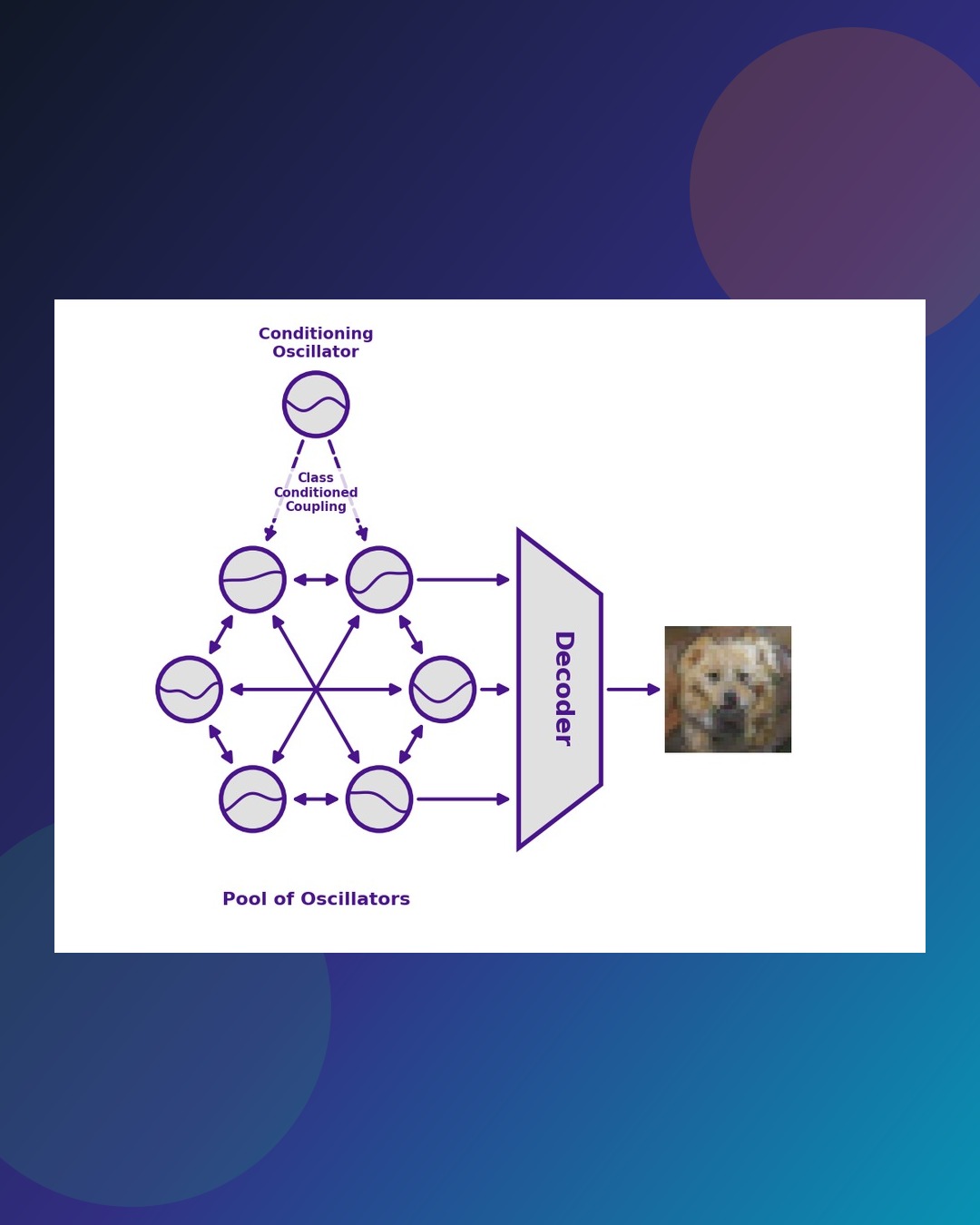
Unconventional AI is exploring whether those dynamics can be trained and used for AI computation. In the Un-0 post, the company describes a pool of oscillators, a conditioning group that steers the requested class, a dynamics step where the oscillators evolve, and a decoder that turns the final state into pixels.
That is the clean social hook: instead of stacking only conventional neural network layers, imagine training a field of tiny rhythms to organize itself into useful signals. Then a decoder turns those signals into an image. The metaphor is not perfect, but it gives non-engineers a doorway into the idea.
What Un-0 proves and what it does not
Un-0 proves that the company has a public model release built around simulated coupled oscillator dynamics. The official post says the model can generate images on benchmark datasets and provides weights, training, and ablation code. That matters because it is more concrete than a pitch deck.
But Un-0 does not prove the full energy thesis by itself. The model runs through a software simulation, and a simulation running on conventional hardware is not the same thing as a future physical chip. The chip stack, memory system, software stack, operations, reliability, and independent energy measurements would all need to matter before the large energy claim becomes a demonstrated infrastructure result.
That distinction is the whole point of this BTI guide. The story is interesting enough without exaggeration. The reader can be impressed by the direction while still knowing where the evidence stops.
How to read the 1000x claim safely
The strongest version of this post should not say “AI power solved.” It should teach readers how to read a big technical claim without getting fooled by it. Use this three-column filter.
| Source point | Safe read | Do not assume |
|---|---|---|
| 1000x energy-efficiency goal | Treat it as an ambitious company goal for generative AI inference, not as a proven deployed result. | Do not say current users already get 1000x lower energy use from a commercial service. |
| Un-0 model release | Un-0 shows an image model running through a software simulation of coupled oscillator dynamics. | Do not call it a finished chip, an independent benchmark, or a consumer product. |
| Memory and data movement | The energy post argues that memory movement is central to the problem, so the answer is system-level. | Do not reduce the story to one magic component replacing every AI accelerator. |
Follow BTI for the next plain-English tech breakdown
If this oscillator-computing guide helped, follow @besttechinsight on Instagram for current AI, chip, space, robotics, and hardware stories translated without hype. BTI focuses on what happened, why it matters, and where the evidence stops.
Sources for this oscillator computing guide
This guide uses public source material and reputable tech reporting. It avoids fabricated testing, prices, ratings, reviews, awards, endorsements, availability, investment guidance, or hands-on claims.
- TechCrunch report on Unconventional AI: Covers Naveen Rao’s startup, the oscillator-computing direction, Un-0, and the 1000x energy goal.
- Unconventional AI Un-0 model post: The official June 25, 2026 model post explains Un-0 as a software simulation of coupled oscillator dynamics.
- Unconventional AI energy-efficiency post: The official research post frames the 1000x target around generative AI inference, memory movement, and system-level work.
Unconventional AI oscillator computing FAQ
Did BTI test Un-0 or the claimed energy savings?
No. BTI did not test Un-0, inspect the company’s hardware, verify chip performance, or measure energy use. This article explains public source material in beginner-friendly language.
Is Un-0 a finished AI chip?
No. Un-0 is described as an image-generation model using a software simulation of coupled oscillator dynamics. A physical chip and full inference stack would be a later step.
What does 1000x less energy mean here?
In this context, it is best read as the company’s long-term energy-efficiency goal for generative AI inference. It should not be treated as an independently proven deployed result.
Why should normal readers care?
If AI usage keeps growing, the energy and memory cost of serving answers matters. Oscillator computing is one attempt to rethink the system rather than only making today’s chips faster.
BTI final take
The useful story is not “a startup solved AI power.” The useful story is “AI’s power problem may require a different computing substrate, and Un-0 is an early software-simulated step toward that bet.” That is specific, current, visual, and honest enough to build a stronger BTI post around.