
AI storage, in plain English
Samsung PM1763 SSD Explained: Why AI Servers Need Faster Storage
The GPU cannot work on model data it is still waiting to receive. Samsung built the PM1763 to make that wait smaller inside next-generation AI servers.
Why would a powerful AI server care about the Samsung PM1763 SSD? Because an accelerator can perform calculations only after the model, dataset, or checkpoint reaches the part of the system that needs it. If storage delivers data too slowly, expensive compute can spend time waiting instead of working.
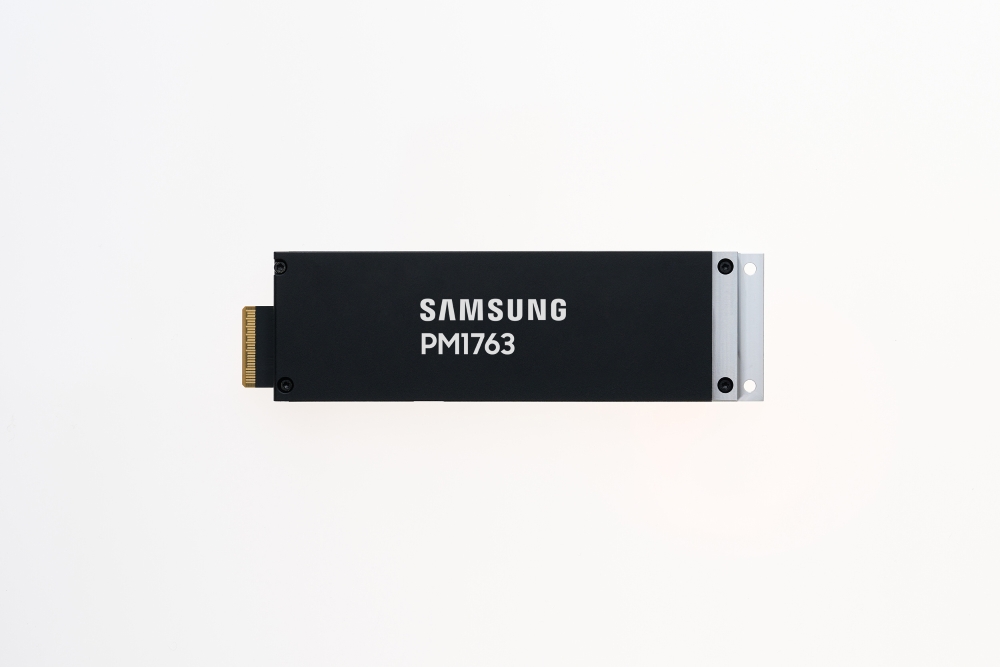
Samsung announced mass production of the PM1763 on July 8, 2026. It is a PCIe 6.0 enterprise SSD for AI and high-performance computing servers, not a consumer drive announced for a laptop, desktop, or game console. The current models come in 4TB, 8TB, and 16TB capacities.
Samsung says the 16TB version reaches sequential read speeds up to 28,400 MB/s and sequential write speeds up to 21,900 MB/s. The company illustrates the read speed by saying a 40GB large language model could be transferred in approximately 1.4 seconds.
That example is useful, but it needs a boundary: transferring a model file is not the same as loading every layer into an accelerator, running inference, or returning a complete answer. Software, memory, processors, networking, batching, and the model itself can still add delay. BTI did not independently test the drive or the 1.4-second example.
The shortest Samsung PM1763 SSD explanation
An AI server is a data-moving system before it is a calculating system. Model files may begin on storage. Training data may be read in large batches. Checkpoints may be saved and restored. Inference services may load different models for different requests. Every one of those jobs moves bytes before or around the math.
Think of an accelerator as a very fast kitchen and storage as the pantry. A faster kitchen does not help if ingredients arrive one box at a time. A faster SSD widens one delivery route. It does not guarantee a faster meal because the refrigerator, cooks, hallways, and order system can still become the slow part.
The PM1763 is Samsung’s attempt to widen the storage route for large AI servers. Its PCIe 6.0 interface provides more link bandwidth than the previous PCIe generation, while Samsung’s controller and NAND determine how the drive uses that link in real workloads.
Where storage sits in the AI data path
| System part | Plain-English job | Useful bottleneck question |
|---|---|---|
| SSD | Stores model files, training data, checkpoints, and results. | Can it deliver the needed data without leaving compute idle? |
| System memory | Keeps active data closer to the processors. | Is there enough capacity and bandwidth for the working set? |
| CPU | Coordinates software, storage requests, and general-purpose work. | Can it prepare and route work quickly enough? |
| GPU or AI accelerator | Runs the large parallel calculations used by the model. | Is it computing, or waiting for data from somewhere else? |
| Network | Moves data between servers, storage systems, and users. | Is the requested data on another machine or in another region? |
What does 28,400 MB/s actually mean?
The number is a maximum sequential read specification for Samsung’s 16TB configuration. Sequential reading means moving a large, continuous stream of data in order. That is different from jumping among many small files or handling a mixed workload with reads, writes, and background tasks at the same time.
At the headline rate, 28,400 MB/s is about 28.4 GB/s using the decimal units Samsung publishes. Dividing a 40GB file by 28.4 GB/s produces roughly 1.4 seconds, which explains Samsung’s model-transfer example. The arithmetic is a simple best-case illustration, not a promise that every 40GB model or server will reproduce the same time.
Real performance depends on the server platform, queue depth, file layout, software stack, thermal conditions, data compression, transfer destination, and whether another component can accept data at the same pace. A fast drive cannot force slower memory or a busy accelerator to receive information faster than it is ready for it.
What Samsung says changed in PM1763
Samsung lists a PCIe 6.0 interface, 9th-generation V-NAND, a newly developed 4nm controller, and NVMe 2.1 support. The 16TB model’s up-to 28,400 MB/s sequential read and 21,900 MB/s sequential write specifications are more than twice the performance Samsung reports for the PM1753 predecessor.
The company also says PM1763 improves power efficiency by more than 1.8 times versus PM1753. That is a vendor comparison, not an independent BTI measurement. A data-center buyer would still need the exact workload, power definition, capacity, form factor, cooling setup, firmware, and system configuration before translating the multiplier into operating cost.
Samsung designed the drive for direct-to-chip liquid cooling. In that setup, a cold plate contacts the device so heat can move into a liquid-cooling loop. SSD cooling sounds surprising because storage is often pictured as passive, but sustained high-speed transfers make controllers and flash work continuously. Thermal limits can reduce performance if heat is not removed.
Why an SSD needs security features
An enterprise SSD can hold model weights, proprietary training data, customer information, and intermediate results. It also shares a server with virtual machines or containers that may belong to different workloads. The data path therefore needs more than speed.
Samsung says PM1763 supports post-quantum cryptography algorithms and TEE Device Interface Security Protocol, or TDISP. Samsung describes TDISP as a way to help protect data paths in virtualized environments. Those features describe supported security capabilities; they do not make a complete system automatically secure. Deployment, keys, firmware, access controls, isolation, monitoring, and patching still matter.
The phrase post-quantum does not mean a quantum computer is inside the drive. It means the security design can use algorithms intended to resist attacks from future cryptographically relevant quantum computers. Buyers still need to verify the exact implementation, certification, configuration, and threat model.
What the PM1763 launch does not prove
It does not prove that storage is the bottleneck in every AI system. A workload may be limited by accelerator compute, high-bandwidth memory, CPU work, interconnects, network traffic, software scheduling, or an outside database. Faster storage helps when storage is on the critical path.
It does not prove that a language model will answer in 1.4 seconds. Samsung’s example describes transferring a 40GB model at the published sequential read rate. Preparing the model, placing it in memory, processing a prompt, generating tokens, applying safety checks, and sending a response are separate steps.
It also does not make PCIe 6.0 a sensible consumer upgrade by itself. A home PC needs a compatible platform and a workload that can use the bandwidth. PM1763 is an E1.S enterprise drive built for servers and liquid-cooled infrastructure. Samsung’s checked sources do not provide a normal consumer price, retail release, or gaming benchmark.
Who should care about this launch?
Cloud providers, AI labs, server makers, and organizations operating large model fleets have the direct buying question. They may load models frequently, stream large datasets, save checkpoints, serve many inference jobs, or need more performance per watt in a limited rack-power budget.
The useful evaluation is a complete-system test. Measure model load time, checkpoint time, accelerator utilization, tail latency, throughput, power, thermals, endurance, failure behavior, software compatibility, serviceability, and total cost under the exact workload. Compare PM1763 with alternatives at the same capacity and configuration rather than treating one sequential number as a universal score.
Ordinary AI users should care indirectly. Faster infrastructure can shorten startup or model-switching delays when storage was the limiting step. But a service can still feel slow for many reasons outside storage, and an infrastructure improvement does not guarantee a visible change in every app.
How BTI evaluated the Samsung PM1763 update
BTI checked Samsung’s July 8, 2026 global newsroom announcement and semiconductor infographic. Those primary sources support the product name, mass-production statement, capacities, interface, NAND generation, controller process, NVMe support, performance specifications, 40GB transfer example, cooling design, efficiency comparison, and security descriptions used here.
We checked PCI-SIG for the PCIe 6.0 interface context and NVM Express for the current NVMe specification family. We separated standards context from Samsung product claims and kept every product-specific number attributed to Samsung.
BTI did not purchase, deploy, benchmark, review, rate, or receive a PM1763. This article contains no affiliate link, retail price, consumer availability promise, award claim, endorsement, investment recommendation, or statement that PM1763 is the best SSD for every AI workload.
BTI’s simple PM1763 rule
A fast accelerator is useful only when the rest of the system keeps it fed. Samsung’s PM1763 widens the storage part of that system with a PCIe 6.0 enterprise SSD designed for sustained AI-server work.
The most interesting part is not the biggest speed number. It is the reminder that AI performance is a chain. Storage, memory, CPU, accelerator, network, cooling, security, and software all have to cooperate. The next evidence to watch is independent, complete-system testing that shows when faster storage raises accelerator utilization or reduces real model-load and checkpoint times.
Samsung PM1763 SSD FAQ
What is the Samsung PM1763?
PM1763 is Samsung’s PCIe 6.0 enterprise SSD for AI and high-performance computing servers. Samsung announced mass production on July 8, 2026.
How fast is the Samsung PM1763 SSD?
Samsung says the 16TB model reaches sequential reads up to 28,400 MB/s and sequential writes up to 21,900 MB/s. Those are vendor specifications, not BTI test results.
Can PM1763 move a 40GB AI model in 1.4 seconds?
Samsung uses approximately 1.4 seconds as a sequential-transfer illustration at its published read rate. Real model loading and inference include additional system steps and may take longer.
Is Samsung PM1763 a gaming or laptop SSD?
No consumer use is announced in the checked sources. PM1763 is an E1.S enterprise drive designed for AI servers, including liquid-cooled environments.
Does a faster SSD make every AI answer faster?
No. It helps when storage is the bottleneck. Compute, memory, networking, software, model behavior, and service load can still determine response time.
Sources
- Samsung PM1763 mass-production announcement: Primary source for the July 8, 2026 launch, capacities, performance specifications, 40GB transfer example, cooling design, efficiency claim, and security features.
- Samsung Semiconductor PM1763 infographic: Primary source for Samsung’s plain-language explanation of the AI storage path, NVMe 2.1 support, and the product’s intended server role.
- PCI-SIG PCI Express 6.0 overview: Standards-body context for the PCIe 6.0 interface and its higher-bandwidth data path.
- NVM Express specifications: Standards-body reference for the NVMe protocol family used by modern solid-state storage.
Source review date: July 11, 2026. Specifications and platform support can change with firmware, server validation, and production configurations.
Follow BTI for the next plain-English tech breakdown
BTI turns current tech stories into simple buyer and science explainers without claiming hands-on testing, prices, ratings, or availability.