
Current space technology explained
NASA Dragonfly Explained: The 8-Rotor Drone Going to Titan
NASA is assembling a flying science lab for a moon with extreme cold, a thick atmosphere, and possible methane rain.
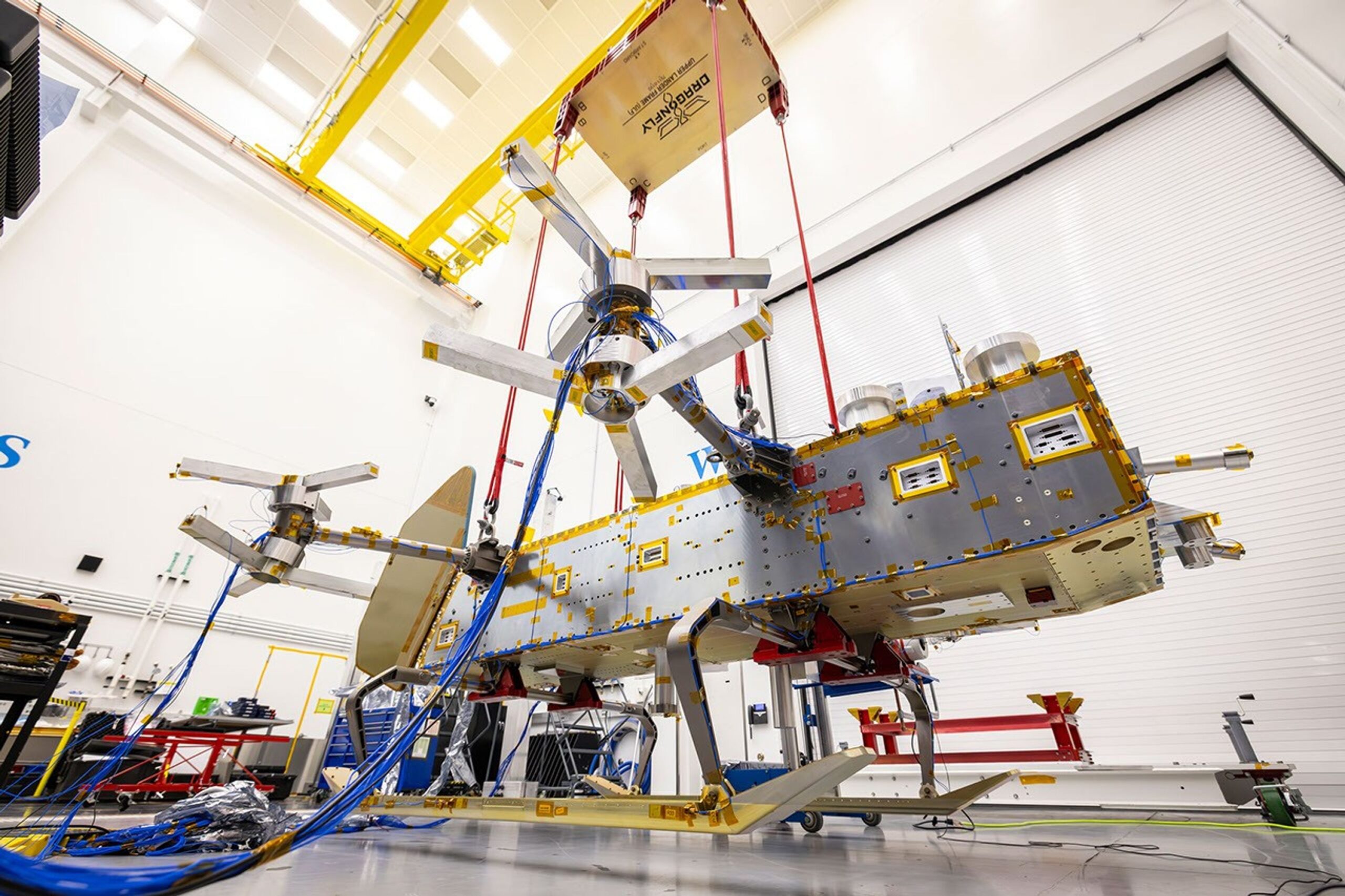
NASA Dragonfly is not a normal rover and it is not already flying on Saturn’s moon Titan. It is a future rotorcraft mission now being assembled and tested on Earth. NASA’s July 9, 2026 update says the nearly 13-foot-long fuselage cleared structural work, was delivered for the next integration phase, and began receiving its mechanical, thermal, and electrical systems.
The memorable part is the shape. Dragonfly will use eight rotor sets to move a full science payload between locations on Titan. A wheeled rover can study only the ground it can cross. A rotorcraft can land, sample one area, then fly miles to a different kind of terrain during the planned mission.
The harder story is the environment. NASA describes Titan as intensely cold, dusty, and dense enough at the surface to produce about 1.5 times Earth’s pressure. Liquid methane rain may fall. Dragonfly must keep that atmosphere out, keep instruments warm, survive its own rotor vibration, and point a radio beam across the solar system.
BTI did not test Dragonfly, inspect private mission data, or attend the assembly work. This guide translates NASA’s public sources checked on July 12, 2026. Future dates, designs, and mission plans can change as testing continues.
NASA Dragonfly quick answer
Dragonfly is a large robotic drone designed to become a mobile laboratory on Titan. NASA plans for it to launch no earlier than July 2028 and reach Titan in late 2034. Once there, the rotorcraft is intended to fly to several sites, study surface material and the atmosphere, and investigate chemistry connected with habitability and the steps that came before biology on Earth.
The July 2026 news is narrower but important. The main frame now looks like the vehicle NASA intends to fly. Engineers completed structural tests, including a suspended vibration test and a sealing test, before starting the long process of adding wiring, electronics, instruments, insulation, and the remaining flight hardware.
That is why the current photographs look unfinished. They show flight structure and real test work, not a finished consumer drone. Artist concepts on NASA’s mission pages show the planned Titan configuration and are labeled as concepts rather than current photos.
Six NASA Dragonfly facts in plain English
This table keeps the current build milestone, the future mission, and the science goal separate.
| Question | What NASA says | What it means |
|---|---|---|
| What changed in July 2026? | NASA says the nearly 13-foot fuselage cleared structural testing, was delivered June 29, and entered systems integration July 1. | Dragonfly is becoming one assembled flight system rather than a collection of separate parts. |
| How does it move? | NASA lists eight sets of 53-inch coaxial rotor blades for repeated flights across Titan. | It is a flying science lab that can land, inspect a site, and move to another one. |
| What is Titan like? | NASA describes average temperatures near minus 290 degrees Fahrenheit, surface pressure about 1.5 times Earth’s, dust, and possible liquid methane rain. | The vehicle must fly, seal, communicate, and stay warm in an environment no consumer drone faces. |
| How does it call Earth? | A 34.4-inch high-gain antenna raises while Dragonfly is stopped and locks down before flight. | The large dish focuses the radio link, then folds away so rotor vibration does not damage or disturb it. |
| When does it travel? | NASA lists launch no earlier than July 2028 and arrival at Titan in late 2034. | The July 2026 milestone is an Earth-based build and test update, not footage from Titan. |
| What is the science goal? | Dragonfly will study Titan’s habitability and chemistry, including processes that may have happened before biology emerged on Earth. | It is not a confirmed-life mission and it has not found life. It will investigate the chemical conditions. |
Why send a drone instead of another rover?
A rover is limited by slopes, rocks, soft ground, and the speed of its wheels. Dragonfly is designed to carry its instruments through the air. NASA’s mission overview says the planned 3.3-year campaign can cover miles and stop at different locations, including dunes and Selk Crater.
Titan helps make that possible. Its atmosphere is dense, so a rotor has more gas to push. Titan’s gravity is lower than Earth’s, so the vehicle needs less lift for the same mass. Those two conditions do not make flight easy. The rotors, motors, structure, navigation, and power system still have to work in extreme cold, far from repairs or real-time piloting.
The plain-English tradeoff is mobility versus complexity. Flight can reach more kinds of terrain, but every takeoff adds vibration, navigation, energy, and mechanical risk. Dragonfly therefore needs to be both aircraft and lander. It must perform science while stopped and protect itself before moving again.
What eight rotor sets change
NASA lists eight sets of 53-inch coaxial blades. Coaxial means two blades can share one rotor position, one above the other. The arrangement creates a wide flying platform around the central body.
The July test update does not claim that the complete flight rotor system flew. Engineers suspended the structure inches above the floor and measured how vibration at future rotor locations traveled into the body and sensors. That gives the team evidence about resonances before delicate instruments and electronics are fully integrated.
Think of resonance as a repeated shake that matches the natural rhythm of another part. A small vibration can grow when the timing lines up. Engineers need to find those paths while they can still adjust mounts, structure, software, or operating limits.
Why engineers pressurized the spacecraft on Earth
Many spacecraft spend most of their working life in vacuum or in a very thin atmosphere. Titan is different. NASA says surface pressure is about 1.5 times Earth’s. The team pressurized Dragonfly’s outer structure and measured how air moved through gaps, cracks, or holes.
This does not mean Dragonfly is a crew cabin. The sealing result feeds thermal analysis. Titan’s atmosphere can move cold gas through the structure and pull heat away from electronics. Engineers need a measured leak rate before they can model whether insulation and internal heating will keep each system inside its operating limits.
The source also mentions possible methane rain and swirling dust. The current test does not prove every future weather condition has been cleared. It is one part of a larger qualification program.
Why the antenna folds before every flight
Dragonfly’s high-gain antenna is a 34.4-inch disc on a motorized arm. NASA says it raises while the rotorcraft is stationary to focus a radio beam toward Earth. It lowers into a lock before flight.
A large dish is useful for communication but awkward beside spinning rotors. Locking it down helps it survive flight vibration and prevents its movement from resonating through the body. The July photographs show the actual antenna hardware and locking mechanism during integration.
The radio link will not feel like a live video call. Titan is far from Earth, so signals take a long time to travel. Dragonfly must carry out planned work with onboard systems and send science data during communication windows.
How Dragonfly gets power so far from the Sun
NASA’s spacecraft page says Dragonfly will use a Multi-Mission Radioisotope Thermoelectric Generator, commonly shortened to MMRTG. The system turns heat from radioactive decay into electricity. Similar power sources support the Curiosity and Perseverance rovers on Mars.
Titan receives much less sunlight than Earth. Its hazy atmosphere reduces the light reaching the surface further. A radioisotope power source can produce electricity and useful heat without depending on bright daily sunshine.
This is not a limitless battery. Mission teams still budget energy across instruments, heating, communications, and flight. Dragonfly is expected to spend time stopped, perform science, communicate, recharge its flight battery, and then move again.
What Dragonfly will actually investigate
Titan has a thick nitrogen atmosphere, carbon-rich chemistry, water ice, dunes, and liquid hydrocarbons on its surface. NASA wants to understand whether environments there can show chemical steps related to habitability and the processes that preceded life on Earth.
Dragonfly will carry cameras, weather sensors, a drill and sample system, a mass spectrometer, a gamma-ray and neutron spectrometer, geophysical sensors, and other instruments. The rotorcraft can compare material from more than one location instead of treating a single landing site as the whole moon.
The careful boundary matters: NASA describes Dragonfly as a mission to investigate prebiotic chemistry and habitability, not as a mission that has detected life. The spacecraft has not launched, reached Titan, or returned a scientific measurement from the moon.
What the July 2026 milestone does not prove
Structural testing does not prove that the full spacecraft is ready to launch. Systems integration, instrument delivery, environmental testing, software validation, launch preparation, the long cruise, Titan entry, descent, landing, and flight all remain ahead.
The photographs do not show Dragonfly flying. One test suspended the body on bungee cords so engineers could measure vibration paths. NASA described that moment as structurally similar to a first flight, not as an actual powered flight.
The mission schedule is also a plan. NASA currently lists launch no earlier than July 2028 and arrival in late 2034. Hardware discoveries, launch readiness, or mission decisions could move those dates.
How BTI evaluated the NASA Dragonfly update
BTI checked NASA’s July 9 integration report, the current mission overview, the spacecraft and instrument page, and NASA’s multimedia library on July 12, 2026. We separated completed Earth-based tests from planned Titan work and kept all dimensions, dates, temperatures, pressure, and mission capabilities attributed to NASA.
We did not infer performance from artist concepts. Concepts are used only to help readers picture the planned mission. Current assembly photographs are identified as real hardware. We did not add a price, rating, review, award, product availability claim, independent benchmark, or investment conclusion.
This article has no affiliate links because Dragonfly is a government science mission, not a checked consumer product offer.
NASA Dragonfly FAQ
Is NASA Dragonfly already on Titan?
No. NASA is assembling and testing Dragonfly on Earth. The mission page lists launch no earlier than July 2028 and arrival at Titan in late 2034.
How many rotors will Dragonfly have?
NASA lists eight sets of coaxial rotor blades. The blades are planned to measure 53 inches, or 1.35 meters, across each rotor set.
Why can a drone fly on Titan?
Titan has a dense atmosphere for the rotors to push and lower gravity than Earth. Flight is still difficult because the hardware must work in extreme cold, dust, and possible methane rain without repair.
Will Dragonfly search for life?
NASA describes the goal more carefully. Dragonfly will investigate habitability and chemistry that may illuminate steps before biology. It has not found life, and it is not presented as a confirmed-life mission.
Why does Dragonfly use nuclear power?
Sunlight is weak at Titan and filtered by its haze. NASA plans to use an MMRTG, which converts heat from radioactive decay into electricity and also supplies useful warmth.
Official NASA sources
- NASA Dragonfly July 2026 integration and test update: The July 9 build milestone, fuselage size, vibration and sealing tests, antenna design, and Titan environment details.
- NASA Dragonfly mission overview: The official future-mission status, launch and arrival timing, planned flight campaign, and science purpose.
- NASA Dragonfly spacecraft and instruments: NASA’s rotor, radioisotope power, communications, camera, drill, and science-instrument overview.
- NASA Dragonfly multimedia library: Official current assembly photographs and clearly labeled artist concepts used to show the planned Titan mission.
BTI final take
The simple Dragonfly map is worth saving: eight rotor sets move the lab, a folding dish calls Earth, a radioisotope generator supplies power and heat, and the body must survive minus-290-degree conditions plus possible methane rain.
The July milestone makes the idea tangible. This is no longer only an illustration of a drone on another world. Engineers are assembling the structure that NASA intends to send. The honest excitement comes with a timeline: build and test now, launch no earlier than 2028, arrive in 2034, then let the science begin.
Follow BTI for the next plain-English tech breakdown
BTI turns current tech stories into simple buyer and science explainers without claiming hands-on testing, prices, ratings, or availability.