
AI infrastructure explainer
AI Factory Tokens Explained: Why NVIDIA and SK Telecom Use the Term
The simple version: an AI factory is a data center built to turn data, electricity, chips, and software into tiny pieces of AI answers.
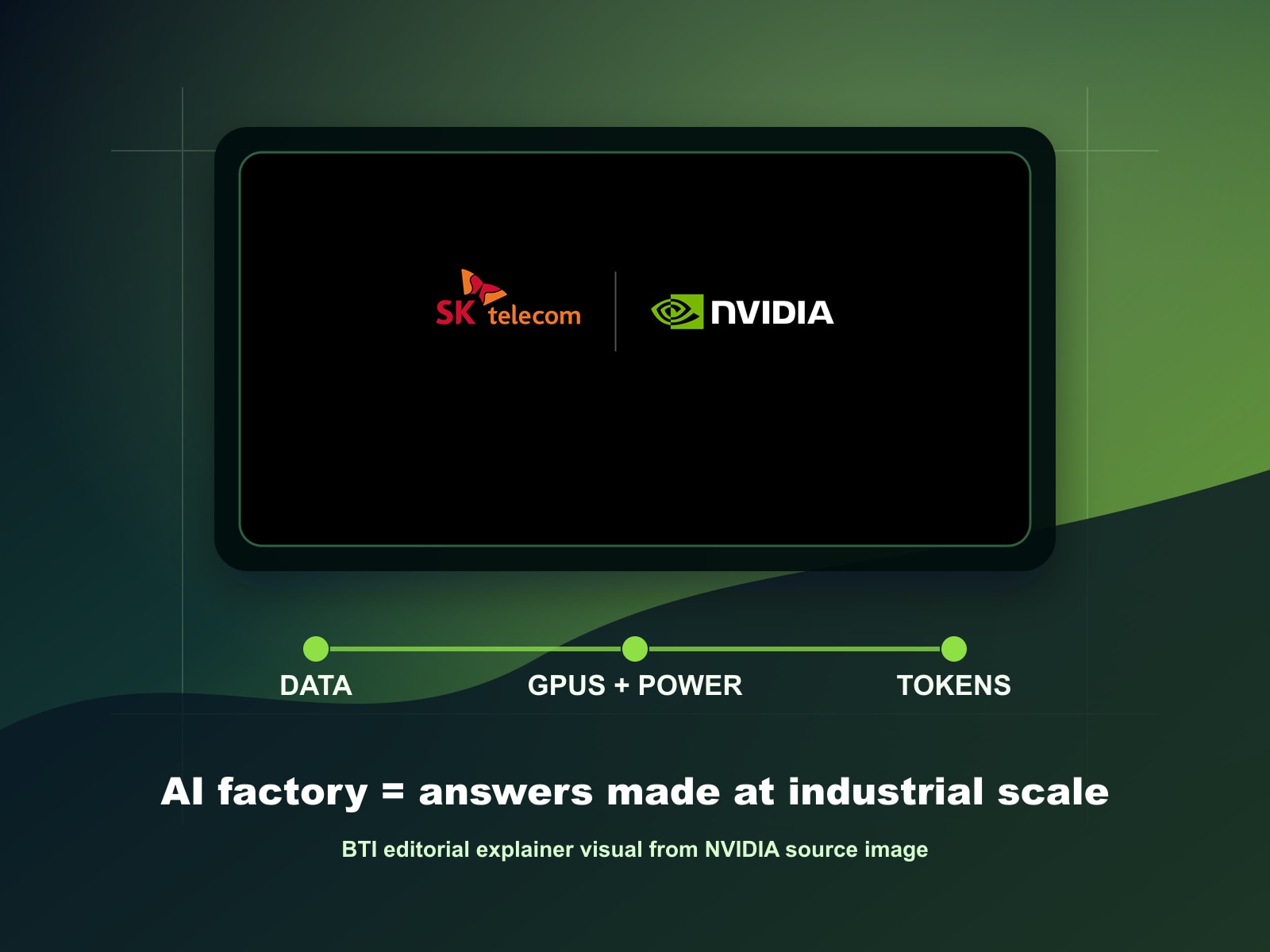
AI factory tokens sound like investor-language until you translate the phrase. NVIDIA and SK Telecom described a Korea AI Cloud built around AI factories, NVIDIA DSX architecture, and token performance per megawatt. The normal-reader version is simpler: this is industrial infrastructure for making AI answers at scale.
A factory usually turns raw material into a product. An AI factory turns data and prompts into tokens. Tokens are the small pieces that make up AI output: words in a response, code pieces in a coding assistant, labels in a vision system, or instructions in an agent workflow.
The idea also explains why a story about Google renting SpaceX compute can belong in an AI explainer, not only a space or business feed. The surprising part is not the rocket brand. It is that modern AI depends on whoever can assemble chips, power, cooling, networking, operations, and reliable capacity at huge scale.
BTI did not test NVIDIA DSX, inspect SK Telecom’s future infrastructure, verify deployment readiness, or make investment, price, availability, performance, or endorsement claims. This guide explains the public source material in plain English so readers can understand the current AI-infrastructure story without needing data-center vocabulary first.
- AI factories are data centers tuned for AI workloads, not consumer gadget factories.
- The output is not a phone or laptop. The output is tokens: tiny units that become AI answers.
- Power, cooling, GPUs, software, and data-center operations are now part of the AI product story.
BTI on InstagramNew tech, decoded in plain EnglishFollow @besttechinsight for quick breakdowns of products, chips, robots, EVs, and science. Full reviews and guides stay here on BTI.
AI factory tokens quick answer
An AI factory is a large system designed to produce AI output repeatedly and efficiently. It needs data, accelerator chips, networking, storage, electricity, cooling, software, security, monitoring, and people who can operate the whole thing. That is why the phrase shows up in stories about telecom networks, sovereign AI, enterprise AI, physical AI, and agentic AI.
The useful translation is this: if a chatbot is the app you see, an AI factory is the industrial back room that makes the answers possible. The factory has to keep many machines working together while controlling cost, power, heat, reliability, and access.
| Piece | Plain-English role | Normal example |
|---|---|---|
| Data | The raw material an AI system learns from, searches, or uses as context. | A company may feed documents, images, sensor records, support history, code, or manufacturing data into AI workflows. |
| GPUs | The machines that do many AI math steps in parallel. | A normal computer chip handles general work. AI data centers use large groups of accelerator chips because AI work repeats huge amounts of math. |
| Power and cooling | The factory limit. More AI work needs more electricity and a plan to move heat away. | That is why the source material talks about megawatts, racks, facilities, and efficiency instead of only talking about chip names. |
| Software operations | The control layer that keeps the factory running, shared, monitored, and updated. | This includes request scheduling, hardware health checks, workload management, and keeping many customers or teams separated. |
| Tokens | The tiny pieces of AI output that become words, code, summaries, labels, and instructions. | When a chatbot writes an answer, it is producing tokens step by step. At scale, those tokens are the output the factory is built to make. |
What “tokens per megawatt” really means
The phrase sounds technical because it is measuring the factory, not the app. A token is a small piece of output. A megawatt is a large unit of power. Put them together and the question becomes: how much useful AI output can the infrastructure produce from a fixed amount of electricity?
That matters because AI is no longer only a model-size story. A company can have powerful models and still run into limits: electricity, cooling, hardware supply, network design, request scheduling, data security, and operational reliability. The bigger AI gets, the more the invisible infrastructure becomes part of the user experience.
For a normal person, the takeaway is not “memorize the metric.” The takeaway is: AI answers have a factory behind them. When AI features feel faster, cheaper, more private, more available, or more specialized, the reason may be better infrastructure rather than only a smarter app.
Why a Google and SpaceX compute story fits here
TechCrunch reported a Google and SpaceX compute arrangement tied to a large cluster of NVIDIA GPUs, CPUs, memory, and related components. BTI is not treating that as investment guidance or a product review. The useful reader takeaway is simpler: AI capacity is becoming infrastructure that companies can rent, reserve, operate, and build around.
That is why the “AI factory” label is helpful even if the phrase sounds strange. A rocket company, a telecom company, a cloud provider, or a chip company can all become part of the same AI-answer chain when they control enough data-center capacity, power planning, specialized chips, networking, and operations.
For Instagram, the cleaner hook is not “tokens per megawatt.” It is: why would Google rent AI chips from SpaceX? The answer is the same map: data goes in, chips and power do work, software keeps requests moving, and small answer pieces come out.
Could AI data centers move into space?
The current SpaceX angle is bigger than one launch clip. Space.com and Axios both covered the idea of orbital data centers: put computing hardware on satellites, use large solar arrays for power, connect systems with optical links, and send data back to Earth. That is a fascinating beginner hook, but it should stay in the “planned and debated” bucket.
The plain-English version is this: space has sunlight and room, but servers still make heat. On Earth, data centers use air, liquid systems, buildings, maintenance crews, and power-grid planning. In orbit, hot electronics have no air around them, so the system needs radiators, launch capacity, repair plans, reliable links, and a reason the work can tolerate the trip through space.
That makes this a strong BTI explainer, not a hype post. Start with the question people can picture: can AI factories leave Earth? Then show the three checks: power is attractive, cooling is hard, and maintenance is much harder when the server rack is flying above the planet.
Why SK Telecom and NVIDIA are a good example
This story is useful because it connects AI to something people already understand: networks. Telecom companies already run critical infrastructure. They know data centers, enterprise customers, national connectivity, and reliability. NVIDIA brings the AI-computing architecture and software stack. The partnership is framed around building AI Cloud capacity in Korea, with the first AI factory planned for 2027 in the source material.
That does not mean BTI is predicting timelines, performance, or business outcomes. It means the source gives readers a clear example of where the AI industry is heading: from demo apps toward industrial systems that support companies, factories, robots, agents, and national AI services.
This is also why a better Instagram post should not say “AI is getting bigger” and stop there. The stronger hook is concrete: NVIDIA and SK Telecom are talking about AI factories that make tokens. That phrase is odd enough to earn the first swipe, and simple enough to translate in one carousel.
What not to overclaim
Do not treat an AI factory announcement as proof that every promised AI feature is ready, cheap, local, or available to normal consumers. Infrastructure announcements often describe plans, architecture, capacity, partnerships, and goals. They are not hands-on reviews of a product someone can buy today.
Do not make this a stock, price, or winner-loser story either. BTI’s safer angle is educational: explain the vocabulary, show the simple map, and help readers understand why chips, power, data centers, and software operations keep showing up in AI news.
AI factory FAQ
What is an AI factory?
An AI factory is data-center infrastructure built and operated for AI workloads. Instead of making physical goods, it produces AI output from data, prompts, compute, power, and software systems.
What is a token in AI?
A token is a small unit of AI input or output. In plain English, tokens are the little pieces an AI model uses to read and produce answers, code, labels, summaries, and instructions.
Why does power matter so much?
AI workloads run on large groups of chips that need electricity and cooling. When companies talk about tokens per megawatt, they are asking how much AI output the factory can produce within a power limit.
Is this a product recommendation?
No. This is a plain-English explainer based on public source pages. BTI is not recommending a purchase or making performance, price, availability, review, or investment claims.
Sources for this AI factory tokens guide
This guide uses public NVIDIA source pages and is written as an educational explainer. It does not make testing, price, rating, stock, availability, award, endorsement, or investment claims.
- NVIDIA and SK Telecom press release: The June 7, 2026 source describes an NVIDIA-powered AI Cloud in Korea, the NVIDIA DSX platform, AI factories, tokens, and token performance per megawatt.
- NVIDIA DSX platform page: NVIDIA describes DSX as software and architecture for designing, simulating, and operating AI factories.
- NVIDIA AI factories page: NVIDIA frames AI factories as data-center infrastructure optimized for AI workloads and tokens per megawatt.
- TechCrunch Google and SpaceX compute report: The report connects SpaceX, Google, and a large NVIDIA-based compute cluster, which is useful context for why AI infrastructure is becoming a mainstream tech story.
- Space.com SpaceX AI satellites explainer: Space.com reports SpaceX’s described AI-satellite plan and frames orbital data centers as still notional rather than demonstrated operating tech.
- Axios space data centers explainer: Axios explains why orbital data centers attract attention and why heat, launch cost, upgrades, and maintenance remain hard problems.
- SpaceX Starlink 17-54 mission page: SpaceX’s current launch page gives the near-term Starlink context without turning this article into a launch-success claim.
BTI final take
The most interesting phrase in the NVIDIA and SK Telecom announcement is “AI factory” because it changes the mental model. Modern AI is not only a chat app. It is an industrial system where data, chips, software, power, cooling, and operations all shape the answer you finally see.
Save the simple map: data goes in, GPUs do the work, power sets the limit, software keeps the factory moving, and tokens come out as AI answers.