
Chip science explainer
Apple Broadcom Custom ASIC Agreement Explained: Why Devices Need Helper Chips
The simple version: modern devices are not powered by one magic chip. They use a team of main chips and helper chips.
The Apple Broadcom custom ASIC agreement is useful because it turns a supplier filing into a plain hardware lesson. Broadcom says it will develop and supply custom ASIC silicon. The silicon is for multiple generations of Apple products through 2031.
That sounds corporate. The simple version is easier. An ASIC is a chip built for a specific job. It is not the same as a general chip that tries to handle many jobs. If one task repeats a lot, a company may tune helper silicon around that task.
BTI did not inspect private deals, test an Apple device, review Broadcom silicon, verify future Apple features, or make a market claim. This guide turns public source material into a safe mental model. Your device is a system, not one chip.
- The filing supports a custom ASIC supply relationship through 2031.
- It does not name future Apple devices, features, benchmarks, prices, or availability.
- The useful reader lesson is how helper chips work beside the main processor.
Apple Broadcom custom ASIC quick answer
Broadcom and Apple expanded a long-running tech collaboration. The new agreements run through 2031. The public filing says Broadcom will develop and supply custom ASIC silicon products. It says those products are for multiple generations of Apple products. In plain English, that points to custom helper chips. It does not point to a specific future Apple feature BTI can confirm.
The useful move is to separate the famous main chip from the quiet helper chips around it. A phone, laptop, watch, headset, or tablet can need a main processor, graphics hardware, radios, sensors, memory, power, security blocks, and custom accelerators. The system is what the user feels.
| Part | Plain-English meaning | Buyer-safe read |
|---|---|---|
| CPU | The main brain for many kinds of work. | This is usually the chip name people know in phones, tablets, and computers. |
| GPU | A chip built for graphics and repeated math jobs. | Useful for graphics, creative apps, and some AI work, but it is not the only chip that matters. |
| NPU | A neural chip aimed at AI-style tasks. | Look for supported apps and real results before treating an NPU number as a buying verdict. |
| ASIC | A chip tuned for one narrow repeated job. | The agreement is about custom helper silicon, not a named Apple feature buyers can check today. |
| System | The chip, radios, memory, sensors, software, power, heat, and services working together. | What users feel usually comes from the whole system, not one headline chip. |
Why devices need helper chips
People usually talk about the main processor because it has the cleanest name. Apple has made that even more visible with its own chip branding. But the headline chip is not the whole device. Wireless, displays, cameras, microphones, storage, security, charging, and AI features all depend on smaller parts working together.
A helper chip can make sense when the job is narrow and repeated. The chip does not need to be good at everything. It needs to be good at the job it was built for. That can mean moving signals, handling a connection, supporting sensors, speeding up one type of math, or working with the main system chip.
This is why the Broadcom and Apple story is more useful than a stock headline for BTI. The filing is current. The lesson lasts longer. Premium devices depend on custom silicon choices that many buyers never see on a spec card.
What ASIC means without the jargon
ASIC stands for application-specific integrated circuit. The phrase sounds intimidating, but the idea is simple. Application-specific means the chip is shaped around one use. Integrated circuit means the parts are built into silicon. Put together, an ASIC is a chip made for one narrow purpose.
That does not make an ASIC better than every other chip. It means the tradeoffs are different. A general processor is flexible. A custom ASIC is focused. A GPU is parallel. An NPU targets AI-style math. A radio chip may care about signals and power. The right question is: what job is this chip tuned for?
For Instagram, this is the clean first-swipe payoff. Frame 1 can ask why Apple would need custom helper chips. Frame 2 should translate ASIC. Then the post can talk about edge AI, speed, or future products with better context.
What the filing actually supports
The SEC filing is short, so BTI should keep the conclusion short too. It supports three core points. Broadcom and Apple expanded a long-standing tech collaboration. The agreements run through 2031. Broadcom will develop and supply custom ASIC silicon products for multiple generations of Apple products.
The filing does not tell readers which Apple products will use which silicon. It does not say a future device is confirmed. It does not give a benchmark, feature list, price, battery result, or retail timeline. That absence matters because it keeps the explainer honest.
| Source point | Safe meaning | Do not assume |
|---|---|---|
| Collaboration extends through 2031 | Broadcom and Apple say the relationship now runs under new multi-year agreements. | Do not turn the date into a promise about a specific iPhone, Mac, watch, headset, or feature. |
| Custom ASIC silicon products | The filing supports custom helper chips built around specific jobs. | Do not claim BTI knows the chip design, benchmark, manufacturing plan, or product roadmap. |
| Multiple generations of Apple products | The agreement is framed broadly across future product generations. | Do not name future devices, release dates, prices, or availability unless Apple or Broadcom says so. |
| Edge AI appears in market coverage | Some coverage uses edge-AI context because custom silicon can help device-side work. | Do not treat the filing as support for a specific Apple Intelligence feature or a measured AI speedup. |
Why this is not just an Apple AI rumor
Some public coverage will connect custom silicon with edge AI because device-side AI needs efficient chips. That context is fair as a category discussion. It is not proof that a named Apple feature, device, or benchmark is coming from this filing.
BTI should use edge AI as one possible example of why custom silicon matters, not as a confirmed result. A chip tuned for a narrow job could support AI, connection work, sensing, security, or another repeated workload. Without specific source language, the safest phrasing is “custom helper chips can matter for device-side workloads.” Do not assign a named Apple AI feature to the filing.
This makes the post more trustworthy. It lets BTI cover the current Apple and chip story without pretending to know private product plans.
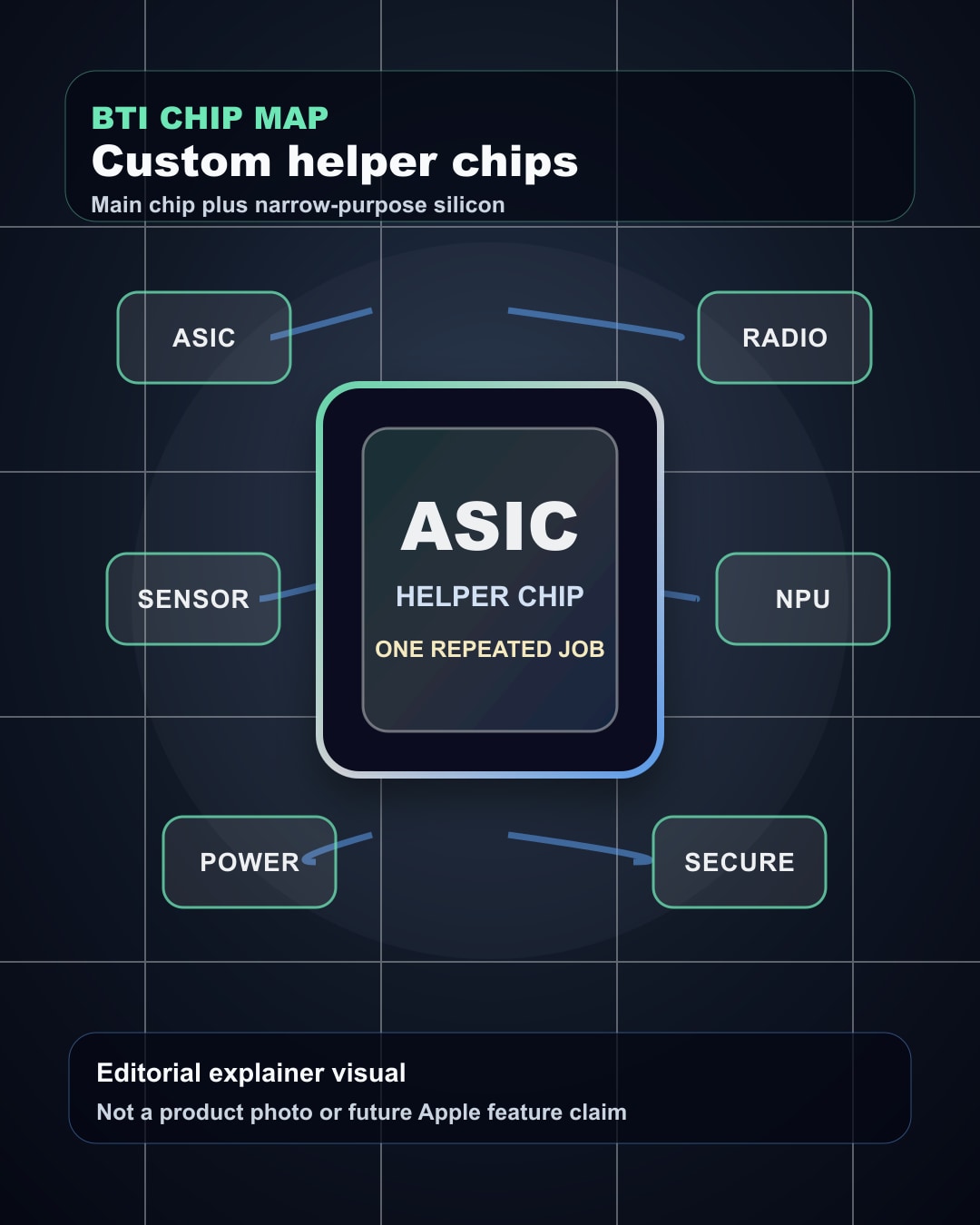
The simple map: main chip plus helpers
The easiest mental model is a small team. The main chip is the lead generalist. It coordinates many jobs and gets the biggest label. Helper chips are specialists. One may focus on a signal. One may focus on security. One may focus on sensors, memory movement, or a repeated compute task.
That is why a device can feel better even when a buyer cannot point to one visible chip. Faster wake time can come from system work. So can steadier wireless, better battery handling, more private processing, or smoother camera features. The user sees the result. The engineering sits underneath.
For a buyer, the rule is simple. Do not buy based on the phrase custom silicon alone. Ask what the device ships with, which feature it improves, whether independent reviews test the result later, and whether the product solves your real problem.
What not to overclaim
Do not turn the Apple Broadcom agreement into a device prediction. Do not claim a future iPhone, Mac, watch, iPad, headset, or AI feature unless a source names it. Do not claim BTI verified chip speed, power, manufacturing, design details, supply volume, or Apple roadmap timing.
Also avoid market framing in the Instagram post. The viral version should be a beginner hardware explainer, not a share-price reaction. BTI can say the public filing exists and explain ASICs. BTI should not tell readers what to do with Apple or Broadcom securities.
Apple Broadcom custom ASIC FAQ
What is a custom ASIC?
A custom ASIC is a chip designed around a specific repeated job. It trades broad flexibility for focus around the task it was built to handle.
Does the filing name a new Apple product?
No. The filing says custom ASIC silicon products for multiple generations of Apple products, but it does not name a future product, feature, release date, price, or benchmark.
Is an ASIC the same thing as a CPU, GPU, or NPU?
No. A CPU is a general processor, a GPU is strong at parallel work, an NPU targets AI-style workloads, and an ASIC is tuned for a narrower specific application.
Should buyers change what they buy because of this?
No. Treat this as a hardware explainer and future-supply story. Buy current devices based on shipped features, independent reviews, support, app fit, and return policy.
Sources for this Apple Broadcom ASIC guide
BTI used public source material. BTI did not perform device testing, chip testing, performance benchmarks, price research, review scoring, availability checks, or market analysis for this guide.
- Broadcom Form 8-K at the SEC: The July 6, 2026 filing source for the 2031 timeline and custom ASIC wording.
- Broadcom investor Form 8-K PDF: Broadcom-hosted copy of the same filing, useful as the company-side document record.
- Broadcom custom silicon overview: Broadcom’s custom-silicon page explains the broader ASIC design category.
- Reuters coverage via AOL: Public news coverage used only for context around the agreement.
BTI final take
The best version of this story is not “Apple has a mystery chip.” It is simpler and more useful: modern devices need helper chips. The Broadcom filing gives BTI a current reason to explain what an ASIC is. It also shows how to separate source-backed facts from future-product guesses.
Follow BTI for the next plain-English tech breakdown
BTI turns current tech stories into simple buyer and science explainers without claiming hands-on testing, prices, ratings, or availability.