
GPT-6 models: Astra, Sol and Luna explained
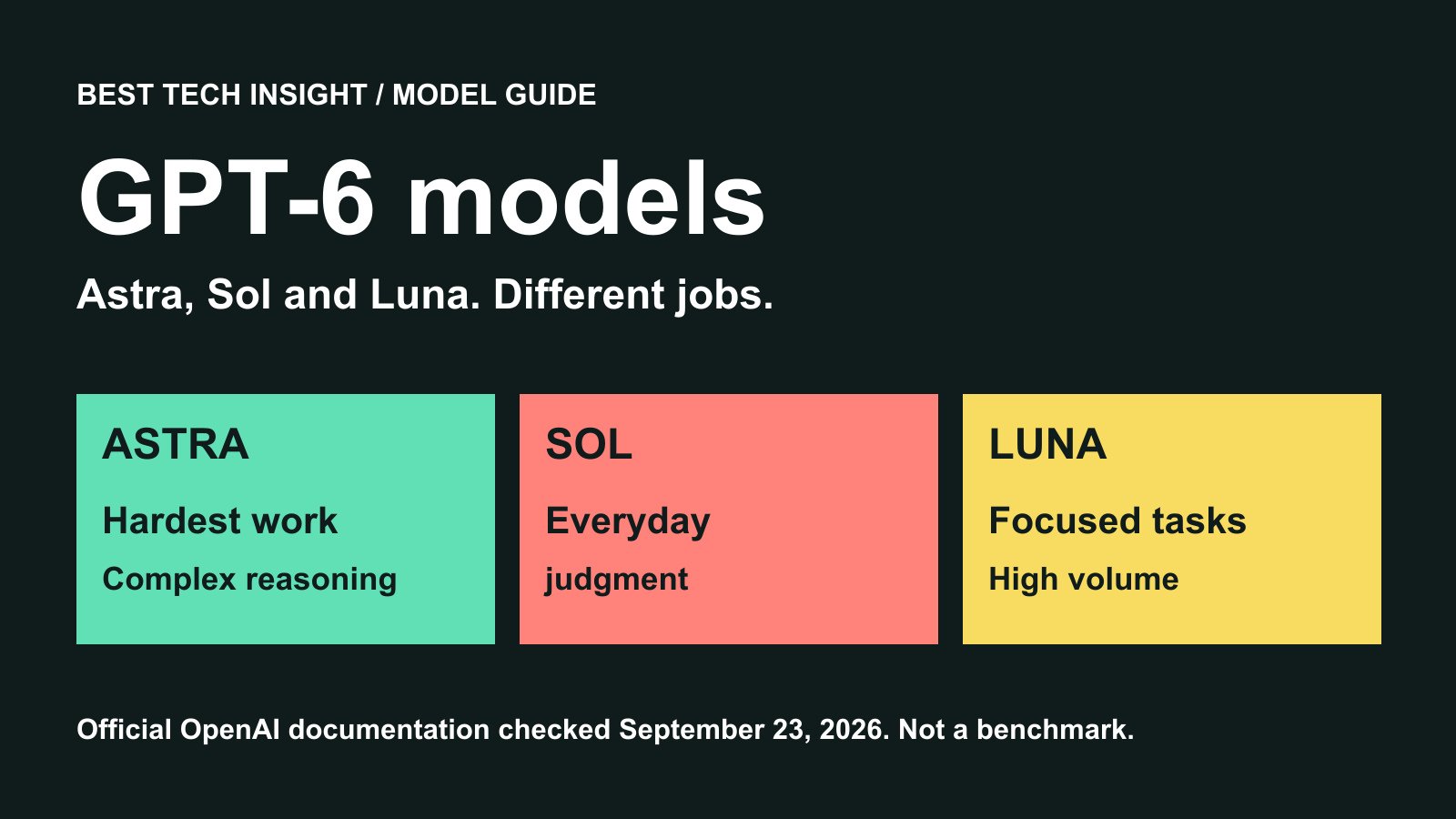
Which GPT-6 model should you use? Start with the job you need help with. Astra is the option to consider for a hard problem with lots of moving parts. Sol is the everyday all-rounder. Luna is worth trying for a small, clearly defined job you need to repeat.
Remember the first letters: A = Ambitious work. S = Standard daily work. L = Little jobs repeated often. These are BTI memory aids, not official model names or limits. Their abilities overlap, and all three can make mistakes. The point is to choose a useful starting place, then check the answer.
This guide follows the documented GPT-6 models. The options you see in ChatGPT or Codex can depend on your account and the product. The examples below do not promise access, a particular speed or a perfect result.
Want the quick version next time?
Follow @besttechinsight for fast, source-backed explanations of new products, chips, AI, robots, EVs, and science. The detailed guide stays here on BTI.
The difference in one everyday situation
Imagine you are organizing a community event. You need to work out a tricky plan, write a clear invitation, and sort the replies. One event, three different kinds of help. Use that picture to remember the models; you do not need to memorize a specification sheet first.
GPT-6 models at a glance
| Model | Memory aid | Try it for |
|---|---|---|
| GPT-6 Astra | A = Ambitious work | Working out a plan when the budget, venue and schedule conflict |
| GPT-6 Sol | S = Standard daily work | Writing the invitation and turning your notes into a schedule |
| GPT-6 Luna | L = Little jobs repeated often | Pulling names and meal choices from each RSVP into a table |
The roles follow OpenAI’s model-selection guide. The memory aid and event examples are BTI editorial explanations, not independent tests. These are starting points, not exclusive jobs: Astra can write an invitation, and Luna is not limited to sorting lists.
Astra: A is for Ambitious work
GPT-6 Astra is OpenAI’s most capable option. Think of it when the question is hard to untangle, the instructions leave important choices open, or the answer has to account for several competing needs.
For the event, imagine three venues with different capacities, fees and opening times. You also need a rain plan. Ask Astra to work through the trade-offs using the information you provide. A useful prompt is: “Compare these three venue quotes against our budget, guest count and schedule. Explain what we would give up with each option, and flag missing facts.”
Remember: complicated problem, consider Astra. A long prompt is not automatically a hard problem; a short question with conflicting requirements can be harder. Check the quotes and the reasoning before making a booking. No model can guarantee that it caught every detail.
Sol: S is for Standard daily work
GPT-6 Sol is a useful all-rounder for writing, planning and coding. It also supports more involved tool-based work. “Standard” is our memory cue, not a claim that Sol can only do basic tasks.
For the same event, you have chosen the venue and know the facts. Try Sol for an invitation that sounds welcoming and a schedule people can follow. A useful prompt is: “Turn these confirmed details into a friendly invitation under 150 words. Keep the date, address and RSVP deadline exact. Then make a simple run-of-show.”
Remember: everyday work, start by trying Sol. You still need judgment about tone, order and what matters, but you are not asking it to solve the whole event from scratch. Review the result for missing details and invented information.
Luna: L is for Little jobs repeated often
GPT-6 Luna is designed for focused work where efficiency matters. “Focused” means the task has clear boundaries: pull out these fields, apply these labels, or make this specific edit.
For the event, try Luna for turning RSVPs into a table. A useful prompt is: “For each reply, extract the guest name, number attending and meal choice. Write ‘not stated’ when something is missing. Do not guess.” Test a few replies first, including a confusing one, before processing the rest.
Remember: a little job done lots of times, consider Luna. Repetition is the memory cue; you can also use it for a single well-defined task. If a reply needs interpretation, flag it for review instead of silently making a decision.
Try remembering it without looking
Which would you try for each job: a plan with conflicting requirements, an everyday invitation, and the same three fields from every reply? Our starting choices are Astra, Sol, Luna. Say it back as Ambitious, Standard, Little. You are learning how to match a task, not memorizing a ranking.
So why not always use Astra?
It is reasonable to try Astra broadly when capability matters more than usage or waiting time. But its standard API rates are higher. Luna has the lowest listed rates of these three, and Sol sits between them. The practical choice is the setup that does the job well enough at a cost and wait you can accept. Check real outputs; a cheaper answer that needs repeated repair may not be a better deal.
API pricing: the difference is substantial
The API lets software send requests to a model. Tokens are small pieces of text used to measure that usage; they are not the same as words. If you just use a chat app, this table is optional background, not your subscription bill.
OpenAI lists these standard, short-context text-token API prices per one million tokens. Input is what you send; output is what the model produces. These are not monthly ChatGPT subscription prices.
| Model | Input / 1M tokens | Output / 1M tokens |
|---|---|---|
| GPT-6 Astra | $10 | $50 |
| GPT-6 Sol | $2 | $10 |
| GPT-6 Luna | $0.10 | $0.50 |
Rates checked September 24, 2026 against OpenAI’s API pricing page. For prompts above 272,000 input tokens, the listed GPT-6 long-context multipliers apply to the whole request: 2x input and 1.5x output. Cached input, cache writes, processing modes and tool charges have separate rules. Check the current page before budgeting.
For a simple illustration, 10,000 standard input tokens plus 2,000 billed output tokens would cost $0.20 on Astra, $0.04 on Sol or $0.002 on Luna. This arithmetic excludes tools, caching and long-context pricing. It is not a promise of the final cost of a task; different models or reasoning settings may use different numbers of tokens.
A shared context limit is not shared capability
Think of context as the model’s working desk: how much material fits in the current task, not how skillfully the model will use it. It is not the same as permanent memory. OpenAI’s model comparison lists a 1,050,000-token context window and a maximum 128,000-token output for each of these three API models. A bigger desk is not proof of a better answer.
All three list text and image input with text output. Direct audio and video are not listed as supported modalities on these model pages. A product can combine a model with separate tools, so do not confuse a tool-enabled app feature with a model’s direct input or output format. Application limits can also differ from the API specifications.
Reasoning effort is a separate decision
Use a second memory aid: model = which helper; effort = how much thinking budget. It is a loose analogy, not a stopwatch or a guarantee. Choosing more effort can change the usage and time a task needs, without changing which model you selected.
The model pages list low, medium, high, xhigh and max reasoning effort for Astra. Sol and Luna additionally list none. These are API options, not a guarantee that every interface presents the same controls.
Choose a model for the kind of work, then evaluate the effort setting. Turning up Luna’s effort does not turn it into Astra. Start with a repeatable task, hold the instructions steady and compare correctness, completion time and billed usage. Do not judge a setting only by whether its answer sounds more elaborate.
What this comparison does not establish
BTI has not independently benchmarked these models for this guide. We are not claiming a universal winner, a measured speed ratio or a guaranteed cost saving for your workload. Model access, tools and limits in ChatGPT and Codex depend on the product and account. API prices do not establish what a consumer plan includes.
For important workflows, build a small test set from real tasks, including failures you already understand. Decide what counts as acceptable before running the comparison. Keep sensitive information and permissions appropriate to the environment, and retain human review where mistakes have meaningful consequences.
What the evidence supports
This comparison uses OpenAI’s separate model specification pages, model-selection guidance, pricing table and comparison tool. The source links sit beside the relevant claims and are collected below. They establish documented roles, rates and limits as of the check date, not measured results on BTI’s workload.
Keep the A, S, L reminder
Astra: Ambitious work. Sol: Standard daily work. Luna: Little jobs repeated often. For the event: work out the tricky plan, write the invitation, sort the replies. The models overlap; this is a shortcut for deciding what to try, not a rule about what each can do.
- Write down the required output and how you will check it.
- Try Sol for mixed everyday work, Luna for tightly scoped repeated work, or Astra for especially difficult reasoning.
- Compare the same representative tasks, including edge cases.
- Keep the least costly setup that consistently meets your quality bar; escalate failures deliberately.
Save the companion comparison on BTI’s Instagram guide hub. The useful question is not “Which name is best?” It is “Which model reliably completes this job at an acceptable cost?”
Frequently asked questions
Which GPT-6 model should I try first?
Sol is a reasonable starting point for varied work requiring judgment. Evaluate Luna for clearly scoped repeated tasks and Astra when the problem is especially complex. Check the result against your own criteria.
Is Luna just Astra with less reasoning?
No. They are separate models. Reasoning effort is an additional setting, not a way to convert one model into another.
Do A, S and L officially stand for these words?
No. Ambitious, Standard and Little are BTI’s memory aid. They are not OpenAI’s official expansions of the model names.
Are these ChatGPT subscription prices?
No. The table describes API token rates. It does not describe monthly plans or confirm account-level model access.
Does a million-token context guarantee accurate recall?
No. Context capacity describes an input limit, not a guarantee of accurate use of every detail. Test retrieval and reasoning on your actual material.
Sources and editorial method
Official OpenAI developer documentation checked September 24, 2026. Model roles and limits are source-based; memory aids, analogies, workflow examples and the selection routine are BTI editorial guidance. No affiliate links, third-party visual assets or independent performance measurements are used.