
Physical AI explained
Carbon Robotics LaserWeeder G2 Explained: How It Tells Lettuce From Weeds
A camera sees plants, software decides what should stay, and a laser targets the weed’s growth point. The difficult part is making that decision correctly at field speed.
How does a laser-weeding machine avoid lasering the lettuce? That question gets to the real engineering inside the Carbon Robotics LaserWeeder G2. The machine does not simply fire at anything green. Cameras photograph the row, computer-vision models classify crops and weeds, targeting software selects a weed’s growth point, and lasers apply heat at that location.
The explanation is timely because Carbon Robotics CEO Paul Mikesell is listed as a speaker at AUTONOMOUS, a physical-AI conference scheduled for July 16, 2026 in San Francisco. The event connection does not make LaserWeeder G2 a new July launch, and the public event page does not promise a new product announcement or a live LaserWeeder demonstration. Carbon introduced the modular G2 line in 2025.
This guide translates Carbon Robotics’ current public product and technology pages, checked July 12, 2026. BTI has not operated the machine, inspected its private training data, verified its error rate, witnessed a field trial, or confirmed performance on a particular farm. Hardware counts and performance figures below are manufacturer specifications unless explicitly described otherwise.
Carbon Robotics LaserWeeder G2 quick answer
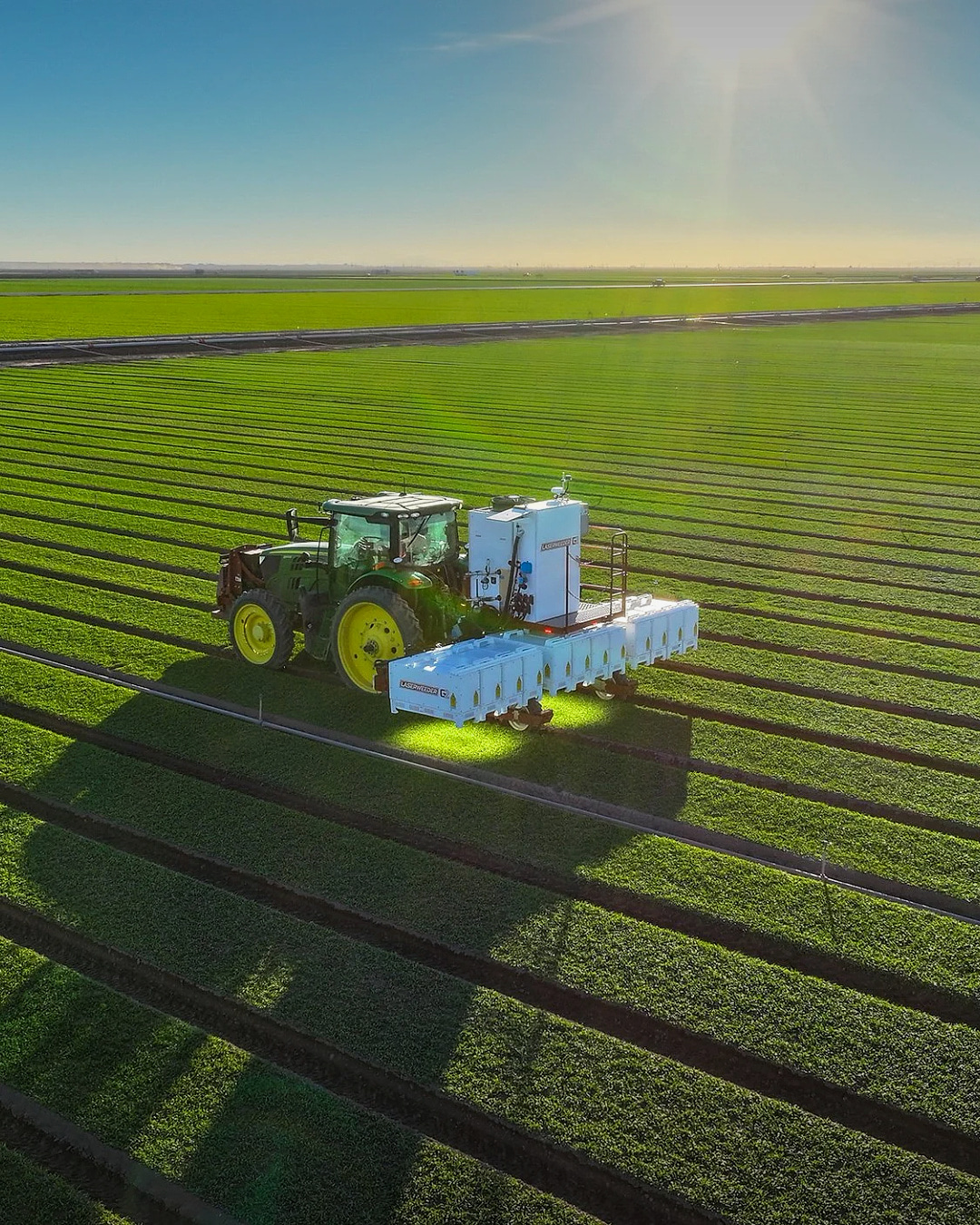
LaserWeeder G2 is a tractor-mounted agricultural implement. Its sealed modules carry cameras, lights, GPUs, and lasers across crop rows. The cameras produce images. The GPUs run models that separate the chosen crop from unwanted plants. The targeting system aims at the meristem, the small area of plant tissue responsible for new growth. A laser then delivers thermal energy to that point.
The lettuce stays because the software is instructed to treat lettuce as the crop. A weed is targeted because the model classifies it as a plant that should not remain in that field profile. That sounds simple when reduced to one sentence, but it depends on image quality, model training, crop selection, weed pressure, plant overlap, field conditions, calibration, and operator controls.
The honest answer is therefore not that AI makes mistakes impossible. The system is designed to make a crop-versus-weed decision before firing, and Carbon publishes sub-millimeter targeting language. A farm evaluating it should still ask for measured results in its own crop, soil, row spacing, growth stage, and operating conditions.
How LaserWeeder G2 sees, thinks, and fires
| Stage | What Carbon states | Plain-English meaning |
|---|---|---|
| 1. Light the row | Twenty LED lights per sealed G2 module support operation in different field-light conditions. | The cameras need a consistent view instead of depending only on sunshine. |
| 2. Photograph plants | Three high-resolution cameras per G2 module capture the crop bed. | The machine first sees shapes and pixels, not a label that already says crop or weed. |
| 3. Classify | Two NVIDIA GPUs per module run computer-vision models across more than 100 crop models. | Software estimates which plant should remain and which growth point is a weed target. |
| 4. Aim | The system places a target on the weed’s meristem, the growth tissue that produces new plant cells. | The target is a small growth point, not the whole green area around it. |
| 5. Fire | Two 240W lasers per G2 module apply thermal energy to the selected weed target. | Heat damages the weed’s growth point while the crop is meant to remain untouched. |
| 6. Record and adjust | Carbon’s operator tools report field, crop, weed, coverage, and machine data, while Plant Profiles can tune model behavior for a field. | Classification is an operating system that must be configured and monitored, not magic vision. |
Step one: make the plants visible
Computer vision begins with light. A camera cannot classify a leaf edge or growth point that it cannot see clearly. Carbon lists 20 LED lights inside each G2 weeding module and describes operation during the day or night. The lights create a more controlled view under the implement while the surrounding field changes from bright sun to shadow.
Each module is listed with three high-resolution cameras. Their job is to turn a moving crop row into a stream of images. A useful image must preserve enough detail to separate leaves, stems, soil, residue, overlapping plants, and the target area while the tractor is moving.
This is why the machine’s large frame is only part of the story. The visually interesting work happens close to the soil, where lighting, optics, vibration, dust, mud, plant motion, and timing all affect what reaches the model.
Step two: decide which plant belongs
Carbon says the camera feed goes to onboard computer-vision models that identify crops and weeds. The current G2 page lists two NVIDIA GPUs per module and more than 100 crop models. The GPU does not know what lettuce is in the human sense. It performs many calculations on the image and produces a classification and target location based on learned patterns.
Carbon’s current AI page describes a Large Plant Model trained on 150 million labeled plants collected across 15 countries, with support language covering more than 100 crops. Those are company-stated dataset and coverage figures, not a BTI audit of the labels or a guarantee for every field.
The page also describes Plant Profiles. An operator can select two or three photos to define local crop and weed conditions, after which the system adjusts model behavior for that field. That detail matters because the same species can look different by growth stage, variety, soil, weather, camera angle, or damage. A broad model supplies a starting point; the field profile tells the system what the operator wants it to protect and target now.
Step three: aim at the growth point, not the whole plant
After classification, the system needs a coordinate. Carbon describes its laser as applying thermal energy to the weed’s meristem. The meristem is growth tissue where new plant cells form. Damaging that small area can stop regrowth without pulling the plant or disturbing the soil around it.
That is the beginner-friendly reason precision matters. The machine is not trying to burn an entire patch of green. It is trying to place energy on a selected point inside a plant that has already been classified as a weed. If the classification or target location is wrong, precision alone does not fix the decision. Classification and targeting must both be right.
The G2 page uses sub-millimeter detection language. Treat that as a Carbon specification. Ask for the measurement method, crop conditions, confidence thresholds, miss rate, crop-injury rate, and what the operator sees when confidence is low.
Step four: apply heat with a sealed laser module
Each G2 module is listed with two 240W lasers. Carbon describes the module as self-contained and fully sealed, with liquid cooling and a 21-inch shoot width. The energy is applied to the selected weed target while the implement travels through the field.
The published safety label is important: LaserWeeder G2 is a Class 4 laser product with invisible laser radiation. A Class 4 label is not a decorative technical detail. Direct or scattered exposure can be hazardous to eyes or skin. The equipment’s physical enclosure, interlocks, operating procedures, maintenance controls, exclusion zones, training, and manufacturer instructions are therefore part of the product, not optional extras.
BTI is not providing laser-safety certification or operating instructions. A prospective operator should obtain the current manual, site requirements, training plan, service procedures, and applicable workplace rules directly from Carbon Robotics and qualified safety personnel before use.
What one complete G2 400 configuration contains
Per-module numbers can feel abstract, so Carbon’s G2 400 page provides a useful named example. It lists eight modules, 16 x 240W diode lasers, 24 high-resolution cameras, and 160 LED lights. It also lists more than 100 AI crop models and a maximum of 6,667 weeds shot per minute.
Those figures describe the G2 400 configuration on the manufacturer page. They are not independent BTI measurements, and the maximum weeds-per-minute figure is not the same as a promised acres-per-hour result in every field. Carbon lists a coverage range of 0.80 to 1.60 acres per hour for that model, which will depend on the operating setup and conditions.
The broader G2 family runs from 8-foot to 40-foot models. Carbon labels them G2 200, 300, 400, 600, and 1200. More width and modules can cover more rows, but they also change tractor, lift, power, transport, field-layout, service, and capital requirements. This is industrial equipment sold through contact sales, not a consumer product with a simple add-to-cart comparison.
What can make crop-versus-weed decisions difficult?
A crop leaf can overlap a weed. Dust can cover a surface. A young crop can resemble a weed. Plants can be damaged, wet, windblown, partly hidden, or outside the growth stages represented in training data. A field can contain volunteer crops that look valid to a general species model but are unwanted in the current row.
Those examples are normal computer-vision edge cases, not claims that LaserWeeder G2 fails in each condition. They are the conditions an evaluator should include in a representative field trial. Ask what happens when confidence is low: does the system skip the target, flag it, slow down, or use an operator setting?
Also ask for crop injury and missed-weed measurements, not only weeds treated per minute. Speed is useful when the crop remains protected. The decision threshold should fit the farm’s tolerance for a missed weed versus an incorrect shot.
A practical evaluation checklist
Start with the exact crop, variety, row spacing, soil type, weed mix, growth stages, weather, and tractor that will be used. Request an uncut field pass rather than a short highlight clip. Mark sample areas before the pass and count crop plants, weeds treated, weeds missed, and any visible crop injury afterward.
Review the operating workflow: who selects the crop profile, who can change targeting parameters, how software updates are controlled, what data leaves the farm, how a machine is stopped, and what happens after a sensor, network, cooling, or laser fault. Ask how service access and remote support are logged.
Finally, build the economics from local evidence. Use the quoted machine and service terms, expected annual acres, tractor and operator time, maintenance, transport, energy, current weed-control costs, crop value, and observed field results. Carbon publishes commercial benefit claims on its site, but BTI has not verified a payback period for a particular farm.
Why this matters before AUTONOMOUS 2026
AUTONOMOUS describes its July 16 event around robotics and physical AI, including perception, compute, sim-to-real work, and deployment. Paul Mikesell, Carbon Robotics’ CEO, appears in the official speaker list. LaserWeeder G2 is a useful concrete example of physical AI because the software decision immediately changes a real object in the world.
That physical action raises the standard above a screen demo. The system must see correctly, decide quickly, aim accurately, manage heat and vibration, protect people and crops, and keep working in a dirty outdoor environment. A convincing model output is only one component of the deployed machine.
No public event source checked for this article promises a new Carbon product launch or a LaserWeeder demonstration. BTI will treat any conference announcement as unconfirmed until a primary source publishes it.
How BTI evaluated LaserWeeder G2
BTI checked Carbon Robotics’ current G2 product page, laserweeding technology page, Carbon AI page, and G2 400 specification page on July 12, 2026. The product page supplied current per-module hardware, the technology page supplied the classification sequence, the AI page supplied model and field-profile descriptions, and one named configuration shows how module counts scale.
Every hardware, dataset, crop-coverage, accuracy, speed, and field-performance statement remains attributed to Carbon unless the sentence simply explains a general technical term. BTI did not convert manufacturer specifications into a review, score, award, purchase recommendation, safety certification, promised return, or investment conclusion.
This article has no affiliate links because BTI did not identify a checked public retail offer for the industrial product. The article exists to explain the system and improve the questions a buyer or operator asks.
LaserWeeder G2 FAQ
How does LaserWeeder avoid hitting lettuce?
Cameras capture the row, computer-vision models classify the selected crop and weeds, targeting software chooses the weed’s meristem, and lasers fire at that point. The crop profile tells the system which plant should remain. BTI has not independently measured its crop-injury or error rate.
Does LaserWeeder G2 use chemicals?
Carbon describes laserweeding as using thermal energy rather than herbicide at the targeted weed. A farm may still use other products or weed-control methods elsewhere in its operation.
Can it work at night?
Carbon says the G2 modules use bed-top LED lighting and are designed for day or night operation. Actual operating limits should be confirmed for the field, weather, crop, and model being evaluated.
Is LaserWeeder G2 autonomous?
The crop-versus-weed detection and laser targeting are automated, but G2 is a tractor-mounted implement with operator apps, configuration, monitoring, and safety procedures. Do not confuse automated weeding with a completely unattended machine.
Is the invisible laser safe?
The product carries a Class 4 invisible-laser warning, which means direct or scattered radiation can be hazardous. Use only the manufacturer’s current enclosure, interlocks, training, maintenance procedures, and qualified safety guidance. BTI has not certified the equipment.
Did LaserWeeder G2 launch in July 2026?
No. Carbon announced the modular G2 line in 2025. The July 2026 reason to explain it is the upcoming AUTONOMOUS conference and its speaker list, not a claimed new launch.
Primary sources
- Carbon Robotics LaserWeeder G2 product page: Primary source for current G2 module hardware, product sizes, laser warning, and company descriptions of operation.
- Carbon Robotics laserweeding technology: Primary source for the camera, onboard computer vision, crop-versus-weed classification, and meristem-targeting sequence.
- Carbon AI and Large Plant Model: Primary source for Carbon’s current descriptions of its training set, crop coverage, Plant Profiles, and operator tools.
- LaserWeeder G2 400 specifications: Primary source for one named configuration used to show how per-module hardware scales into a complete implement.
- AUTONOMOUS 2026: Official event page listing July 16, 2026 in San Francisco and Carbon Robotics CEO Paul Mikesell among the speakers.
BTI final take
The simple map is see, classify, aim, fire. Lights and cameras create the image. GPUs run crop models. Software chooses a weed’s growth point. A sealed laser module applies heat. The reason it does not simply laser the lettuce is that classification comes before targeting.
The most useful next question is not whether the machine looks futuristic. It is how often that full decision remains correct in the buyer’s real field, and what the system does when it is uncertain. That is where a physical-AI demonstration becomes operational evidence.
Follow BTI for the next plain-English tech breakdown
BTI turns current tech stories into simple buyer and science explainers without claiming hands-on testing, prices, ratings, or availability.