
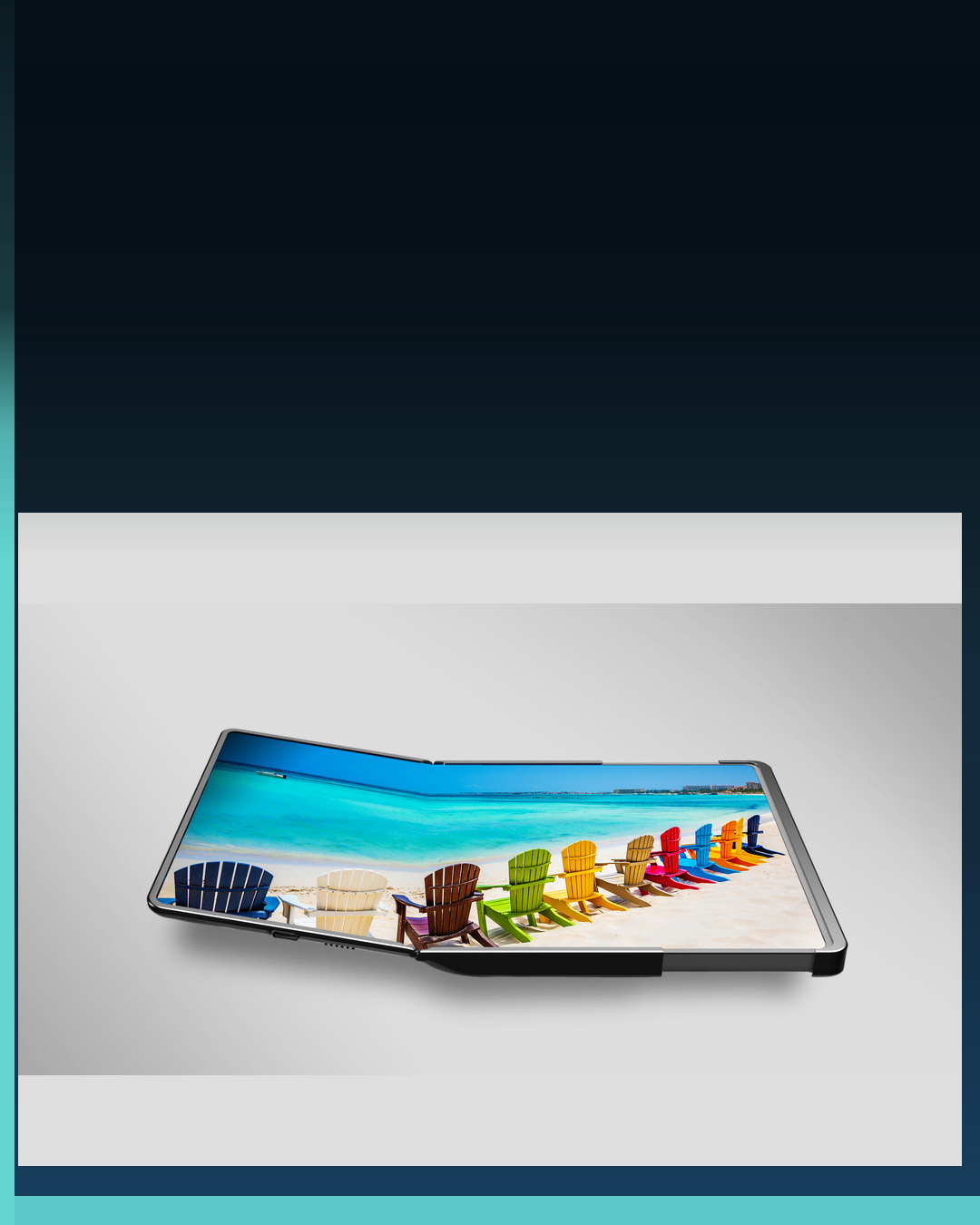
Samsung Display-hosted concept media in a BTI editorial composition. The image represents Samsung’s slidable OLED development family, not an announced retail phone.
New phone technology, plain English
Samsung Slidable Phone Concept: How 4.7 Inches Becomes 7.2
A working screen can slide wider before the complete phone is ready to survive pockets, drops, dust, apps, and years of use.
The Samsung slidable phone concept is easy to describe and harder to build. During a July 2026 visit to Samsung Display’s headquarters in South Korea, reporters saw a Flex Slidable concept with a 4.7-inch display expand to 7.2 inches. They also saw a Flex Hybrid concept that combined a folding section and a sliding section in one 7.2-inch design.
The immediate question is where the extra screen goes. It does not appear from nowhere. Part of the flexible OLED remains hidden inside the body when the concept is closed. As the frame extends, a controlled path feeds more of that panel into view. The visible screen becomes wider while the unused section stays curved or stored behind the structure.
That demonstration is real evidence of a working concept. It is not a product announcement. Samsung Display did not provide a retail model name, price, release date, battery size, camera system, repair policy, or durability result for a final phone. Samsung Display makes panels and supplies device companies. Samsung Electronics is the separate business that sells Galaxy phones.
Want the quick version next time?
Follow @besttechinsight for fast, source-backed explanations of new products, chips, AI, robots, EVs, and science. The detailed guide stays here on BTI.
Samsung slidable phone concept: the quick answer
A normal phone keeps its entire display exposed. A foldable changes the shape by bending the screen around a hinge. A slidable changes the visible area by keeping part of a flexible panel inside the body and guiding it outward when more screen is needed.
The July Flex Slidable demo reportedly started at 4.7 inches and reached 7.2 inches. That is roughly the move from a compact screen to a small-tablet-sized viewing area without opening a book-style hinge. A second concept, Flex Hybrid, combined a folding section with a sliding section.
The panel is only one part of a phone. A shipping device also needs a rigid frame, moving rails or another controlled extension system, touch sensing, a protective surface, antennas, cameras, speakers, a battery, cooling, software that redraws apps at changing sizes, and a way to keep dirt away from the stored screen. That system boundary explains why an impressive demo can still be far from a retail product.
What was demonstrated, and what remains unknown
| Evidence | What was observed | What it means | What remains unknown |
|---|---|---|---|
| Flex Slidable concept shown July 2026 | A 4.7-inch screen expanded to 7.2 inches in a reporter demonstration. | Samsung Display has a working concept that stores part of a flexible OLED inside the body. | Product name, final mechanism, release date, price, battery, cameras, durability, and repair plan. |
| Flex Hybrid concept shown July 2026 | A second 7.2-inch concept combined a folding section with a sliding section. | Folding and sliding can be combined to change both the shape and visible screen area. | Whether the extra complexity can meet consumer-device thickness, weight, and reliability targets. |
| Samsung Display’s earlier Slidable Flex family | Samsung-hosted media shows one-way and two-way expandable OLED concepts. | The July demonstration belongs to a longer development path, not a one-day rendering or rumor. | Which earlier design lessons, dimensions, or components carry into a future phone. |
| Executive readiness boundary | Samsung Display executives described the slidable form as difficult and did not announce a shipping device. | A working panel demo can exist before the complete phone is ready. | When or whether Samsung Electronics or another customer will commercialize this exact concept. |
The 4.7-inch and 7.2-inch figures come from a July 15 firsthand report of Samsung Display’s demonstration. They are concept dimensions, not specifications for a retail Galaxy phone.
Where the hidden OLED goes
OLED panels can be made on thin, flexible layers because every pixel produces its own light. A slidable design uses that flexibility without asking the user to fold the device in half. The unseen part of the display follows a broad curve inside or behind the frame. When the frame moves, the panel travels with it and exposes a larger flat section.
Think of a paper map moving through a wide, gentle turn rather than a sheet being sharply creased. The curve still matters. Bend it too tightly or pull it unevenly and layers can deform. A useful mechanism must keep tension even across millions of pixels while the touch layer and protective surface stay aligned.
Samsung Display’s official Slidable Flex images show one-way and two-way concepts, while its Flex Hybrid media shows a screen that both folds and extends. Those images establish the development family. They do not prove that every concept uses the same motor, rail, backing plate, cover material, or internal routing.
Slidable, foldable, rollable: the simple difference
| Form | What moves | Main benefit | Main engineering question |
|---|---|---|---|
| Slidable | Part of the screen moves out from storage inside the body. | A compact device gains more visible area without a book-style opening motion. | Can the panel travel smoothly while resisting dust, uneven tension, and impact? |
| Foldable | The screen bends around one or more hinges. | A large screen closes into a smaller footprint. | Can the crease, hinge, cover, and layers survive repeated folds and drops? |
| Rollable | A longer section winds around a curved path or spool. | A much larger change in visible area may fit inside a compact enclosure. | Can the roll stay thin, evenly tensioned, protected, and fast enough for daily use? |
| Flex Hybrid | One region folds while another slides. | More than one screen shape is possible from one device. | Can two moving systems remain thin, light, durable, and affordable together? |
The panel is ready before the phone is ready
A concept can prove the optical part first. The screen lights, responds, and changes size. A retail phone must repeat that motion in a pocket, on a desk, in heat and cold, after a drop, and around lint or grit. The mechanism cannot pinch the panel, expose a sharp edge, or create a distracting ridge.
Space is another problem. The stored screen and moving frame compete with the battery, cameras, speakers, antennas, wireless-charging coil, and cooling hardware. Making the body larger can solve some packaging problems, but it weakens the compact-phone benefit that makes the concept interesting.
Software must also understand the changing canvas. An app should not restart, lose a draft, stretch controls, or hide a button when the screen expands. Video may benefit immediately, while keyboards, games, camera previews, split-screen work, and one-handed use need separate decisions. A bigger panel is useful only when the interface changes well with it.
Five tests that would matter before buying one
- Dust and pocket test: Does grit reach the stored panel, rails, or edge seal?
- Extension-cycle test: Does the screen remain flat and aligned after repeated opening and closing?
- Drop and pressure test: What happens when the device is extended, partly extended, or closed?
- Battery and heat test: How much power does the larger active area and moving mechanism use?
- App-resize test: Do common apps, games, video, keyboards, and multitasking layouts adapt without restarting?
Those questions are more valuable than guessing a release date. They separate a display demonstration from the daily experience a buyer would actually own.
Why Samsung Display is not the same as a new Galaxy phone
Samsung Display develops and manufactures display technology. Samsung Electronics builds and sells Galaxy devices. The companies work together, but Samsung Display also supplies other device makers. A panel concept can therefore show what the component business can make without confirming which customer will use it.
This distinction matters during the week before a product event. Samsung has separately confirmed Galaxy Unpacked for July 22, 2026, but the slidable demonstration does not establish that a 4.7-to-7.2-inch phone will appear there. Treating a display concept as an event leak would turn evidence into speculation.
The useful conclusion is narrower and stronger: Samsung Display showed reporters a working slidable screen concept and openly described unresolved commercialization work. The technology is physically understandable. The product decision remains open.
How BTI checked the Samsung slidable claims
BTI reviewed two independent firsthand reports published July 14 and July 15, 2026. Tom’s Guide supplied the 4.7-to-7.2-inch observation, the second 7.2-inch Flex Hybrid observation, and the executive comments about commercialization. TechRadar independently described the Samsung Display lab visit, flexible-display testing, the 7.2-inch concepts, and the difference between a display demonstration and a consumer device.
BTI then checked Samsung Display’s official Flex Hybrid release, official Slidable Flex Solo media, and official Flex OLED overview. Those manufacturer pages establish the concept family and supply the product imagery used in BTI’s original layouts. BTI did not reuse CNET, Tom’s Guide, or TechRadar footage, edits, captions, or music.
The topic was selected after a bounded public competitor sample found CNET’s July 14 Samsung Display Reel at 834 visible likes plus comments, 3.564 times its sampled account median and 3.674 times its sampled Reel median. Those public interactions are a directional packaging signal only. They do not reveal reach, retention, saves, shares, follows, watch time, cause, or proof of virality.
BTI did not visit the lab, inspect the prototypes, measure either display, operate the mechanism, or test durability. This article has no affiliate link because the demonstrated concepts are not verified retail products. No price, preorder, stock, release, review, rating, award, endorsement, or buying recommendation is implied.
What the July demonstration does not establish
- A Samsung Electronics product name, Galaxy model, launch date, price, preorder, or retail availability.
- The final extension mechanism, motor, rail, panel stack, cover material, battery, cameras, or software behavior.
- Dust resistance, water resistance, drop resistance, cycle life, crease visibility, repair cost, or warranty coverage.
- That the 4.7-to-7.2-inch concept will appear at Galaxy Unpacked or ship through Samsung or another brand.
- Any BTI hands-on test, benchmark, review score, product rating, award, endorsement, or affiliate recommendation.
What to remember
The extra screen is stored, not created. A flexible OLED follows a curved path inside the concept body. Extending the frame feeds more of that panel into view, changing the visible area from a reported 4.7 inches to 7.2 inches.
The demonstration answers one question: can Samsung Display make the panel move and light as a working concept? It leaves the buyer questions open: can a complete phone stay thin, clean, cool, durable, repairable, and useful while doing it?
Follow @besttechinsight for the next exact phone, chip, robot, AI product, or science demonstration decoded without the jargon. Related BTI guides cover what Samsung has actually confirmed for July 22, why car controls now affect Euro NCAP scores, and what Tornyol’s moth test did and did not prove.
Samsung slidable phone concept FAQ
Did Samsung announce a 4.7-to-7.2-inch phone?
No retail phone was announced in the sources reviewed by BTI. Samsung Display showed a working Flex Slidable concept to reporters.
Where does the extra display go when the concept is closed?
Part of the flexible OLED remains stored inside or behind the body along a curved path. The mechanism exposes more of that panel as the frame extends.
Is a slidable phone the same as a foldable phone?
No. A foldable changes shape around a hinge. A slidable changes how much of a flexible panel is visible by moving part of it out of storage.
Will Samsung show this phone at Galaxy Unpacked on July 22?
The demonstration does not prove that. Samsung has confirmed the event, but it has not connected this exact 4.7-to-7.2-inch concept to a shipping Galaxy product.
Can people buy the Samsung Flex Slidable concept?
BTI found no verified retail listing, price, preorder, or release date for the demonstrated concept. It should be treated as development hardware.
Sources
- Tom’s Guide: July 15 Samsung Display first look: Firsthand report for the 4.7-to-7.2-inch Flex Slidable demonstration, the 7.2-inch Flex Hybrid, and Samsung Display’s readiness boundary.
- TechRadar: July 14 Samsung Display lab tour: Independent firsthand account of the display lab, flexible-panel tests, 7.2-inch concepts, and executive comments.
- Samsung Display: Flex Hybrid and Slidable Flex press release: Manufacturer source for the fold-plus-slide concept family and official editorial imagery.
- Samsung Display media library: Slidable Flex Solo: Manufacturer-hosted photograph of Samsung Display’s one-direction expandable OLED concept.
- Samsung Display OLED Era: Flex OLED: Manufacturer overview of flexible, slidable, rollable, and foldable OLED form factors.
- CNET Instagram: Samsung Display headquarters Reel: Public competitor-format evidence used only to identify the current visual-event interest pattern.