
Space power explained
BOHR Nuclear Battery Explained: How a CubeSat Makes Power Without Sunlight
BOHR does not carry a tiny reactor. Its experiment turns the natural decay of tritium directly into a steady electrical current inside a semiconductor.
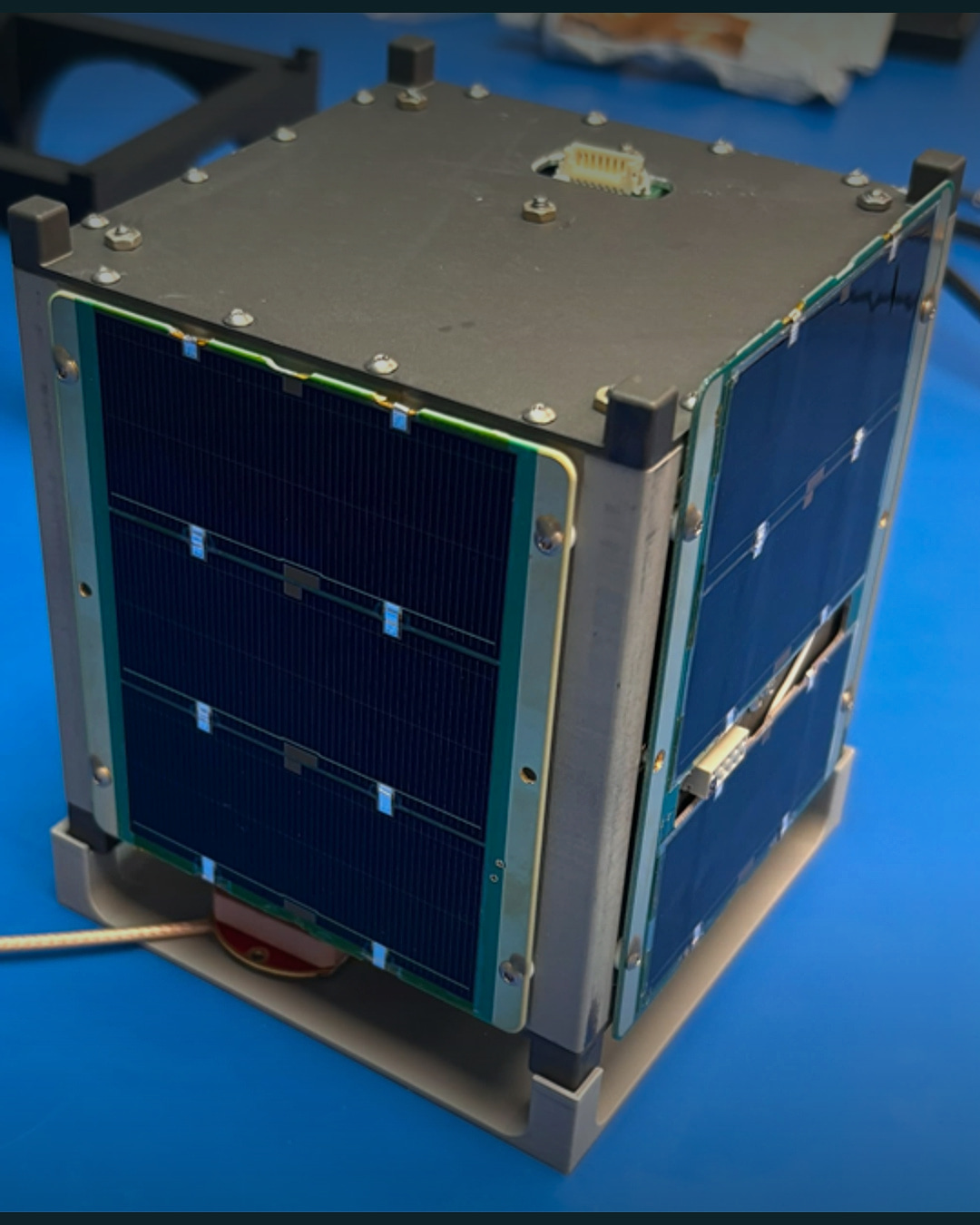
The BOHR nuclear battery is an orbital test of betavoltaic micropower. City Labs says its Betavoltaic Orbital High-Reliability CubeSat launched July 7, 2026 on SpaceX Transporter-17. The spacecraft carries a NanoTritium power source as a dedicated demonstration payload.
The headline needs one important correction before the science makes sense: the nuclear battery does not run every system on the CubeSat. City Labs says conventional solar power operates the satellite bus, while NanoTritium powers and validates the test payload. BOHR is therefore a flight demonstration of one power source inside a solar-operated spacecraft, not evidence that its small battery can propel a satellite or replace all onboard power.
The beginner map is tritium decays, beta particles move, a semiconductor absorbs their energy, and a small current flows. There is no chain reaction and no recharge cycle. The tradeoff is equally important: betavoltaics are designed for low, steady power over long periods, not the high power a launch vehicle, home, laptop, or spacecraft radio may need at peak load.
Want the quick version next time?
Follow @besttechinsight for fast, source-backed explanations of new products, chips, AI, robots, EVs, and science. The detailed guide stays here on BTI.
BOHR nuclear battery quick answer
Tritium is a radioactive isotope of hydrogen. The EPA lists its physical half-life as 12.3 years and says it emits a very weak beta particle. In a City Labs betavoltaic device, those emitted particles interact with a semiconductor structure. Their energy creates electrical current directly instead of first making heat, spinning a turbine, or charging a conventional battery.
That makes a betavoltaic closer in concept to a solar cell than to a reactor: both use a semiconductor to turn incoming particle energy into current. The input is different. A solar cell depends on light arriving from outside. A tritium betavoltaic receives a continuing stream of beta particles from radioactive decay inside a sealed power source.
City Labs has not published the BOHR payload’s exact voltage, current, total energy, or expected telemetry profile on the launch release. Its technology page lists specifications for named P100 and development-stage P200 products, but BTI does not transfer those numbers to BOHR without a source saying the payload uses that exact configuration.
Five reported facts, translated carefully
| Reported fact | What it means | What not to assume |
|---|---|---|
| Launched July 7, 2026 on Transporter-17 | The BOHR CubeSat reached its demonstration mission aboard a SpaceX rideshare launch. | Launch and deployment begin the test; they do not prove years of orbital output. |
| NanoTritium powers the demonstration payload | The nuclear battery supplies a dedicated experiment inside the spacecraft. | City Labs says the satellite bus still uses conventional solar power. |
| Tritium emits low-energy beta particles | A radioactive form of hydrogen releases energetic electrons as it naturally decays. | Low-energy radiation is not zero risk; containment, handling, review, and disposal still matter. |
| A semiconductor converts decay energy directly | The beta particles transfer energy into a semiconductor structure, producing a small electrical current. | This is not a fission reactor, a heat engine, or a rechargeable chemical cell. |
| BOHR output has not been published on the launch page | The mission is about validating steady micropower where sunlight or battery replacement can be difficult. | Do not apply another City Labs product’s voltage or current specification to the BOHR payload. |
Step one: radioactive hydrogen changes on its own
Ordinary hydrogen has one proton in its nucleus. Tritium adds two neutrons, making the nucleus unstable. Over time, individual tritium atoms transform through beta decay. The EPA describes the emitted radiation as weak beta particles and gives tritium a 12.3-year half-life, meaning half of a starting collection of tritium atoms will have decayed after that interval.
A half-life is not a promise that the battery delivers perfectly flat power for 12.3 years and then stops. Decay is gradual. Electrical output also depends on the amount and form of tritium, semiconductor design, conversion efficiency, packaging, temperature, radiation damage, and the electronics receiving the power. BOHR’s mission can help measure how the complete device behaves in orbit.
City Labs says it stores tritium in a solid metal-hydride platform rather than relying on compressed gas. That is a developer description of its architecture, not a general guarantee that every tritium device is safe under every accident or disposal condition.
Step two: the semiconductor catches the decay energy
Beta particles are energetic electrons. When they enter the semiconductor structure, they transfer energy into the material and create mobile electrical charge. The device’s internal electric field separates that charge so current can flow through a circuit. The process is called betavoltaic conversion.
Nothing has to burn, spin, or be recharged for the decay to continue. That simplicity is attractive for electronics that need a dependable trickle of power in places where changing a battery is expensive or impossible. It does not create energy from nothing: the source is the finite radioactive decay energy in the tritium, and output declines as the isotope decays and the device ages.
The word nuclear can make this sound like a miniature power plant. It is not. A fission reactor sustains a neutron-driven chain reaction and controls heat production. BOHR’s betavoltaic payload uses spontaneous radioactive decay and converts particle energy directly into electricity at a much smaller power scale.
What BOHR powers and what solar still powers
| BOHR system | Reported power source | Purpose |
|---|---|---|
| NanoTritium demonstration payload | Tritium betavoltaic | Generate and validate continuous low-level electrical output in orbit. |
| Satellite bus | Conventional solar power | Operate the CubeSat platform that carries, communicates with, and supports the experiment. |
| Launch vehicle | Falcon 9 propulsion | Carry BOHR and the other Transporter-17 payloads to their deployment path. |
This separation prevents the most tempting overstatement. The betavoltaic payload can demonstrate useful nuclear micropower without having enough output to run the entire spacecraft. The launch release does not publish a BOHR power budget, so BTI does not infer which bus subsystems could or could not run from a future scaled design.
Betavoltaic, RTG, and solar are three different power paths
| Power system | Energy path | Useful strength | Important limit |
|---|---|---|---|
| BOHR-style betavoltaic | Beta particles to semiconductor to current | Steady micropower without sunlight or charging | Low output; BOHR-specific performance is not yet public |
| NASA-style RTG | Plutonium-238 decay heat to thermocouples to current | Long-lived spacecraft electricity and heat | Larger nuclear system with a different isotope, conversion path, and mission process |
| Solar array | Photons to semiconductor to current | Substantial renewable power where illumination is available | Output changes with distance, angle, shadow, dust, and spacecraft orientation |
Nuclear power in space is not new. NASA and the Department of Energy have used radioisotope power systems for decades. City Labs calls BOHR the first commercial nuclear-powered satellite and the first nuclear CubeSat. That narrower company claim should not be rewritten as the first nuclear spacecraft ever.
Why a tiny current can still matter
A remote sensor may spend most of its life asleep, waking briefly to measure, timestamp, store, or transmit data. Memory retention, clocks, security electronics, and health monitors can also value continuity more than peak power. In those cases, a predictable trickle can reduce dependence on a chemical battery that self-discharges or a solar panel that enters darkness.
Space creates unusually hard replacement problems. A sensor in a permanently shadowed lunar region cannot count on direct sunlight. A deep-space craft receives less solar energy as distance increases. Distributed monitoring hardware may be inaccessible for years. A long-lived source can keep a small subsystem alive while another source handles high-power events.
Those are application reasons, not BOHR results. The mission still needs telemetry showing usable output, stability, degradation, temperature behavior, radiation tolerance, and communication with the spacecraft. A successful launch proves that the payload entered the test environment; it does not by itself validate a decades-long service life.
How BTI evaluated the BOHR story
BTI checked the City Labs July 7 launch release and technology overview, SpaceX’s Transporter-17 listing, the EPA tritium page, the FAA payload-review overview, and NASA’s radioisotope-power explanation on July 12, 2026. Company statements remain attributed, while the EPA, FAA, NASA, and SpaceX pages supply independent definitions and mission context.
An authenticated Instagram Business Discovery capture informed packaging only. Interesting Engineering’s July 12 BOHR Reel showed 896 likes and 10 comments at capture time, or 906 visible interactions. That count is not reach, plays, saves, shares, follows, watch time, causation, or proof of virality. BTI borrows only the concrete-object-first mechanic and uses original wording, official-source visuals, large integrated text, its own audio, and the solar-bus caveat the short headline can hide.
BTI did not build, handle, launch, inspect, or independently test BOHR. We did not audit its launch-safety analysis, payload authorization, telemetry, radiation containment, electrical output, lifespan, or commercial readiness. No affiliate link appears because this is an orbital technology demonstration rather than a checked retail offer. No Product or Review schema is used.
What remains unknown
- The exact NanoTritium configuration, tritium inventory, voltage, current, power, and energy delivered by BOHR.
- The payload’s telemetry cadence, temperature range, conversion efficiency, and degradation curve.
- How much of the demonstration operated immediately after deployment and what success criteria City Labs will publish.
- Whether a future design could power additional spacecraft subsystems without solar support.
- Complete independent safety, launch-accident, reentry, disposal, and lifecycle assessments for a scaled commercial fleet.
- Manufacturing scale, integration schedule, mission pricing, customer availability, and long-term operating record.
What to remember
BOHR is interesting because its power path is simple enough to picture: tritium decay, beta particle, semiconductor, current. It can make electricity without sunlight, charging, combustion, or a chain reaction.
The scale and system boundary matter just as much. NanoTritium powers the demonstration payload; solar power runs the satellite bus. Launching that experiment is a real commercial-space milestone, while long-duration orbital performance remains the measurement BOHR now has to produce.
Follow @besttechinsight for the mechanism behind the headline in plain English. Related BTI explainers cover how a ship caught Long March 10B in a net, why NASA is building an eight-rotor craft for Titan, and how FireSat looks for small fires from orbit.
BOHR nuclear-battery FAQ
Is BOHR carrying a nuclear reactor?
No. Its NanoTritium payload uses spontaneous tritium decay and a semiconductor to make a small current. It does not sustain a fission chain reaction.
Does the nuclear battery power the whole BOHR satellite?
No. City Labs says NanoTritium powers the demonstration payload while conventional solar power operates the satellite bus.
How does a tritium betavoltaic make electricity?
Tritium emits low-energy beta particles as it decays. Those particles transfer energy into a semiconductor structure, which separates electrical charge and produces current.
How long can tritium make power?
The EPA lists tritium’s physical half-life as 12.3 years. Actual device output declines over time and also depends on design, conversion efficiency, environment, and aging, so the half-life is not a flat-output warranty.
Is BOHR the first nuclear spacecraft?
No. Nuclear power has flown in space for decades. City Labs describes BOHR more narrowly as the first commercial nuclear-powered satellite and first nuclear CubeSat.
Has BOHR already proven decades of operation?
No. The July 7 launch placed the demonstration in orbit. Long-duration output, stability, degradation, and mission results still need measured telemetry and public reporting.
Sources
- City Labs BOHR launch release: Primary company source for the July 7 mission, the NanoTritium payload role, the solar-powered satellite bus, and the reported regulatory milestone.
- City Labs tritium and betavoltaic technology overview: Company explanation of tritium metal hydrides, beta-particle conversion, semiconductors, and current product-series boundaries.
- U.S. EPA tritium basics: Government source for tritium as a radioactive hydrogen isotope, beta radiation, and the 12.3-year physical half-life.
- FAA commercial-space payload review overview: Government context for what a commercial-space payload review considers; it is not independent proof of every City Labs performance or safety claim.
- NASA radioisotope power systems overview: Official context for the different RTG architecture, which converts plutonium-238 decay heat into electricity for spacecraft.
- SpaceX Transporter-17 mission page: Official launch listing for the July 7, 2026 Falcon 9 rideshare mission.