
Humanoid robotics explained
1X NEO Robot Hands Explained: Why Tendons and Touch Matter
The motors sit in NEO’s forearm, tendons pull its fingers, and touch sensors help the hand notice contact and slip. That explains the hardware. It does not make every demo autonomous.
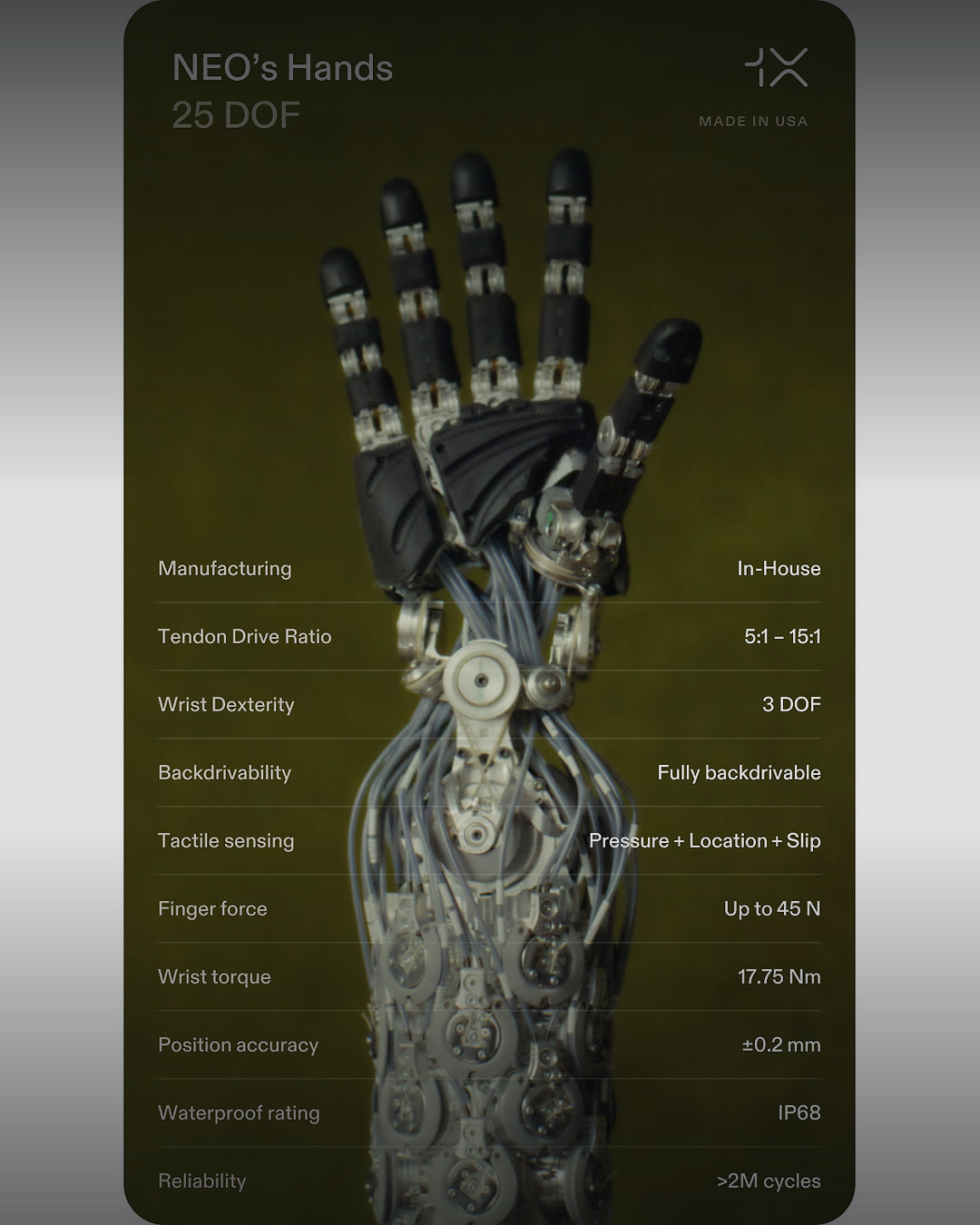
The 1X NEO robot hands are designed less like a rigid claw and more like a sensing instrument. 1X revealed them on July 9, 2026. The company described 25 powered degrees of freedom, motors in the forearm, tendon-driven fingers, low-ratio transmissions, force-controlled joints, and tactile skin.
The simple idea is motor pulls tendon, tendon bends finger, the joint feels resistance, and the skin notices contact or slip. Putting those pieces together can help a robot grip objects with different shapes and adjust when an object begins to move.
The launch montage is visually impressive, but it needs a clear evidence label. A 1X representative told WIRED that some clips were machine-articulated while others were operated to demonstrate the hardware’s upper limits. The footage is useful evidence of motion range, speed, sensing, and hardware capability. It is not a continuous test showing NEO independently choosing, completing, and recovering from every household task in the montage.
See the next robot breakthrough without the jargon
Follow @besttechinsight for visual breakdowns of robot hands, home robots, the chips behind them, and what product demos actually show.
1X NEO robot hands: the quick answer
A common robot gripper can open, close, pick, place, and push. A five-finger hand has to coordinate many more motions while also handling uncertain contact. The object may be soft, slippery, transparent, partly hidden, or slightly different from the object used during training.
1X’s answer is to give NEO 22 powered motions across the fingers and palm. Three more sit at the wrist. Low-ratio tendon drives make the fingers backdrivable. That means an outside force can move a finger backward through the mechanism. The motor can measure that reaction through the same drive. Tactile material adds pressure, contact-location, and shear information at the hand’s surface.
That architecture can provide richer data to the control software. It does not remove the software problem. The robot still needs perception, task planning, motion control, error detection, and recovery policies that can turn sensory data into reliable work.
Five facts translated without the hype
| Reported fact | What it means | What it does not prove |
|---|---|---|
| 25 degrees of freedom | 1X says 22 powered motions are in the fingers and palm, with three more at the wrist. | A motion count describes hardware articulation, not whether every household task is autonomous. |
| Forearm motors pull tendons | Moving motors away from the fingers can keep the hand lighter while cables transmit force through the wrist. | The architecture does not by itself establish lifetime, maintenance cost, or superiority over every robot hand. |
| Low-ratio, backdrivable joints | An outside push can move a finger backward through the drive instead of meeting a nearly locked gearbox. | Compliance can reduce impact force, but it is not a universal home-safety certification. |
| Tactile skin senses contact and shear | The hand can measure pressure, where contact happens, and sideways force that can signal a slipping object. | A sensor can provide useful data without proving that software will interpret every object correctly. |
| The launch clips used more than one control mode | A 1X representative told WIRED that some clips were machine-articulated and others were operated to show the hardware limit. | The montage demonstrates movement and hardware range; it is not one continuous autonomous chore test. |
Why put the motors in the forearm?
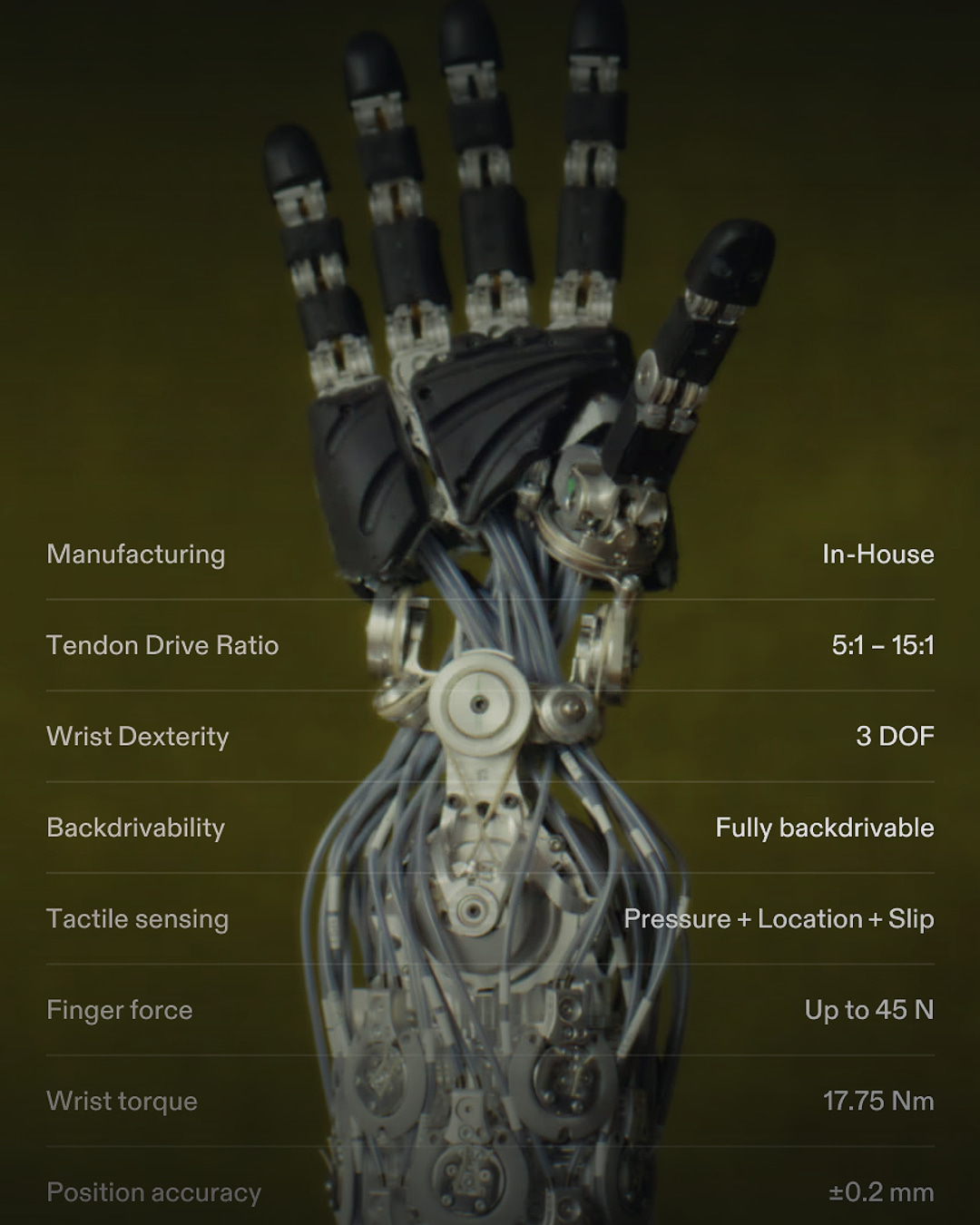
Electric motors take up space and add mass. A motor and high-ratio gearbox in every finger segment can make the hand bulky. The wrist and arm must then accelerate that extra mass. 1X instead places the motors in NEO’s forearm. Proprietary tendons run through the wrist to the hand.
Think of each tendon as a strong cable. A finger joint bends when a motor pulls the matching cable. Releasing or balancing tension lets it move the other way. Human tendons are living tissue. NEO uses engineered materials and motors. The analogy describes the force route, not a copy of a human hand.
The arrangement can keep more mass close to the arm and leave the fingers lighter. It also creates hard engineering questions. The team must manage tendon routing, friction, stretch, wear, replacement, calibration, and cable interference. 1X says it designs the motors, electronics, tendons, transmissions, sensing, firmware, and final assembly together. Independent long-duration field evidence will still matter.
Why the low gear ratio matters
A gearbox trades speed for torque. Very high reduction can help a small motor move a heavy load. It also adds friction. That friction can stop an outside force from traveling backward to the motor. The finger may hold position strongly while providing little useful information about what pushed it.
1X reports approximate ratios of 5:1 to 15:1 for its quasi-direct tendon drive, compared with ratios around 100:1 or 200:1 that it says are common in the field. With the lower-ratio path, pushing a NEO finger can move the drive backward. The motor controller can measure the effort needed to hold or change position.
1X calls that force transparency. In plain English, force travels out to the object and a reaction travels back to the motor. This can help with gentle grips, obstructions, and contact. It does not prove that the complete robot is safe in every room or around every person. Safety depends on the whole system. Speed, task, software, environment, supervision, failure modes, and certification all matter.
What 25 degrees of freedom actually changes
A degree of freedom is one independently controlled motion. A simple gripper may use one motion to open and close. A five-finger hand needs many more. Its fingers bend at several joints, spread, meet the thumb, and coordinate with the wrist.
1X says NEO has 22 fully actuated degrees of freedom in the fingers and palm and three at the wrist. The company emphasizes an opposable thumb rather than distributing motion evenly. That can support several grasp types: pinching a small object, wrapping the hand around a larger one, turning an item inside the palm, or holding a tool while the wrist changes angle.
More joints also mean more control variables. Software decides where each joint should go and how much force to use. It must also react when reality differs from the plan. The count expands what the hardware can attempt. It does not guarantee that a learned policy can perform every task.
Touch adds information a camera can miss
A camera can identify an object and estimate its pose. Some contact details appear only after a grip begins. A transparent glass can be hard to see clearly. A soft bag changes shape. A grape can roll. An object can start to slip while fingers block the camera’s view.
1X says NEO’s tactile skin measures normal force, contact location, and shear. Normal force presses into a surface. Shear acts along it. A change in shear can warn that an object is sliding. The controller can use that signal to adjust its grip before the object drops.
The joints provide another stream called proprioception: their measured position and effort tell the robot where its hand is configured even when a camera cannot see every joint. Vision, joint state, motor force, and tactile skin are therefore complementary. A useful hand needs the software to combine them at the right time.
What the launch demos show, and what they do not

| Demo example | Useful hardware signal | Evidence still needed |
|---|---|---|
| Picking grapes or holding a wine glass | Fine contact, compliant grip, and handling of rounded or fragile-looking objects. | Repeat success across different objects, lighting, placement, contamination, and control modes. |
| Building with LEGO or picking up a screw | Small-object positioning and coordinated finger motion. | Autonomous task planning, error recovery, completion rate, time, and independent replication. |
| Zipping a jacket or plugging in USB-C | Contact-rich movement where force and alignment both matter. | Unedited start-to-finish chores with unfamiliar garments, cables, ports, and failure cases. |
| Yielding to a drawer or impact | Backdrivability and low finger inertia can make the mechanism move with an external force. | Whole-system hazard analysis, injury limits, fault response, certification, and long-term damage data. |
1X also reports force, positioning, sealing, cycle-life, and production figures. Those are company specifications and test descriptions, not BTI measurements. Better evidence would show complete chores across many trials. Each trial should name its control mode and include failures. It should also show how the robot recovers without a hidden edit or operator.
Hardware capability is not the same as autonomy
This distinction is easy to lose in a fast product video. A hand can make a movement while a human selects or guides it. Hardware tests often use direct commands to find speed, force, motion, and durability limits. An autonomous policy may not yet use that full range reliably.
WIRED asked 1X about the launch footage. A company representative said some videos were machine-articulated and some were operated to show the upper limit of the hardware capabilities. 1X’s own NEO operation page also describes Expert Mode, where a human can remotely supervise actions for tasks the robot does not know.
Neither detail makes the hand uninteresting. It gives the audience the right question. The July reveal is mainly a hardware story. NEO now has a more articulated, force-aware, tactile hand. Repeated and labeled start-to-finish tasks will tell the autonomy story.
A better way to compare robot hands
| Question | Simple gripper approach | 1X NEO approach |
|---|---|---|
| How many motions? | Few motions make control and manufacturing simpler. | 1X reports 25 force-controlled degrees of freedom for more varied grasps. |
| Where does contact information come from? | External cameras, fingertip sensors, motor current, or added force sensors. | Backdrivable joints plus tactile skin measuring pressure, location, and shear. |
| How does it handle impact? | Depends on actuator, gearbox, control mode, padding, and system design. | 1X emphasizes low-ratio tendon drives and low finger inertia that can yield under force. |
| What remains difficult? | Reliable perception, planning, grasp selection, calibration, wear, cleaning, failure recovery, service, cost, and safe operation in varied real environments. | |
How BTI evaluated the 1X NEO hand story
BTI reviewed 1X’s July 9 engineering announcement and current NEO operation page, then checked WIRED’s same-day reporting for the control-mode clarification. Company specifications remain attributed to 1X. BTI did not translate promotional phrases such as near human-level or most capable into independent findings.
Topic ranking used two separate signals. An authenticated BTI competitor study found stronger mechanics in recent technology posts. These included exact-product visuals, one literal consequence, concise swipes, and large integrated text. Separately, a public Reddit thread sharing the NEO reveal showed about 2,138 votes at capture time. That count shows directional interest only. It is not Instagram reach, plays, saves, shares, follower growth, causation, or proof of virality.
BTI did not build, order, handle, operate, independently test, benchmark, certify, or review NEO. We did not verify every specification, control mode, durability result, safety claim, production count, capacity target, shipment plan, or household task. No affiliate link appears because this explainer does not use a checked retail affiliate offer. No Product or Review schema is used.
What to watch next
- Unedited, start-to-finish household tasks with the control mode labeled for every run.
- Success rates across unfamiliar object shapes, materials, locations, lighting, and clutter.
- Failures, recovery attempts, time to completion, and when human supervision is requested.
- Independent measurements of force, positioning, tactile response, noise, heat, and energy use.
- Tendon, skin, joint, and sensor wear after realistic cleaning, impacts, dust, moisture, and service cycles.
- Whole-robot safety evaluation, privacy controls, remote-operation boundaries, and maintenance procedures.
What to remember
NEO’s new hand is easier to understand as a loop: move, touch, feel, adjust. Forearm motors pull tendons to move 25 powered joints. Backdrivable drives report resistance. Tactile skin adds pressure and slip information.
That is a meaningful hardware foundation for handling everyday objects. The remaining question is whether NEO’s software can use the foundation reliably and autonomously across complete chores. The launch montage did not answer that by itself because its clips used more than one control mode.
Follow @besttechinsight for the mechanism behind the newest product and science headlines. Related BTI explainers cover how Weave Isaac 1 approaches home chores, what robot soccer tests, and how a field robot separates crops from weeds.
1X NEO robot hands FAQ
How many joints do the 1X NEO hands have?
1X reports 25 powered degrees of freedom: 22 across the fingers and palm plus three at the wrist. A degree of freedom is one independently controlled motion.
Why does NEO use tendons?
Motors in the forearm pull engineered tendons through the wrist. This can keep the hand lighter while transmitting force to many finger joints.
What does backdrivable mean?
It means an outside force can move a finger backward through the drive. The mechanism can yield and the motor controller can measure the reaction instead of the gearbox blocking most of it.
Can the NEO hand feel an object slipping?
1X says its tactile skin measures normal force, contact location, and shear, which can provide a signal that an object is beginning to slide. BTI has not independently tested that system.
Were all the new NEO hand demos autonomous?
No such conclusion is supported. A 1X representative told WIRED that some clips were machine-articulated and others were operated to show the hardware’s upper limit.
Do the demos prove NEO can do every household chore?
No. They show a range of hand movements and object interactions. Reliable household autonomy requires repeated start-to-finish tasks, labeled control modes, failure data, recovery behavior, and broader independent testing.
Sources
- 1X NEO hands engineering announcement: Primary company source for the July 9, 2026 reveal, hand architecture, reported specifications, demonstrations, durability work, and production-capacity target.
- 1X NEO order and operation page: Primary company context for NEO operation and Expert Mode, in which a human can remotely supervise unfamiliar tasks.
- WIRED report on NEO’s new hands: Independent reporting and the quoted 1X clarification that the launch clips mixed machine-articulated and operated demonstrations.
- Public discussion of the 1X reveal: Directional topic-interest evidence used only to rank the explainer; votes and comments do not establish reach, followers, product performance, or virality.