
AI infrastructure explainer
Qualcomm Dragonfly HBC explained: Why AI Has a Memory Wall
The simple version: AI answers are not limited only by math. They are also limited by how fast useful memory can reach the compute.
Qualcomm Dragonfly HBC is a current AI infrastructure story from Qualcomm’s June 24, 2026 Investor Day. Qualcomm announced a broader Dragonfly data center roadmap that includes the Dragonfly C1000 CPU, High Bandwidth Compute, AI300 inference accelerator, connectivity products, custom silicon, and Modular software.
The beginner-friendly hook is not “new chip roadmap.” The better hook is: AI answers can hit a memory wall. A model may need math, but it also needs the right data close enough to the hardware doing the answer-making work. When memory movement becomes the limit, a faster chip alone is not the whole fix.
BTI did not test Qualcomm Dragonfly hardware, inspect Qualcomm’s data center systems, audit the HBC design, verify benchmark claims, or make a stock-market recommendation. This article translates public source material so normal readers can understand why memory, power, and software suddenly matter in an AI chip story.
- HBC stands for High Bandwidth Compute, Qualcomm’s approach to moving memory closer to inference work.
- The memory wall is the point where AI work waits on memory movement, capacity, or energy instead of only raw math.
- The most useful social angle is simple: ChatGPT-style answers need memory, power, networking, and software behind the screen.
Qualcomm Dragonfly HBC quick answer
Qualcomm Dragonfly HBC matters because it reframes the AI-chip race around inference efficiency. Inference is the live answer-making phase: the request arrives, the model reads context, and the system creates output tokens. At large scale, that process depends on memory bandwidth, memory capacity, power, networking, and software orchestration.
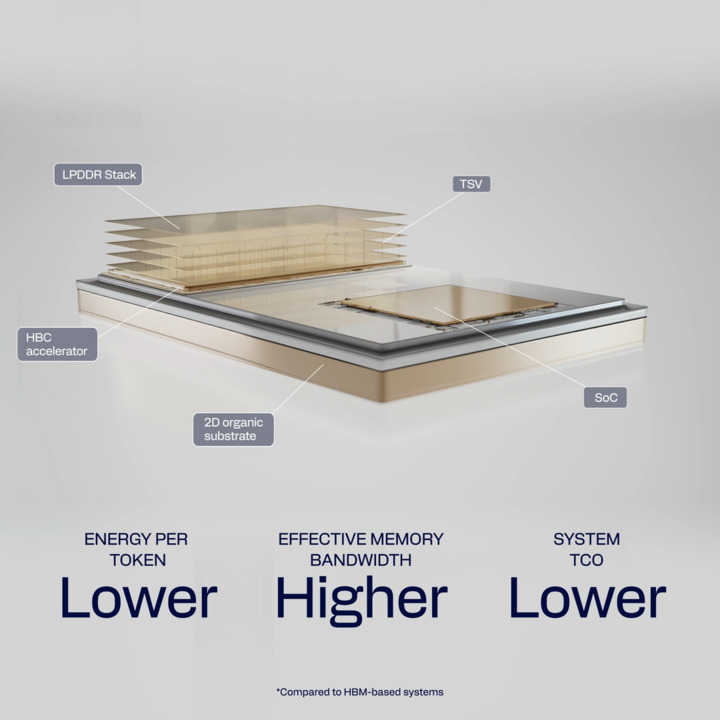
Qualcomm’s source pages describe HBC as a way to address the memory wall. In plain English, that means the system tries to keep more useful memory closer to the compute that is making AI answers. The goal is not a consumer feature you can buy today; it is infrastructure for data centers and hyperscale AI workloads.
| Bottleneck | Plain meaning | Why it matters |
|---|---|---|
| Memory capacity | The system needs enough room to hold model data, context, and the working pieces of an answer. | Bigger or busier AI workloads can stall when the useful data is not close enough or large enough. |
| Memory bandwidth | How quickly the system can move useful data between memory and compute. | Qualcomm frames HBC around the memory wall because AI inference can wait on data movement, not only math. |
| Energy per token | How much power it takes to make the small pieces that become AI answers. | A popular AI service has to serve many answers, so power efficiency affects scale. |
| Networking | The links that connect chips, racks, storage, and software services inside a data center. | A single chip does not make the AI product. The rack and network have to keep work flowing. |
| Software orchestration | The control layer that sends the right AI work to the right hardware at the right time. | Qualcomm’s Modular acquisition shows that hardware still needs a developer and deployment layer. |
What is the AI memory wall?
The memory wall is a simple idea with a technical name. A chip may be able to do math quickly, but the work can still slow down if the needed data has to travel too far, too often, or through a system that uses too much power. For AI inference, that data can include model weights, context, intermediate values, and the pieces needed to keep generating the next token.
That is why “tokens per watt” matters in this story. A token is a small piece of AI output. A sentence, code response, search summary, or agent step is built out of tokens. A data center that serves many AI requests has to create those pieces repeatedly without wasting power or stalling on memory movement.
For normal readers, the best mental model is a kitchen. The chef can be talented, but dinner slows down if the ingredients are across town. HBC is Qualcomm saying the ingredients need to move closer to the cooking surface.
What Qualcomm announced
Qualcomm did not announce only one isolated part. The Dragonfly story is a stack: CPU, inference accelerators, HBC memory architecture, connectivity, infrastructure management software, and Modular’s developer layer. That matters because modern AI systems are rarely one magic chip. They are coordinated systems.
| Piece | Source-backed role | Beginner translation |
|---|---|---|
| Qualcomm High Bandwidth Compute | Qualcomm says HBC is built to address the memory wall with lower energy per token. | Put more of the answer-making memory close to the compute doing the AI work. |
| Qualcomm Dragonfly AI250 | Qualcomm lists AI250 as introducing HBC for disaggregated inference workloads. | A rack-scale inference path where memory is part of the headline, not a footnote. |
| Qualcomm Dragonfly AI300 | Qualcomm lists AI300 as a later rack-level inference platform with increased bandwidth and deployment options. | The roadmap says the memory idea is meant to scale, not stay as one isolated chip. |
| Qualcomm Dragonfly C1000 CPU | Qualcomm describes C1000 as a data-center CPU for agentic, general-purpose, and AI head-node work. | The CPU side keeps the AI system organized while accelerators do specialized work. |
| Modular software | Qualcomm says Modular strengthens software across CPU, GPU, NPU, and custom ASIC environments. | The stack needs software that lets developers run AI work across different kinds of hardware. |
Why this is different from a phone-chip story
Qualcomm is famous to many readers because of phone chips and wireless technology. Dragonfly is a different lane: data center AI infrastructure. That means the user does not hold the chip. The user sees the result when an AI service answers quickly, stays reliable, or can support more complex tasks.
The C1000 CPU is part of that larger system. Qualcomm and Meta announced a multi-generation collaboration for data center CPUs, with Qualcomm saying its first-generation Dragonfly C1000 CPU is planned for production starting in the second half of 2028. That is important source context, but it is not a claim that consumers can buy a Dragonfly product now.
The Modular acquisition adds another clue. Qualcomm’s announcement says Modular helps AI run efficiently across CPU, GPU, NPU, and custom ASIC architectures. Translation: if AI hardware keeps diversifying, developers need software that can coordinate across more than one kind of chip.
What not to overclaim
Do not treat this as a finished consumer product review. Do not say BTI tested Dragonfly. Do not turn Qualcomm’s roadmap into a price, rating, buy recommendation, or stock call. Do not turn a source-backed benchmark estimate into an independent BTI benchmark.
The safe takeaway is narrower and stronger: Qualcomm is publicly positioning Dragonfly and HBC around AI inference, memory bandwidth, memory capacity, and power efficiency. That is enough for a useful explainer. The article can explain the memory wall without pretending to know more than the sources prove.
Sources for this Qualcomm Dragonfly HBC guide
This guide uses public Qualcomm source pages plus independent Investor Day coverage. It avoids fabricated testing, prices, ratings, reviews, awards, stock-market advice, availability claims, customer-performance claims, and hands-on benchmark claims.
- Qualcomm Dragonfly roadmap announcement: The official June 24, 2026 source introduces Dragonfly C1000, HBC, AI300, connectivity, custom silicon, and the memory-wall framing.
- Qualcomm Dragonfly AI accelerator page: Qualcomm explains memory bandwidth, memory capacity, data movement, tokens per watt, AI250, AI300, and Dragonfly management software.
- Qualcomm Dragonfly data center page: Qualcomm describes Dragonfly as rack-scale AI infrastructure with CPU, AI accelerators, connectivity, and custom silicon.
- Qualcomm and Meta data center CPU announcement: The official release describes a multi-generation CPU collaboration and says the C1000 CPU is planned to enter production in the second half of 2028.
- Qualcomm Modular acquisition announcement: Qualcomm frames Modular as software for efficient AI across CPU, GPU, NPU, and custom ASIC architectures.
- ServeTheHome live Investor Day analysis: ServeTheHome independently summarizes the Investor Day memory-wall explanation and HBC positioning.
Qualcomm Dragonfly HBC FAQ
What is Qualcomm Dragonfly HBC?
Qualcomm Dragonfly HBC refers to Qualcomm’s High Bandwidth Compute technology inside its Dragonfly data center AI roadmap. Qualcomm frames HBC as a way to address memory bandwidth, memory capacity, and data movement limits for AI inference.
What does memory wall mean in AI?
The memory wall is the point where moving or accessing data becomes a major limit. For AI inference, the system needs both compute and memory close enough to keep creating useful answer tokens efficiently.
Is this a consumer chip?
No. This is a data center AI infrastructure story. It is about the hardware and software behind AI services, not a phone, laptop, or desktop part that BTI readers can buy today.
Did BTI test Qualcomm Dragonfly or HBC?
No. BTI did not test the hardware, inspect the architecture, or verify performance claims. This is a source-backed plain-English explainer, not a hands-on review or benchmark.
BTI final take
The useful story is not just that Qualcomm announced another AI chip roadmap. The useful story is that the AI bottleneck is moving from “can the chip do math?” to “can the whole system feed useful memory to the compute without wasting power?”
That is a strong BTI explainer because it turns a technical hardware announcement into a normal-reader idea: AI answers need ingredients close to the kitchen.
Follow BTI for the next plain-English tech breakdown
BTI turns current tech stories into simple buyer and science explainers without claiming hands-on testing, prices, ratings, or availability.