
New physics, plain English
Black Hole Energy Lab: What CUNY Actually Built
A stationary electronic circuit reproduced one energy-transfer effect associated with rotating black holes. No black hole was made, and the energy was not free.
The black hole energy lab result came from a ring of electronic resonators that amplified selected electromagnetic waves while the device itself stayed still. The CUNY experiment, published in Nature on July 8, 2026, used precisely timed changes around the ring to make waves behave as if they were interacting with an object rotating at an otherwise unreachable speed.
That sentence sounds like a black hole was placed on a workbench. It was not. The researchers created an engineered analogy for rotational super-radiance, a process in which a wave can leave a rotating system with more energy than it brought in. The laboratory system reproduced the essential wave-amplification behavior with radio-frequency electronics and time modulation, not gravity, collapsed matter, or an event horizon.
The beginner map is stationary ring, timed pattern, synthetic rotation, selected wave, amplification. The power source is the externally driven modulation that changes the circuit over time. The result is useful because it gives scientists a controllable way to study extreme rotational wave physics without mechanically spinning material at impossible speeds.
Black hole energy lab: the quick answer
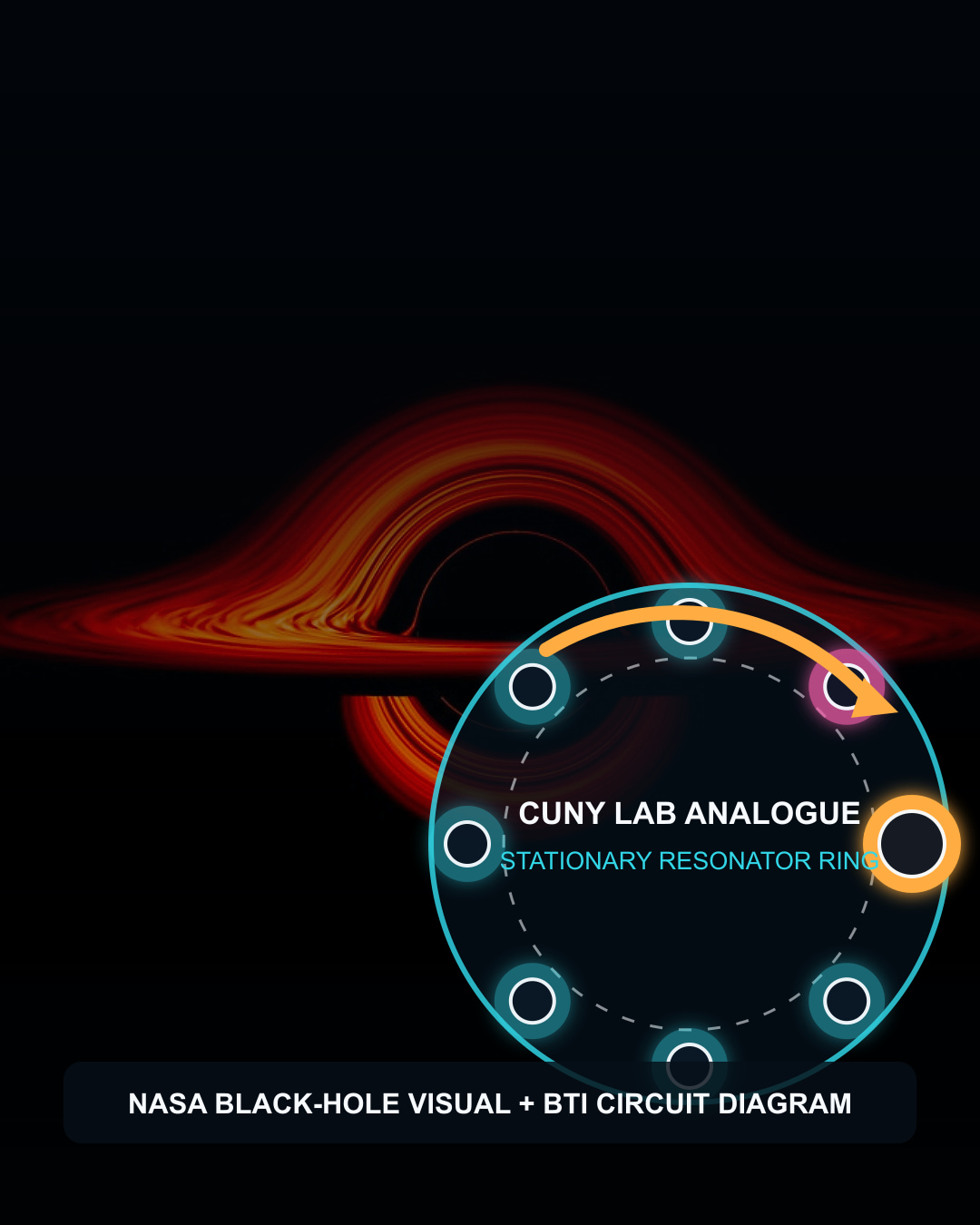
The CUNY team arranged electronic resonators in a ring. Think of each resonator as a station that can temporarily store and exchange electromagnetic energy. Instead of rotating the physical ring, the researchers changed the properties of those stations in a carefully sequenced pattern. The pattern traveled around the circle, so an incoming wave experienced an environment that behaved as if it were rotating extremely fast.
A wave with the right rotational direction and frequency could interact with that driven pattern and leave with a larger amplitude. In the researchers’ language, the experiment observed Floquet rotational super-radiance. Floquet describes a system whose properties repeat in time. Super-radiance describes the selective amplification. Rotational identifies the angular motion being emulated.
The experiment did not turn gravity into household electricity. It transferred energy from an actively modulated electronic medium into selected waves. That is a real and measurable form of wave amplification, but it obeys ordinary energy accounting: the electronics that create the time-varying pattern must be powered.
Five headlines translated carefully
| Headline | What happened | What not to assume |
|---|---|---|
| Black-hole energy physics reached a lab circuit | CUNY researchers reproduced rotational super-radiance in a ring of electronic resonators. | They did not create, contain, or extract energy from an actual black hole. |
| The device acted as if it rotated extremely fast | A carefully timed pattern changed the resonators around the ring and synthesized effective rotation. | The circuit itself stayed still; no material object mechanically spun at that speed. |
| Selected waves left with more energy | Waves with the matching rotational properties were amplified by the time-modulated medium. | The effect was selective, not a universal amplifier for every incoming wave. |
| The pattern can appear superluminal | The engineered modulation can emulate effective motion faster than light for the wave interaction. | Matter and information were not shown traveling through space faster than light. |
| Energy came from a driven system | External electronics supplied the changing conditions that transferred energy into the amplified wave. | This is not free energy, a black-hole power plant, or a commercial electricity source. |
Why black holes entered the story
In 1969, physicist Roger Penrose described a route for extracting rotational energy from a spinning black hole. Near a rotating black hole is a region called the ergosphere, where spacetime is dragged around with the black hole. In the classic thought experiment, one part of an incoming object falls inward while another part escapes carrying more energy than the original object had. The extra energy comes from the black hole’s rotation.
Yakov Zel’dovich later translated the core idea from particles and curved spacetime into waves and rotating matter. A wave with the right rotational relationship to a sufficiently fast object could take energy from that rotation and become stronger. The conceptual connection is therefore not that every amplifier is a miniature black hole. It is that both systems can exchange rotational energy with a selected wave.
The practical obstacle is speed. Mechanically spinning an ordinary object fast enough to reach the desired electromagnetic regime is extraordinarily difficult. CUNY’s approach avoids that bottleneck by synthesizing motion with a traveling pattern of timed property changes. The pattern can reach effective regimes that a solid rotor cannot survive.
How the stationary ring creates synthetic rotation
| Step | Lab action | Plain-English picture |
|---|---|---|
| 1. Build the ring | Connect electronic resonators so waves can circulate through a closed path. | A circular line of stations can pass energy from one station to the next. |
| 2. Change the stations in sequence | Rapidly modulate each resonator’s properties at controlled times. | A pulse of changing conditions appears to travel around the ring. |
| 3. Send in a rotational wave | Apply a wave with defined frequency and angular momentum. | The wave has a direction and twist that can match or oppose the synthetic motion. |
| 4. Measure the output | Compare outgoing modes with the incoming signal. | Matching waves can leave stronger because the driven medium transfers energy to them. |
No piece of the circuit has to race around the ring. A familiar analogy is a stadium wave: the pattern travels around the seats even though each person only stands and sits in place. The analogy is limited because the resonator experiment is a precisely driven electromagnetic system, but it helps separate traveling pattern from traveling matter.
Where the amplified wave gets its extra energy
The word extract can sound like the circuit discovers energy hidden in empty space. The energy source is more ordinary. External control electronics repeatedly change the resonators. That time-dependent drive creates the synthetic rotating medium. Under the right conditions, energy from the drive is transferred into a selected wave mode, and the outgoing wave has a larger amplitude.
That is why the Nature abstract describes parametric processes. A parameter of the system changes over time, and that changing parameter can supply energy to the wave. A child on a swing offers a loose analogy: moving at the right time can increase the swing’s motion, while badly timed movement may not. In the lab, the timing, frequency, angular momentum, losses, and coupling determine which wave is amplified.
The selectivity matters. The experiment is not a box that boosts every signal passing through it. The wave must occupy the right rotational mode and fall within the engineered spectral conditions. Losses also shape the useful bandwidth. Those constraints are part of the result, not small print that can be removed from the headline.
Does synthetic superluminal rotation break the speed of light?
No result here shows a material object or usable message moving through space faster than light. The researchers describe an effective superluminal rotation produced by spatio-temporal modulation. It is the location of a driven pattern, not a chunk of matter, that can sweep around the ring at an effective rate beyond the mechanical limit.
Patterns can behave differently from objects. A laser spot projected across a distant surface can move faster than light if the angle changes quickly enough, but the spot is not one physical object carrying information from one location to the next at that speed. The CUNY system is more sophisticated, yet the same boundary is useful: an effective pattern speed is not evidence that relativity has been overturned.
The importance is experimental access. Synthetic motion lets researchers test wave interactions associated with extreme rotation in a stable, controllable device. That can expose effects that would be inaccessible if every experiment required a physical rotor moving at the corresponding speed.
Lab circuit versus astrophysical black hole
| Question | CUNY lab system | Rotating black hole |
|---|---|---|
| What rotates? | A timed electromagnetic pattern creates effective rotation; the circuit stays still. | The black hole has physical angular momentum and drags nearby spacetime. |
| What interacts? | Radio-frequency waves in a network of modulated resonators. | Fields, waves, or matter in an extreme gravitational environment. |
| Where does added energy come from? | The externally driven time modulation transfers energy to a selected wave. | The theoretical process draws from the black hole’s rotational energy. |
| What was demonstrated? | Controllable rotational wave amplification in a laboratory analogue. | No direct astrophysical energy-harvesting system was built or tested. |
What this could help researchers study
CUNY says the platform creates opportunities in fundamental wave physics, communications, optics, photonics, and quantum science. The immediate value is a repeatable experimental system: researchers can change modulation speed, coupling, loss, frequency, and wave rotation without building a faster mechanical rotor or approaching a real black hole.
Selective amplification can be interesting for signal processing because a system that responds differently to wave direction or angular momentum may separate, route, or strengthen particular modes. Time-varying media also support research into non-reciprocal behavior, where transmission differs by direction. Those are research directions, not specifications for a finished modem, optical amplifier, quantum computer, or power generator.
The CUNY announcement explicitly says the findings still need adaptation into practical technologies. BTI found no product name, commercial release date, price, efficiency figure, retail availability, or device-performance benchmark in the university release or Nature abstract. The paper establishes a controllable physical effect; engineering a useful product is a separate stage.
How BTI evaluated the black-hole lab claim
BTI reviewed the CUNY Advanced Science Research Center announcement and the peer-reviewed Nature article on July 13, 2026. We separated the measured laboratory result from the Penrose and Zel’dovich inspiration, then checked every public-facing explanation against three questions: what physically moved, where the extra wave energy came from, and what the experiment did not build.
The CUNY release supplies the accessible description and attributed statements about possible research implications. The Nature paper supplies the technical language: spatio-temporal modulation, effective motion without mechanical displacement, a ring of time-modulated resonators, and angular-momentum-selective amplification. NASA’s black-hole visualization appears only as labeled astrophysical context in BTI artwork; it is not evidence of the circuit or a depiction of the experiment.
BTI did not design, reproduce, inspect, or independently test the resonator network. We did not review the complete laboratory data beyond the public paper and supplementary-material listing, calculate the system’s full energy budget, or verify a commercial application. No affiliate link appears because this is current science coverage rather than a checked retail offer. No Product or Review schema is used.
What remains unknown or outside this result
- How this specific radio-frequency platform will scale in size, bandwidth, efficiency, noise, and manufacturing complexity.
- Which proposed communications, optical, photonic, or quantum applications can outperform simpler established hardware.
- How much total control power a practical implementation would require relative to useful amplified output.
- Whether future versions can preserve the effect under wider temperatures, component variation, interference, and long operating periods.
- Any path, timetable, or engineering method for extracting useful energy from a real astrophysical black hole.
- Commercial pricing, availability, reliability, certification, or independent product performance, because no consumer product was announced.
What to remember
The most useful sentence is simple: a stationary ring used timed electronic changes to make selected waves behave as if they met an ultrafast rotating system. Matching waves extracted energy from the driven medium and became stronger.
The three guardrails are equally memorable: no black hole was created, no material device spun at a superluminal speed, and no free energy appeared. The achievement is a controllable laboratory bridge between a famous extreme-physics idea and practical wave experiments.
Follow @besttechinsight for the mechanism behind the headline in plain English. Related BTI explainers cover how BOHR turns tritium decay into micropower, how 1X NEO senses a slipping object, and how a light-powered chip separates computation from electrical input.
Black-hole energy lab FAQ
Did CUNY create a black hole in the laboratory?
No. The team built a ring-shaped network of electronic resonators that reproduced a wave-amplification effect inspired by rotating-black-hole physics.
Did the experimental device physically spin?
No. The resonators stayed in place. Their properties changed in a timed sequence, creating a traveling pattern that waves experienced as synthetic rotation.
What is rotational super-radiance?
It is a process in which a wave with suitable rotational properties gains energy from a rotating or effectively rotating medium and leaves with greater amplitude.
Where did the amplified wave’s extra energy come from?
It came from the externally powered time modulation that drove the resonator network. The experiment transferred energy from that engineered medium into selected wave modes.
Did anything travel faster than light?
The work used an effective superluminal modulation pattern. It did not demonstrate matter or information traveling through space faster than light.
Can this experiment generate commercial electricity?
No commercial power system was demonstrated. The result is a research platform for studying rotational energy transfer and selective wave amplification.
Sources
- CUNY ASRC July 8 research announcement: Primary university explanation of the stationary resonator ring, timed modulation, synthetic rotation, selective wave amplification, and practical-research boundary.
- Nature: Observation of Floquet rotational super-radiance: Peer-reviewed paper and abstract describing the time-modulated resonator network, angular-momentum-selective amplification, and energy transfer from the driven medium.
- NASA black-hole accretion-disk visualization: Official visual context used in BTI artwork. It illustrates an astrophysical black hole and is not a photograph or diagram of the CUNY experiment.
Follow BTI for the next plain-English tech breakdown
BTI turns current tech stories into simple buyer and science explainers without claiming hands-on testing, prices, ratings, or availability.